
The Horsehead Nebula is a cold, dark cloud of gas and dust in the constellation Orion, roughly 1,300 light-years from Earth. It is also called Barnard 33 (B33). The familiar horse-head silhouette appears because the dense cloud blocks light from the brighter emission nebula IC 434 behind it—not because the Horsehead is an actual animal-shaped solid object in space. It lies south of Alnitak, the easternmost star of Orion’s three-star belt.
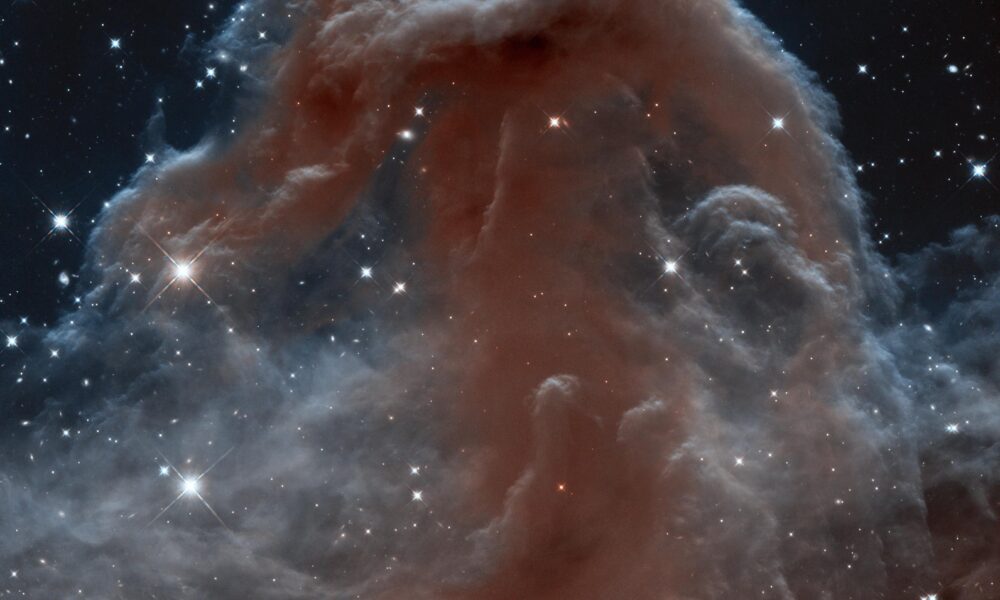
The two photographs here are real images recorded by NASA’s Hubble Space Telescope, not AI drawings. They show the same astronomical object at different wavelengths and dates: a detailed infrared portrait from 2013, and the famous darker visible-light silhouette documented by Hubble’s earlier Heritage team. The contrast explains what astronomers learn from different kinds of light and why looking through a backyard telescope can be very different from a space-telescope image.
Horsehead Nebula: quick facts
| Feature | Explanation |
|---|---|
| Catalog designation | Barnard 33 / B33 |
| Constellation | Orion |
| Approximate distance | About 1,300 light-years in NASA’s 2024 Webb research; some older Hubble descriptions use around 1,500 |
| What it really is | Dark molecular cloud and dust pillar |
| Bright background | Emission nebula IC 434 |
| Nearby landmark | Alnitak (Zeta Orionis), easternmost bright star of Orion’s Belt |
| Historic identification | Noticed on photographic plates in the late 1880s, associated with Williamina Fleming |
| Why horse-shaped? | A chance silhouette created by dense dust against illuminated gas |
| Modern telescope observations | Hubble, Spitzer and Webb, among others |
NASA’s 2024 James Webb article uses the roughly 1,300-light-year distance, while Hubble’s infrared overview describes the broader Orion Molecular Cloud as around 1,500 light-years distant. These approximate values are compatible with differences in estimates and how the region is described.
What does the real Horsehead Nebula look like?
In ordinary visible-light photographs, the Horsehead is mostly dark—a dense foreground mass standing out against brighter reddish gas. The shape resembles a horse’s muzzle and head, which is why people remember it. The resemblance is a chance effect of the cloud’s three-dimensional geometry projected onto the sky. If you viewed the same interstellar dust pillar from a very different direction, it would not necessarily resemble a horse.
NASA’s 2013 Hubble infrared portrait looks more luminous and translucent than the famous visible-light silhouette. Infrared observations can penetrate some obscuring dust that blocks visible light, revealing more stars in the background and wispy material at the illuminated edge of the cloud. The colors were assigned to represent infrared measurements, so this is authentic telescope data but not exactly the view human eyes would see if they traveled nearby.
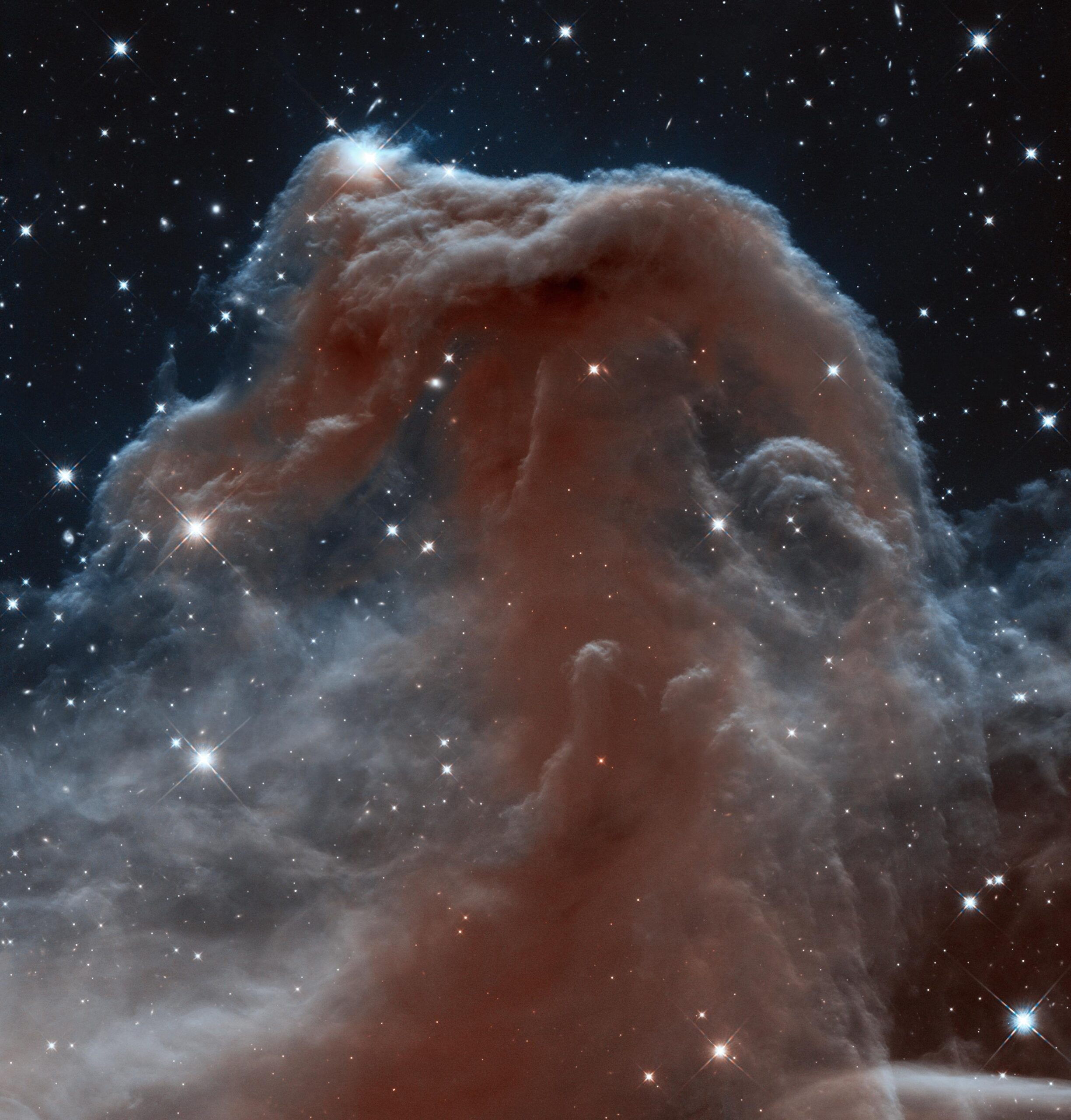
The first image is official NASA Photojournal PIA16008, released for Hubble’s 23rd anniversary in April 2013 and acquired using Wide Field Camera 3. The wisps along the nebula’s top are lit by radiation from the nearby Sigma Orionis star system. Behind it, Hubble recorded stars and distant galaxies that appear more clearly in infrared wavelengths.
Why is the nebula dark in visible light?
The Horsehead contains relatively dense gas and dust. The dust grains absorb and scatter visible light, which makes the cloud look like an opaque silhouette. The background emission nebula IC 434 is illuminated by energetic radiation from nearby hot stars, giving observers a contrast between a bright glowing background and the foreground dark cloud.
The dark region is not an empty hole. It is the opposite: a concentration of intervening matter. This distinction matters because astronomical photographs contain many kinds of dark areas. Some are actual gaps with little glowing matter; a dark nebula such as the Horsehead is an area where dust is blocking what is behind it.
What is the difference between the Horsehead and Orion Nebula?
The Horsehead Nebula (Barnard 33) and Orion Nebula (M42) are different astronomical objects, though both occur within the larger Orion Molecular Cloud Complex and the same general constellation. M42 is a luminous, extensive stellar nursery around young stars and is a famous bright telescopic target. The Horsehead is a smaller, difficult dark silhouette visible against IC 434.
| Object | Nature | What observers see |
|---|---|---|
| Horsehead Nebula / B33 | Dark molecular cloud pillar | Faint dark silhouette against IC 434 |
| IC 434 | Bright emission nebula | Glowing background that outlines Horsehead |
| Orion Nebula / M42 | Bright H II region and stellar nursery | Large luminous nebula visible in modest telescopes |
| Flame Nebula / NGC 2024 | Bright nearby star-forming cloud | Separate glowing region near Alnitak |
It is also easy to confuse the Horsehead with Pillars of Creation, which are tall dust columns in the Eagle Nebula. Both involve stellar nurseries eroded by radiation, but they belong to different regions of the Milky Way and have different distances and appearances.
Where is the Horsehead Nebula in Orion?
Start with the three bright stars of Orion’s Belt in the night sky. The Horsehead sits just to the south of Alnitak (Zeta Orionis), one of the belt’s prominent stars, within the Orion B molecular-cloud region. The bright Flame Nebula is nearby, as is NGC 2023. A photograph that includes the Belt and nearby emission regions can help locate the area, but the familiar horse shape is far too subtle for unaided visual recognition.
In the Northern Hemisphere, winter evenings are usually convenient for observing Orion. The best time varies by latitude and sky conditions. You should identify Alnitak through a current star chart rather than assuming that a photograph’s left and right sides match how Orion is oriented in your telescope.
What does the classic visible-light Hubble photo show?
The next image uses Hubble’s earlier visible-light observations to show the dark horse-shaped structure more conventionally. NASA’s original Photojournal record, PIA04215, credits JPL/NASA, NOAO, ESA and the Hubble Heritage Team. It is an authentic scientific image with processing and compositing acknowledged in the source record, not a fictional nebula image.
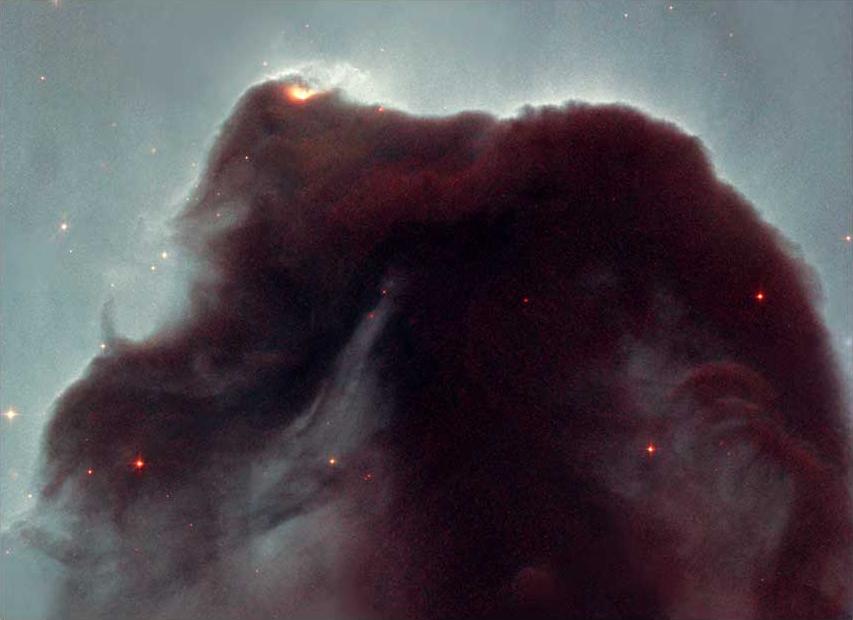
Compare its darker foreground cloud with the more translucent 2013 infrared scene. The differences are caused primarily by observing wavelength, image processing, and field of view; they are not evidence that the nebula dramatically changed shape in the years separating the pictures. The source page explains that the original Hubble view involved the Hubble Heritage project and limited ground-based supplementary observations at the frame edges.
Who discovered the Horsehead Nebula?
The Horsehead’s image became famous through astrophotography, but its recognition dates to the late nineteenth century. NASA credits Scottish astronomer Williamina Fleming with finding the object on a photographic plate in 1888. She was one of the influential researchers who analyzed astronomical photographic records and cataloged many celestial objects.
The designation Barnard 33 comes from a catalog of dark nebulae associated with astronomer E. E. Barnard. A catalog designation is not the same as a claim that Barnard was the first person ever to photograph or notice the shape. The scientific name and discovery history are discussed in NASA’s Hubble Horsehead Nebula infrared reference.
Is the Horsehead Nebula being destroyed?
The cloud’s illuminated edge is gradually changed by energetic ultraviolet radiation from nearby hot stars. Radiation heats and pushes away gas and dust in a process often called photoevaporation. Dense parts of the cloud can resist erosion longer than surrounding lower-density material, creating a projecting pillar whose recognizable outline slowly evolves.
NASA has reported a scientific estimate that the Horsehead formation may persist for around five million more years before the current silhouette erodes substantially. This is a model-based timescale, not a countdown clock or a prediction precise to a particular year. It also does not mean all matter in the broader Orion molecular clouds suddenly disappears at the same time.
What did the James Webb Space Telescope find in 2024?
Webb examined the illuminated top of the Horsehead using its Near-Infrared Camera (NIRCam) and Mid-Infrared Instrument (MIRI). NASA released the images on April 29, 2024. The new views resolve small-scale structures at the boundary where starlight interacts with gas and dust, including molecular hydrogen and dust components observed at different infrared wavelengths.
The Webb analysis focused on a photodissociation region (PDR): a transition layer in which ultraviolet radiation from nearby young massive stars heats and changes the chemistry of material between ionized gas and denser molecular cloud interiors. Rather than simply producing a prettier version of the iconic silhouette, these data help astronomers study how radiation affects interstellar matter.
NASA’s 2024 Webb research summary explains the findings and notes that the close-up image covers only part of the nebula, not the entire horse-shaped silhouette. Thus, if a Webb photo looks unlike the usual Horsehead, it may be showing a deliberately zoomed-in region.
Can you see the Horsehead Nebula with a small telescope?
It is an extremely challenging visual target. Much of the photograph’s striking red-and-dark contrast depends on long exposures and careful image processing. Under light-polluted skies, even a telescope that easily shows the Orion Nebula may fail to reveal the Horsehead at all. Larger apertures, exceptionally dark skies and a suitable hydrogen-beta (H-beta) filter can improve the chance of seeing the faint IC 434 background and its dark indentation.
Do not use high magnification immediately. The Horsehead lies in a wide, faint emission complex, so observers often begin at low power and use averted vision. Conditions such as sky transparency, surface brightness and observer experience matter greatly. There is no aperture size that guarantees a clear horse shape for every observer.
How to photograph the Horsehead Nebula responsibly
- Check the target location south of Alnitak using a current sky chart for your latitude.
- Use a suitable camera or tracking telescope. Long exposures are often needed to reveal faint emission and dust contrast.
- Control the glare from Alnitak, a bright nearby star that may cause halos or reflections in some setups.
- Keep calibration frames and notes, such as exposure lengths, filters and processing steps, if you plan to present the result as original astrophotography.
- Distinguish real observations from composites. Combining telescope exposures is normal; inventing structure with generative tools and labeling it a NASA photograph would be misleading.
Deep-sky photography often uses H-alpha filters to emphasize the glowing hydrogen region, but the final appearance will depend on how channels are mapped to color. If you post an image to an editorial website, keep its original source and appropriate rights information and do not erase a third-party publisher’s watermark to make a borrowed image appear self-owned.
Horsehead Nebula vs. Rose Nebula: why do they look different?
The Horsehead’s most memorable feature is dark foreground dust blocking a bright background. The Rosette Nebula, by contrast, is often shown as a more widespread glowing emission region surrounding young star clusters, with cavities shaped by radiation and stellar winds. Both are associated with stellar formation and energetic radiation, but photographs emphasize different geometries.
Our Rosette Nebula guide explains that object, while our Hubble Deep Field explainer covers why telescope exposure and image processing can reveal structures not directly visible to the naked eye.
Horsehead Nebula frequently asked questions
Is the Horsehead Nebula a real shape in space?
It is a genuine interstellar cloud. Its horse-like outline is produced by the shape of dense dust viewed from Earth against a brighter background.
How far away is the Horsehead Nebula?
About 1,300 light-years in NASA’s 2024 Webb explanation; some older descriptions of the larger region use roughly 1,500 light-years.
Is the Horsehead the same as Orion Nebula?
No. Barnard 33 and Messier 42 are separate objects within the wider Orion cloud complex.
Why is it called Barnard 33?
B33 is its designation in Barnard’s catalog of dark nebulae, while Horsehead is the familiar nickname for its striking silhouette.
Can I see the Horsehead with binoculars?
Most observers cannot resolve its shape with ordinary binoculars. A large telescope, dark sky and specialized observing conditions may be necessary for visual detection, although photography can reveal it more easily.
Why is the 2013 Hubble image blue or violet?
It represents infrared telescope data mapped into colors visible to human eyes, not the literal naked-eye colors of the dusty cloud.
Are the NASA photos in this article from 2026?
No. The images come from earlier Hubble observing campaigns. They are genuine archival observations, not a live 2026 view.
Will the Horsehead vanish in five million years?
NASA has discussed that as an estimated erosion timescale. It is not a precise guarantee; the structure changes gradually under radiation from nearby stars.
Photo credits and primary NASA references
The two actual Hubble images used here are PIA16008 (2013 infrared view; credits NASA/ESA/STScI) and PIA04215 (earlier visible-light view; JPL/NASA, NOAO, ESA and the Hubble Heritage Team [STScI/AURA]). Full official records: PIA16008 at NASA Science and PIA04215 at NASA Photojournal. Both are locally hosted in AVARIXO’s Media Library, with identification and credit information retained, and use is editorial without any claim of institutional endorsement.
The science of the illuminated edge is supported by NASA’s 2024 Webb Horsehead report, and the discovery and traditional telescope facts by NASA’s Hubble overview. The core distinction is straightforward: the Horsehead is a real dark cloud, its famous outline depends on our viewing angle, and different telescope wavelengths reveal different parts of its physical structure.