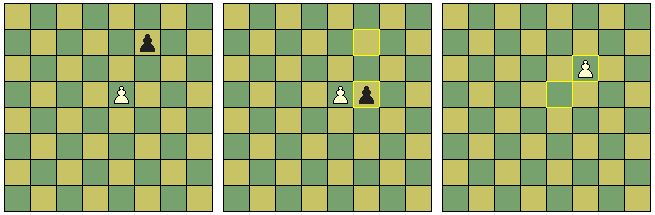

What is en passant in chess?
En passant is a special pawn capture in chess. It lets a pawn capture an opposing pawn that has just advanced two squares from its starting position, as though that pawn had moved only one square. The capture must be made immediately on the next move; if you play another move first, that opportunity disappears.
The name is French for “in passing.” It prevents a pawn from using its first two-square move to slip past an enemy pawn that would otherwise have been able to capture it.
The three conditions for an en passant capture
- The opponent has just moved a pawn two squares from its original square in one move.
- Your pawn is on the correct adjacent rank and file, so it could have captured the pawn had it moved only one square.
- You capture on your very next move, and the capture must leave your own king safe.
If any condition fails, en passant is not legal. The captured pawn is removed from the square it reached after its two-square move, even though your capturing pawn lands on a different square.
En passant example with exact chess squares
Suppose White has a pawn on e5 and Black has a pawn on d7. Black plays …d5, moving that pawn two squares from d7 to d5. White may now play exd6 e.p.: the white pawn moves diagonally from e5 to d6, and the black pawn on d5 is removed.
Why d6? If Black had advanced only one square from d7 to d6, White’s e5 pawn could have captured it normally. En passant allows the capture on d6 even though the black pawn actually reached d5.
How Black can capture en passant
The rule works for both sides. Imagine a black pawn on c4 and a white pawn on b2. If White plays b4 from b2 to b4, Black may respond …cxb3 e.p.. The black pawn moves from c4 to b3 and the white pawn that just arrived on b4 is removed.
White must have moved b2–b4 in the immediately preceding move. If the pawn had been sitting on b4 for several turns, Black could not suddenly claim an en passant capture.
Why en passant is only available for one move
The right to capture en passant is tied to the opponent’s last move, not to the current arrangement of pawns alone. Suppose Black plays …d5 next to your white pawn on e5. If White responds with a knight move instead of exd6 e.p., the option to capture that pawn en passant is gone. Even if the two pawns remain side by side for ten moves, White cannot take en passant later.
This makes en passant easy to overlook in fast games. After every opposing two-square pawn push, briefly check whether one of your pawns can legally capture it in passing.
When en passant is illegal
| Situation | En passant allowed? | Reason |
|---|---|---|
| Opponent just pushed a pawn two squares beside yours | Possibly | Check king safety and exact squares |
| Opponent moved the pawn one square | No | Ordinary capture rules apply |
| Opponent pushed two squares two turns ago | No | The immediate-response window passed |
| Your pawn is not adjacent on the correct rank | No | It cannot capture the passing square |
| Capture would expose your own king to check | No | A move leaving your king in check is illegal |
The king-safety rule matters in puzzles: removing two pawns from a rank can uncover a rook or queen attack. A seemingly available en passant move may therefore be illegal because it exposes your king.
How to recognize the move in notation and online chess
Algebraic notation usually records en passant like an ordinary pawn capture, such as exd6 or cxb3. Some teaching diagrams add “e.p.” to make the special rule explicit. In online chess, you typically drag or click your pawn onto the empty square behind the opposing pawn’s two-square advance; the game removes the captured pawn automatically.
If a chess app refuses the move, verify that the last move was a two-square pawn push and that the capture would not expose your king. Do not assume the app has a bug just because the pawns are adjacent.
En passant versus a normal pawn capture
In a normal capture, a pawn moves diagonally one square onto the square occupied by an opposing piece. In en passant, the capturing pawn still moves diagonally one square, but lands on the square the opposing pawn passed through. The opposing pawn is removed from the square where its two-square advance ended.
No other chess piece can capture en passant. Knights, bishops, rooks, queens and kings all follow their usual capture rules. En passant is also distinct from pawn promotion, which occurs when a pawn reaches its final rank.
Tactical uses: opening lines and changing pawn structure
En passant can be strategically important. Removing a pawn may open a file for a rook, change which squares are controlled or create a passed pawn. It can also be a tactical mistake if the capturing pawn abandons a useful square or reveals an attack on your own king.
Before capturing, ask three questions: Does the capture improve my pawn structure? Does it open a line for either side? Is there a forcing move, such as a check or attack, that is stronger? En passant is an option, not an obligation.
Common mistakes and how to avoid them
- Trying it late: The capture must be made immediately after the two-square push.
- Capturing the wrong pawn: The target must be the pawn that just moved two squares, not any adjacent pawn.
- Moving onto the pawn’s current square: Your pawn moves to the square the opponent passed through.
- Ignoring king safety: An en passant capture cannot legally expose your own king to check.
- Confusing it with promotion: Promotion happens at the end of the board; en passant is a mid-board capture opportunity.
Frequently asked questions
Can en passant happen more than once in a game?
Yes. Different pawns can create separate opportunities at different times, provided each capture meets the rules.
Can you capture en passant with a pinned pawn?
Only if moving that pawn does not leave your king in check. Many pinned-pawn en passant attempts are illegal.
Is en passant mandatory?
No. You may choose another legal move, but the en passant option for that particular two-square advance then expires.
Can you do en passant after a pawn moves one square?
No. The opponent’s pawn must have just advanced two squares in a single move.
Does en passant work in tournament chess?
Yes. It is part of the official rules, not an optional house rule.
Official rules and practice
The FIDE Laws of Chess, Article 3.7.3.1, describe the special capture, and Article 3.7.3.2 explains that it is legal only on the move immediately following the two-square advance. To remember it, use this sequence: two-square push, adjacent pawn, immediate capture, king safe. Set up the e5/d7 example on a board and practice both sides before trying it in a live game.

Other Articles