
A horseshoe crab is an ancient marine arthropod, not a true crab. Horseshoe crabs are more closely related to spiders and scorpions than to the crustacean crabs whose name they share. The Atlantic horseshoe crab (Limulus polyphemus) lives along the eastern coastline of North America and is known for its horseshoe-shaped shell, rigid pointed tail, mass beach spawning and blue blood used in medical safety testing. The tail is not a venomous stinger; it helps the animal steer and right itself.
The two photographs in this guide show real Atlantic horseshoe crabs recorded by U.S. Fish and Wildlife Service photographers, rather than cartoons or stock illustrations. This article covers their actual size, what the blue blood does, why shorebirds depend on their eggs, safe handling on a beach, and how modern non-animal endotoxin tests relate to their conservation.
Horseshoe crab at a glance
| Question | Reliable answer |
|---|---|
| Is it a true crab? | No. It is a chelicerate arthropod, more closely related to spiders and scorpions |
| Atlantic species | Limulus polyphemus |
| How many living species? | Four worldwide, including one native to the Atlantic coast of North America |
| Where does the Atlantic species live? | Atlantic coastal waters from Maine toward the Yucatán Peninsula |
| Exceptional adult female size | About 24 inches (60 cm) long, including the tail; shell about 12 inches (30 cm) across |
| Large female mass | About 11 pounds (roughly 5 kg) in U.S. Fish and Wildlife Service examples |
| What is the tail called? | Telson |
| Why is blood blue? | It contains copper-based oxygen-carrying hemocyanin |
| Why do the eggs matter? | They feed shorebirds, especially migrating red knots |
Measurements refer specifically to the Atlantic species and vary by sex and region. The U.S. Fish and Wildlife Service species profile reports the large-female dimensions and explains the animal’s basic structure. Do not assume every horseshoe crab on a beach reaches the maximum length.
What does a real horseshoe crab look like?
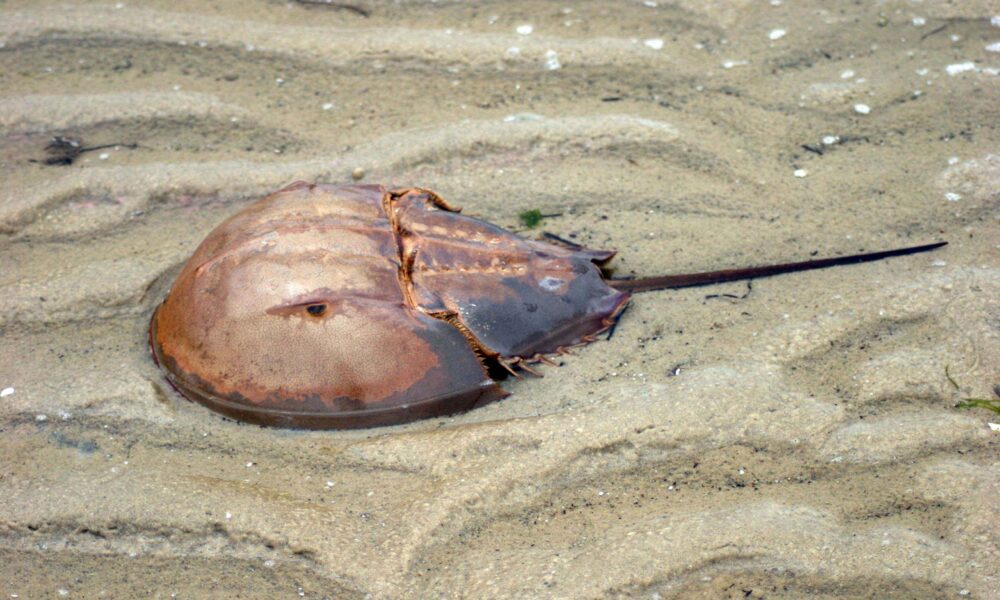
An Atlantic horseshoe crab looks like a rounded, dark-brown or olive, helmet-shaped shell with a long, slender extension behind it. The smooth front section is called the prosoma, the middle body region is the opisthosoma, and the long rear point is the telson. The animal’s legs and many working mouthparts are underneath the protective shell, so photographs taken from above do not show how it walks or handles food.
Our featured photo is an actual U.S. Fish and Wildlife Service photograph of an Atlantic horseshoe crab on wet sand. The long tail is clearly visible, as is its broad horseshoe-shaped upper shell. This genuine animal photo is a better reference for identifying a stranded crab than an illustration that exaggerates its size or gives it pincers like a traditional crab.
Why are horseshoe crabs called living fossils?
Horseshoe crabs resemble ancient fossils and belong to a very old evolutionary lineage. The Smithsonian’s National Zoo notes that their broader history reaches back about 450 million years; the Fish and Wildlife Service describes a recognizable body form persisting for about 350 million years. Those figures refer to different ways of describing the lineage and morphology, not an assertion that an individual modern species existed unchanged for exactly that entire time.
“Living fossil” does not mean horseshoe crabs stopped evolving. Their anatomy, genetics, ecology and ancestral forms have undergone evolutionary changes. It simply draws attention to a distinctive body plan that has recognizable ancient relatives. Their long history makes them especially interesting to paleontologists, but their survival is not guaranteed just because the group has endured previous changes to Earth’s oceans.
Do horseshoe crabs sting with their tails?
No. The pointed tail is not a venomous stinger. Horseshoe crabs use the telson to help turn themselves upright if a wave flips them onto their backs and to help steer while moving in water. The point may look alarming, but the animal does not use it to inject venom into swimmers or beachgoers.
That does not mean people should grab, pull or swing a crab by the tail. The telson is part of the animal’s body, not a handle, and forceful handling can injure it. Avoid disturbing nesting crabs. Where local wildlife guidance permits assisting a stranded upside-down animal, gently turn it upright by the sides of its shell rather than dragging it by the tail, and leave it where it can return to the water.
Why is horseshoe crab blood blue?
The blood, more precisely hemolymph, contains hemocyanin, an oxygen-carrying protein that uses copper. Oxygenated hemocyanin gives the fluid its characteristic blue color. Mammalian blood instead uses iron-containing hemoglobin, which is responsible for its familiar red color when oxygenated. The blue appearance is real chemistry, not a filter or the result of marine water staining the animal.
Horseshoe crab hemolymph also contains special immune cells called amoebocytes, which can respond to certain bacterial endotoxins. Scientists developed a reagent known as Limulus amebocyte lysate (LAL) from these cells. LAL became an important tool in checking products for contamination by bacterial endotoxins; the test does not detect every possible microorganism or all forms of contamination.
How is the blue blood used in medicine?
Hospitals, drug manufacturers and medical-device producers need ways to detect dangerous bacterial endotoxins in certain products. The LAL test uses components derived from horseshoe crab blood that react to these substances, helping assess the safety of materials intended for medical use. That is the reason blue blood is medically important—not that it cures diseases or is injected directly into patients as a treatment.
The collection process raises conservation questions because animals must be captured and handled, some die, and additional effects may occur after release. NOAA’s horseshoe crab facts explains blood collection and the role of testing, while Smithsonian’s conservation overview notes concern about mortality and alternatives. It is misleading to claim that all harvested crabs automatically die, or that every released animal is unaffected.
Are there replacements for horseshoe crab blood testing?
Yes. Researchers and manufacturers have developed recombinant Factor C (rFC) and other synthetic, non-animal-derived endotoxin testing reagents. In a recognized standards listing dated December 2025, the U.S. FDA describes USP chapter <86> as a bacterial endotoxins test using recombinant reagents, including rFC and recombinant cascade reagents. Whether a method can substitute for another in a particular regulatory workflow still depends on validation and applicable standards.
See the FDA recognized-standard entry for USP <86>. This is a real option that could reduce reliance on horseshoe crab blood; it is not evidence that harvesting instantly ended worldwide or that LAL has disappeared from the medical industry.
Why do horseshoe crabs come onto beaches?
Atlantic horseshoe crabs spend much of their lives in coastal waters and return to suitable sandy beaches during the breeding season. In Delaware Bay and nearby areas, large spawning gatherings occur particularly in late spring and early summer, often in association with high tides around full and new moons. Females lay eggs in sand while males fertilize them externally.
Mass spawning can be a spectacular sight, but the exact timing varies by water temperature, location and the particular year. Beach visitors should not assume a specific number of crabs will appear on a particular night. Some eggs remain buried, while others are exposed by tides and waves and become food for wildlife.

The second photo shows horseshoe crabs in coastal water during a gathering, photographed by Gregory Breese of the U.S. Fish and Wildlife Service. It is a separate scene from the sand photo, not a cropped copy. Both images identify Limulus polyphemus, rather than an unrelated crustacean or another Asian horseshoe crab species.
What eats horseshoe crab eggs?
The eggs are an important seasonal food source for migratory shorebirds. One famous example is the rufa red knot, a small long-distance migrant that stops around Delaware Bay as it travels toward northern breeding grounds. The birds can feed rapidly on abundant eggs exposed near the surface of the sand, building energy reserves for the next leg of their migration.
The U.S. Fish and Wildlife Service explains that Delaware Bay’s horseshoe crab eggs are particularly important to red knots during their spring stopover. Other shorebirds, fishes and marine animals also benefit from the eggs. When spawning habitat is degraded or the timing of egg availability changes, the impact can extend through the coastal food web. See USFWS: Knot an Easy Journey and USFWS red knot monitoring for the research context.
How big can an Atlantic horseshoe crab get?
The Atlantic species varies considerably by sex and location. The U.S. Fish and Wildlife Service reports particularly large mature females along the Georgia coast: approximately 12 inches across the broad shell and 24 inches in total length including the tail, with some around 11 pounds. Males are typically 25–30% smaller than females.
These are upper-end examples, not exact lengths for every adult. A crab seen on a New Jersey beach may be smaller, and juvenile animals have a very different scale. To avoid misleading comparisons, distinguish body width from full body-plus-tail length, and do not mistake the telson for an extra appendage to be excluded from total length.
Are there other horseshoe crab species?
There are four living horseshoe crab species. One, Limulus polyphemus, inhabits the Atlantic coast of North America. Three relatives occur in Asia in different coastal and estuarine habitats. The global grouping is older than any modern individual species, so it is inaccurate to call the entire group native only to Delaware Bay, or to describe every horseshoe crab photograph as Limulus polyphemus without identifying its source.
This article’s photographs are verified as the Atlantic species. Scientific studies and conservation reports sometimes discuss Asian species with different population pressures, habitats and protection rules. When looking up horseshoe crab status, always check which species and geography the assessment covers.
What do horseshoe crabs eat?
Atlantic horseshoe crabs forage on the seafloor for marine worms, small mollusks and other invertebrates. Their walking legs and mouthparts help manipulate food, while their movement through bottom sediments can disturb and mix the substrate. They are not predatory land crabs that chase beachgoers and do not use large claws to attack people.
Because they feed and breed in coastal ecosystems, habitat quality matters. Dredging, shoreline development, pollution and altered sediment can affect the animals and the resources they depend upon. They are part of the larger marine invertebrate community; our deep-sea jellyfish explainer contrasts a very different kind of marine animal and its ecology.
Are horseshoe crabs endangered?
Population condition is not the same in every region, and different conservation bodies may use different classifications. Some Atlantic areas have seen improvement after management measures, while harvest pressure, coastal construction and reproductive habitat loss remain concerns. NOAA notes that commercial bait use and beach conditions are continuing conservation issues.
In the U.S., harvest regulations differ by state and can change. A rule limiting or prohibiting harvest in one coastal state does not automatically apply across all Atlantic coastlines. For a current management decision or visit, consult the relevant state wildlife agency and the Atlantic States Marine Fisheries Commission rather than assuming one uniform rule.
How can you help a horseshoe crab on a beach?
- Keep your distance from large spawning groups. Avoid walking through nesting animals or disturbing egg-laying.
- Don’t pick up a crab by its tail. The telson helps it right itself and can be damaged by pulling.
- If a crab is upside down and local guidance permits help, gently lift or turn it by the sides of its hard shell and place it upright close to where it was found.
- Don’t take an animal home. Coastal wildlife and collection rules vary, and an aquarium may not provide the right conditions.
- Protect sandy nesting habitat. Follow closures, beach driving restrictions and signage during the spawning season.
- Watch shorebirds too. Avoid disturbing feeding red knots and other migrants while the eggs are abundant.
Some East Coast barrier islands are important wildlife habitats. If planning a trip to observe coastal ecology, see our Cumberland Island National Seashore visitor guide for general beach access information. It does not promise a horseshoe crab spawning event at a particular time.
Common questions about horseshoe crabs
Are horseshoe crabs dangerous to humans?
They do not have a venomous tail stinger and are not aggressive predators of people. Avoid rough handling and respect the shell and legs as you would any wild animal.
Why is horseshoe crab blood so valuable?
Special immune cells in their blood can be used in LAL assays to detect certain bacterial endotoxins. The blood is not a medicine that cures infections.
Can horseshoe crabs swim?
Yes. They can move in coastal water and use their legs and tail for locomotion and control, although they are commonly seen crawling along the seafloor or on shore.
How many eyes do horseshoe crabs have?
They have multiple light-sensing structures, including two conspicuous compound eyes on the shell and additional smaller sensors. Their visual system is more complex than the two prominent eyes alone suggest.
Why are horseshoe crab eggs important to birds?
They provide concentrated seasonal food that allows migrating shorebirds, including red knots, to rebuild energy reserves.
Do horseshoe crabs lay eggs every day?
No. Atlantic horseshoe crabs return to suitable beaches in spawning seasons influenced by tides, water temperature and location. The number of visits and eggs varies.
Is it true they have not evolved for 450 million years?
No. Their evolutionary lineage is ancient and their body plan resembles fossils, but the living species have evolved. The slogan “unchanged for 450 million years” oversimplifies the fossil evidence.
Does a synthetic test replace all horseshoe crab blood collection?
No. Recombinant endotoxin test methods exist, but their adoption and validation differ by manufacturer, method and jurisdiction. Horseshoe crab-derived assays are still used in parts of the industry.
Primary scientific sources and authentic photographs
Taxonomy, habitat and size are based on the U.S. Fish and Wildlife Service Atlantic horseshoe crab species account and NOAA Ocean Service’s horseshoe crab guide. Anatomy, medical importance and the non-stinging telson are corroborated by Smithsonian’s National Zoo. The 2025 FDA listing for the recombinant bacterial endotoxins test supports the alternatives discussion.
The actual wildlife photos are public-domain works by Bill Perry and Gregory Breese, photographers for the U.S. Fish and Wildlife Service, locally uploaded to AVARIXO. Original media records: horseshoe crab on sand and crabs in shallow water. The images do not rely on hotlinks, synthetic wildlife scenes or a generic stock crab substituted for Limulus polyphemus.
Bottom line: a horseshoe crab is an ancient, real marine arthropod whose protective shell, harmless righting tail and copper-based blue blood tell a remarkable story. Its medical value and importance to migratory birds make responsible science and beach habitat protection especially important.

Other Articles

Stalemate in Chess: Meaning, Rules, Examples and How to Avoid a Draw