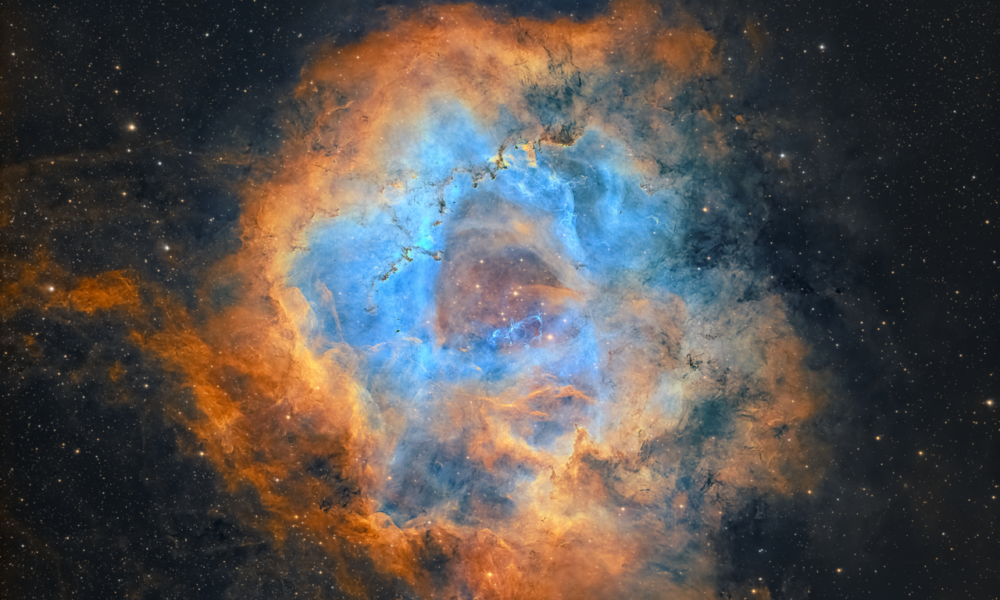

Quick answer (reviewed October 13, 2026): The Rose Nebula most commonly refers to the Rosette Nebula, a giant rose-shaped cloud of glowing gas and dust in the constellation Monoceros, about 5,000 light-years from Earth. It is an active stellar nursery, not a planet or a galaxy. The young stars in the central open cluster NGC 2244 help light up and carve out its distinctive hollow center. Astronomers also call the nebula Caldwell 49 or Sh2-275.
Beautiful space photographs can make the Rosette look like a colorful flower, but the glowing clouds, dark dust lanes, filter colors and central cluster have specific physical explanations. Below, we separate what the image actually shows from what camera processing adds, explain the confusing NGC numbers, and show how beginners can find the object in the sky. The facts below draw on NASA’s Rosette Nebula context description, University of Zurich astrophysics, and the European Southern Observatory.

Imaging note: The photograph above is a genuine telescope observation made using narrowband light filters and processed into a Hubble-style color palette. It is not an illustration and does not claim to reproduce the colors a human eye would see through an eyepiece.
What is the Rose Nebula?
The Rosette Nebula is a vast emission nebula, technically an H II region: hydrogen gas has been ionized by energetic radiation from stars. When atoms and electrons interact, the gas releases light at distinctive wavelengths. This is why a cloud that would otherwise be difficult to see shines in many astronomical images.
The Rosette is part of the Milky Way, located toward the faint constellation Monoceros (the Unicorn), near prominent winter-sky landmarks such as Orion. The nebula occupies an extended region of sky rather than a neat small point of light. What looks like soft flower petals in a photograph is the illuminated edge of a star-forming cloud.
Rose Nebula versus Rosette Nebula: “Rosette Nebula” is the conventional name of this Caldwell 49 object. The shorter “rose nebula” is a descriptive nickname also used in astronomy writing for flower-like clouds, so a photograph without a catalog number can sometimes refer to another object. For this guide, “Rose Nebula” means the much-photographed Rosette Nebula surrounding NGC 2244.
Rose Nebula facts at a glance
| Question | Answer | Important qualification |
|---|---|---|
| Official common name | Rosette Nebula | “Rose Nebula” is a common descriptive variation |
| Other designations | Caldwell 49, Sh2-275; gas regions cataloged near NGC 2237 | NGC 2244 names the embedded star cluster |
| Location | Monoceros, in our Milky Way | It is not in the Andromeda Galaxy |
| Distance | About 5,000 light-years | Published estimates vary with measurement method |
| Overall size | Roughly 100–130 light-years across in different references | Authors may measure different boundaries of the cloud |
| Central cluster | NGC 2244 (Caldwell 50) | The stars and the surrounding gas are related but distinct objects |
| Primary type | Emission nebula / star-forming H II region | Not a planetary nebula created by a dying Sun-like star |
| Best Northern Hemisphere observing season | Generally winter evenings | Best month depends on latitude and available darkness |
NASA describes the region as around 100 light-years across and approximately 5,000 light-years away, while the University of Zurich gives a roughly 130-light-year physical span. That is not necessarily a contradiction: the border of a diffuse cloud is not a rigid physical surface, and size estimates can depend on which faint emission is included.
Why does the Rosette Nebula look like a rose?
The petals are giant clouds of gas, not solid material
The broad ring-like structure comes from regions of ionized gas, dust and denser molecular material. Darker lanes in images are especially interesting: dust blocks light from objects behind it and highlights the nebula’s uneven structure. The bright outline of a “petal” is not a physical shell made of rock. It is a region where material and incoming radiation produce a strong visible contrast.
The star cluster helps create the central opening
The hot, massive stars in NGC 2244 release intense ultraviolet radiation and drive fast stellar winds. The energy heats and pushes surrounding gas. Over time, this creates the central cavity, reshapes nearby clouds and can compress some material farther away. According to the University of Zurich’s description, denser knots at the cavity edges may continue collapsing toward the next generation of stars.
The shape is real, but photographs increase its contrast
The overall cloud and its cavity exist whether or not a photograph has been processed. Astronomers nonetheless combine exposures and adjust contrast to make faint gas visible. Some images use visible-light filters; others use infrared or narrowband emissions. These treatments help show structure but can also make the nebula look more vivid than it would to your eyes.
What is NGC 2244, and why is it inside the Rose Nebula?
NGC 2244 is a relatively young open star cluster in the central region of the Rosette Nebula. It includes hot, luminous stars whose radiation drives much of the surrounding cloud’s glow. The cluster is not the entire nebula: it is a population of stars seen against and within the gas.
Sources commonly describe the central cluster as a few million years old. A NASA Chandra X-ray survey analyzed a young cluster population and detected hundreds of X-ray sources associated with stars in this environment. This matters because optical light does not reveal every young star, particularly where dust is thick.
NGC 2237 vs NGC 2244: which number should I search?
These numbers are easy to mix up. NGC 2237 commonly appears in references to the nebular gas complex. NGC 2244 names the star cluster in the middle. Both are part of what a wide-field photograph shows, but they are different objects within one larger star-forming region.
The Caldwell catalog makes a similar distinction: Caldwell 49 is the nebula, and Caldwell 50 is the open cluster. When using a planetarium app, a search for one number may highlight the broader gas cloud, while the other centers on the brighter collection of stars.
Does the nebula create the stars, or do the stars create the nebula?
It is a feedback relationship. Stars can form in sufficiently dense parts of a large cold molecular cloud. Once the most massive young stars begin shining strongly, they ionize and reshape the remaining gas, which makes the visible emission nebula bright. The photograph therefore records a place where star formation and stellar feedback happen together.
Are the red, blue, gold and green colors real?
The answer depends on the wavelength range and color mapping of the specific photograph. Hydrogen-alpha emission contributes characteristic deep-red light in ordinary optical images. Oxygen and sulfur have other strong emission lines. Modern astronomical cameras often capture those channels separately, then researchers or astrophotographers assign display colors to the data.
| Image type | What it records | What its colors mean |
|---|---|---|
| Visible-light broadband | Broad portions of visible light | Usually closer to a natural-color representation, though exposure and processing still matter |
| Narrowband H-alpha / O III / S II | Light around selected emissions from hydrogen, oxygen and sulfur | Channels can be mapped to assigned colors for contrast and scientific interpretation |
| Hubble-style palette | Often narrowband channels combined in the S II, H-alpha and O III ordering | Gold, cyan and other strong tones do not necessarily match natural-eye colors |
| Infrared space-telescope view | Wavelengths invisible to human eyes | Visible colors are necessarily representational |
The Rosette image used here is a real narrowband astrophotograph captured by astrophotographer Chuck Ayoub and mapped to a Hubble-style palette. That detail is important: it is not a Hubble Space Telescope photograph and should not be labeled as one. NASA also has its own distinct Hubble observation of a small Rosette region.
Why can’t I see those colors easily with a telescope?
At very low light levels, human vision is less sensitive to color. A camera can accumulate light over long exposures, and digital stacking raises the signal-to-noise ratio. Even a beautifully resolved Rosette in an astrophotograph may appear as subtle gray nebulosity or be difficult to detect visually at the eyepiece. The brighter central star cluster is usually a better first target for beginners.
How to find the Rose Nebula in the night sky
The Rosette lies in Monoceros, a faint winter constellation near Orion. Because Monoceros has less conspicuous naked-eye stars, a planetarium app or a star chart makes the search much easier. The steps below are general observing guidance rather than the result of a first-hand test.
- Choose a suitable season: for most mid-northern latitudes, clear winter evenings give favorable placement. Early or late in the season, the object may be lower and more affected by haze.
- Start with a dark location: avoid direct lighting and, when possible, a bright Moon. The nebula has low surface brightness even though it covers a large area of sky.
- Find Orion: identify Orion’s well-known belt as an easy reference, then locate Monoceros to the east of Orion using your chart.
- Search for NGC 2244: the central open cluster is easier to detect than its surrounding glowing gas. Center the cluster in a low-power field.
- Look for diffuse nebulosity: under dark skies, use a wide-field eyepiece and allow your vision to adapt. An appropriate nebula filter may improve contrast depending on your equipment.
- Manage expectations: the photographs’ intricate colored “petals” generally require a camera and exposure stacking rather than a quick glance through a small telescope.
What telescope or camera is suitable?
The answer differs between seeing the cluster and photographing the whole nebula. NGC 2244 is accessible with simpler binoculars or telescopes under favorable conditions, while the extended nebulosity needs dark skies and a wide field for an enjoyable visual observation. Astrophotographers frequently use refractors or fast wide-field setups with narrowband filters; a long-focal-length narrow view can cut off most of the outer cloud.
Do not assume a larger telescope always produces a better view of the entire Rosette. Its apparent size is substantially wider than the full Moon, so a narrow-field instrument can show only the central region. Field of view and sky darkness can matter as much as aperture.
Rosette Nebula vs other famous cosmic photographs
A star-forming nebula should not be confused with a deep image of distant galaxies. For example, the Hubble Deep Field points toward a seemingly empty patch of sky to reveal galaxies far beyond the Milky Way. The Rosette is part of our own galaxy and is comparatively nearby.
| Subject | What the image contains | Typical distance scale |
|---|---|---|
| Rosette Nebula | Ionized gas, dust, hot young stars and a cluster | Thousands of light-years |
| Planetary nebula | Gas ejected by an evolved lower-mass star | Varies; different origin |
| Hubble Deep Field | A field filled with distant galaxies | Many galaxies billions of light-years away |
This is why the Rosette’s “rose” is a useful nickname but not a classification. Astronomically it belongs to the category of emission nebulae and H II regions.
Common mistakes when identifying Rosette Nebula pictures
- Assuming every flower-shaped nebula is Caldwell 49. Check the catalog identification or star field.
- Calling NGC 2244 the gas cloud. It primarily designates the bright central open cluster.
- Assuming image color proves temperature or chemical abundance by itself. A palette may be assigned and processed, so read the filter information.
- Describing the central dark area as empty space. The cavity contains stars and tenuous material, not a literal hole in the universe.
- Confusing the entire nebula with the much smaller area imaged by Hubble. An orbiting telescope may show close-up details, while a wide-field camera reveals the overall rose shape.
Frequently asked questions
Is the Rose Nebula real?
Yes. The Rosette Nebula is a real star-forming gas-and-dust complex in our Milky Way. Its flower-like appearance is the result of physical structure, though the vivid colors in photographs may involve narrowband processing.
What is the Rose Nebula’s real name?
The object in Monoceros is usually called the Rosette Nebula. Catalog identifiers include Caldwell 49 and Sh2-275; NGC 2244 identifies the associated central star cluster.
How far is the Rose Nebula from Earth?
NASA describes it as roughly 5,000 light-years away. Published estimates differ slightly, so this should be understood as an approximate astronomical distance, not an exact single-mile calculation.
Why is there a hole in its center?
The hot stars in NGC 2244 generate ultraviolet radiation and strong stellar winds that help clear and reshape the gas near the center. Astronomers call the resulting region a cavity; it is not a black hole.
Is Rosette Nebula a galaxy?
No. It is an emission nebula inside our Milky Way. A galaxy contains vast populations of stars and many different gas clouds; the Rosette is one region within a galaxy.
Can I see Rosette Nebula with the naked eye?
Its extended gas emission is generally too faint for easy naked-eye viewing. The embedded star cluster may be seen with binoculars, but photographing the colored nebula typically requires longer exposures and suitable equipment.
Is the photograph natural color?
No. The image in this article is based on actual telescope observations captured with narrowband filters and displayed using a Hubble-style color mapping. It does not claim to represent how the nebula looks to an unaided human eye.
Primary scientific references
- NASA Science: Rosette Nebula Context Image — nebula dimensions, location, energy sources and gas.
- NASA Science: Rosette Nebula — close-up Hubble observations and the difference between data and visualization.
- University of Zurich Department of Astrophysics: Rosette Nebula and NGC 2244 — ionization, stellar winds and narrowband channels.
- European Southern Observatory: The Rosette Nebula — ionized hydrogen and young stars.
- NASA HEASARC: NGC 2244 X-ray Sources — evidence for the young cluster population.
Editorial note: Scientific distances, ages and physical dimensions are estimates, and different studies or conventions can produce slightly different values. The page distinguishes a real observation from assigned display colors and does not claim that AVARIXO captured the photograph.