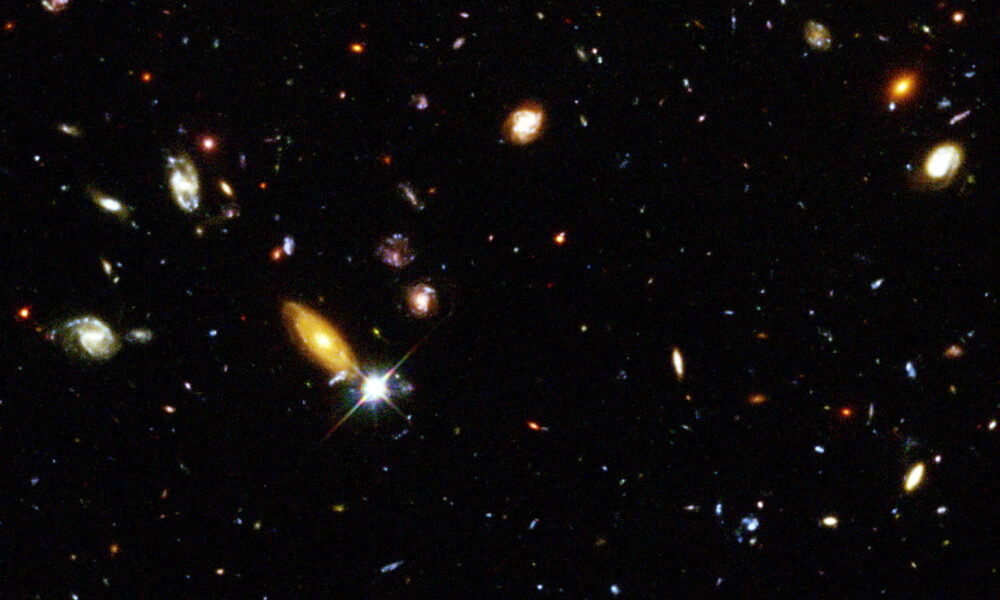

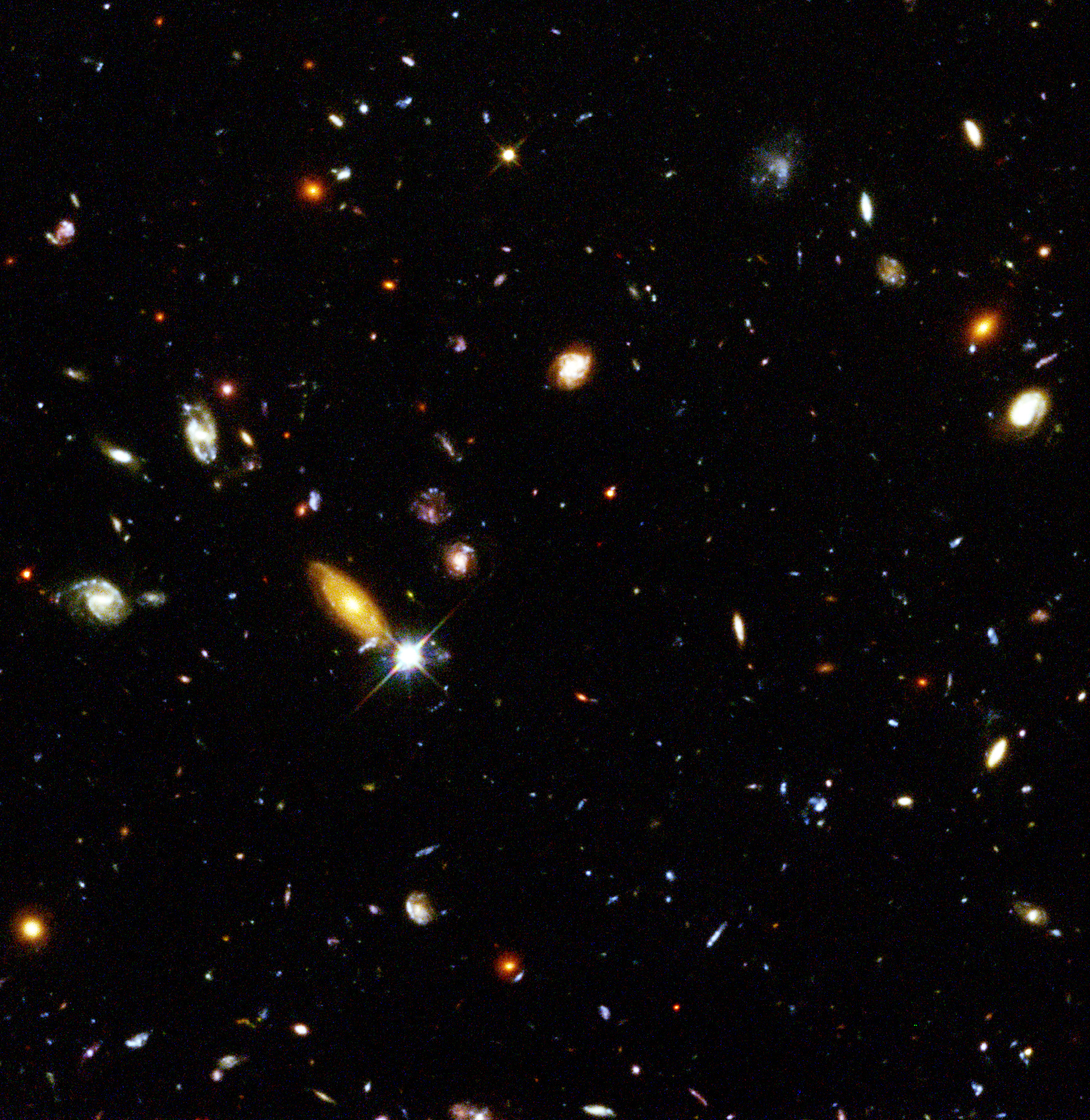
The Hubble Deep Field is a genuine photograph of thousands of distant galaxies, assembled from observations of a tiny patch of sky in December 1995. Rather than aim Hubble at a nearby planet or a famous nebula, astronomers pointed it toward a seemingly empty area near the Big Dipper for ten days. The finished image revealed that a very small area of sky contains an extraordinary number of galaxies, many of them so faint that an ordinary short exposure would miss them.
If you are looking at the famous picture and wondering what those colored specks really are, this guide explains the image itself, how it was made, what its colors mean, and the essential differences between the Hubble Deep Field (HDF), Hubble Ultra Deep Field (HUDF), eXtreme Deep Field (XDF) and newer James Webb deep fields. This is a historical science explainer, not a claim that a new Hubble image was released today.
What is the Hubble Deep Field?
The Hubble Deep Field-North (often abbreviated HDF-N) was an observing campaign using the Hubble Space Telescope’s Wide Field and Planetary Camera 2 (WFPC2). The target was a small region of the constellation Ursa Major chosen to avoid bright nearby stars and large known obstructions. Hubble collected many long exposures of that same location and astronomers assembled them into one exceptionally deep view.
NASA’s original 1996 announcement reported at least 1,500 galaxies visible in the early analysis, while subsequent Hubble/ESA explanations discuss roughly 3,000 galaxies in the full field. These are not necessarily contradictory counts: source descriptions may refer to different detection criteria, image regions or stages of analysis. The reliable takeaway is thousands of galaxies in a region that initially looked nearly empty, not an exact one-size-fits-all count.
| Question | Original Hubble Deep Field answer |
|---|---|
| Where is it? | Ursa Major, near the Big Dipper in the northern sky |
| When were the images recorded? | December 18–28, 1995 |
| When was it first released? | January 15, 1996 |
| Which telescope took the data? | NASA/ESA Hubble Space Telescope |
| Which instrument? | Wide Field and Planetary Camera 2 (WFPC2) |
| How many exposures? | 342 separate exposures in the original campaign |
| What is in the picture? | Mostly distant galaxies, with a few foreground Milky Way stars |
| Is it the same image as HUDF? | No. HUDF was a separate, later survey of a different region in Fornax |
Sources: NASA’s history of Hubble deep fields; ESA/Hubble’s deep-fields science overview; NASA’s HDF image record.
How to read the original Hubble Deep Field image
A deep-field photo looks like a random scattering of bright and faint dots until you know what to look for. Begin with the shapes rather than treating every bright object as a star.
1. Tiny smudges are often entire galaxies
Many oval, spiral, stretched or irregular shapes are not single stars. They are galaxies: enormous gravitationally bound systems containing stars, gas, dust and other material. Hubble does not resolve every individual star in these remote systems, so the combined light of billions of stars can appear as one faint fuzzy object. The assortment of shapes matters to astronomers because it provides evidence about how galaxies changed over cosmic time.
2. A few objects with sharp spikes are foreground stars
Bright stars in telescope images can show diffraction spikes produced by telescope optics. These stars usually belong to our own Milky Way, much closer than the distant galaxy population. One reason astronomers selected this field was to keep foreground clutter low. Do not assume the biggest object is automatically the farthest or that every point of light represents another galaxy.
3. Red does not automatically mean “older” or “farther”
Images combine light measured in multiple filters, and some visible colors are assigned to wavelengths the human eye would not see in the same way. A galaxy’s apparent color can be influenced by its star formation, dust, distance, redshift and the exact filters used. For a specific galaxy, you need spectral or other calibrated measurements to infer a reliable distance. In everyday terms, you can notice that the red and blue shapes differ, but you cannot estimate exact ages merely by looking at pixels.
4. The black gaps are not proof that there is nothing there
Even very deep images have detection limits. Some sources are too faint or radiate primarily at wavelengths outside the instrument’s sensitivity. Looking with different telescopes and infrared wavelengths can reveal more details. A black pixel therefore means not detected above the limit in that dataset, rather than a guaranteed empty volume of space.
Why did Hubble photograph an “empty” part of the sky?
A normal astronomical picture points at a known bright target. The HDF team made almost the opposite choice. By avoiding obvious bright objects, they could spend scarce telescope time gathering faint light from galaxies not well studied before. The concept resembles a long-exposure camera photograph, but executed with precisely scheduled spacecraft observations and calibrated scientific detectors.
The team selected an observing field near the handle of the Big Dipper, away from the Milky Way’s bright plane. They also planned around Hubble’s viewing geometry so it could return repeatedly without excessive interruptions. This created a relatively clean core sample of the universe: not a literally random snapshot of every region, but a carefully chosen tiny area where remote galaxies could be studied.
Photographing this apparently blank region was scientifically valuable because nearby galaxies already revealed only part of cosmic history. Faint distant galaxies offered clues to their earlier shapes, star formation and interactions, allowing astronomers to test models of galaxy evolution rather than rely on local examples alone.
How was the 1995 Hubble Deep Field image made?
- Choose a quiet region: astronomers screened a small patch of northern sky for bright objects and obstructions.
- Observe repeatedly: Hubble obtained 342 exposures during December 18–28, 1995, according to NASA’s historical summary.
- Use multiple filters: observations were taken at several wavelengths so the images could reveal differences among objects, not just provide a brighter grayscale picture.
- Process the detector data: scientists corrected calibration effects, aligned images, rejected defects and combined valid exposures. That stacking raises the ability to detect faint light.
- Create a public color composite: separate filtered observations were mapped into color channels to produce the recognizable image. The colors encode measured data, not a single instantaneous view as a human eye would see it.
- Study the sources: researchers measured galaxy counts, morphology, colors and brightness, then followed up with other instruments where possible.
The Hubble Deep Field image is therefore an authentic scientific observation, not a made-up illustration; it is also an intentionally processed composite. Those facts are compatible. Astronomy imaging almost always requires calibration and color mapping when interpreting faint objects across multiple filters.
Which wavelengths went into the published image?
The NASA image record lists observation filters around 300, 450, 606 and 814 nanometers. Its stated public color recipe maps blue to approximately 450 nm, green to 606 nm and red to 814 nm for that version. Different NASA/ESA releases, crops and processing versions may look somewhat different even when they derive from the same observation. This is another reason to identify the exact file rather than assume that every search result for “Hubble Deep Field” shows the same composite.
Hubble Deep Field vs Ultra Deep Field vs eXtreme Deep Field
Three famous names are often mixed up. Their chronology, locations and observing depths differ:
| Project | Main observation / release era | Sky region | Useful distinction |
|---|---|---|---|
| Hubble Deep Field-North (HDF) | 1995 observations, 1996 release | Ursa Major | Original landmark observation showing thousands of faint galaxies |
| Hubble Ultra Deep Field (HUDF) | 2003–2004 | Fornax | Later, much deeper survey using newer Hubble instrumentation |
| Hubble eXtreme Deep Field (XDF) | 2012 release combining past data | Inside the HUDF region in Fornax | Combines observations across a decade; narrower region, fainter reach |
| James Webb deep fields | From 2022 onward | Various fields, including galaxy clusters | Infrared observations, frequently of different fields and targets |
NASA reports around 10,000 galaxies in the well-known 2004 HUDF view. Its 2012 XDF image contains about 5,500 galaxies in a smaller area, despite reaching fainter sources. A lower count in a narrower image does not mean it is less deep; field size and limiting brightness are different measurements. Likewise, a modern Webb picture can probe faint infrared sources without being a direct one-for-one replacement for the original 1995 HDF scene.
For primary evidence, see NASA’s HUDF record and NASA’s XDF explanation.
Is the original HDF still the deepest image ever?
No. It was record-setting for its time and remains historically important, but the “deepest image” designation is context-dependent and has evolved through later observing campaigns and instruments. Always ask deepest in which wavelength, across what field and by what measurement? “The deepest image ever” without qualifiers is not a lasting description of the 1995 photo.
What did the Hubble Deep Field change in astronomy?
The HDF made it much harder to assume that the faint distant universe should look like a handful of familiar nearby galaxies. Astronomers observed many compact, irregular and interacting-looking galaxies, supporting investigations of how structure grew and merged over billions of years. The image also motivated studies at other wavelengths and subsequent deep-field observations in new sky regions.
It turned a picture into a statistical dataset
The image is visually famous, but researchers needed the catalog of measured sources to make scientific claims. Galaxy counts, luminosities, apparent sizes and color distributions matter for testing population models. A single photograph cannot by itself prove the precise age, composition or fate of every object.
It established a repeatable observing strategy
Researchers continued the strategy with HDF-S, HUDF, infrared updates and XDF. The core idea — invest observing time in a well-chosen field to study otherwise invisible populations — extends beyond Hubble and helps explain why modern observatories spend time on deep surveys even when the target initially looks unremarkable.
Can you see the Hubble Deep Field with a backyard telescope?
No, not in the way the Hubble image presents it. The best-known HDF galaxies are extraordinarily faint; the original observation required many long exposures with a space telescope and scientific processing. Even a dark sky and an ordinary consumer telescope cannot recreate this deep color mosaic visually. You can explore the same part of the sky with planetarium software or online imagery, but the visible stars in your eyepiece should not be mistaken for all the remote HDF galaxies.
For a different kind of skywatching activity that is practical from the ground, our Orionid meteor shower viewing guide explains how to plan a real observation night. Meteors in Earth’s atmosphere and distant galaxies seen in a deep-space telescope image are entirely different targets.
Where can you download the original Hubble Deep Field image?
Use the institutions that released the underlying observations, not rebranded copies whose processing or provenance is unclear. NASA’s image archive provides high-resolution files and technical metadata. The ESA/Hubble release page for image opo9601a1 identifies the individual image version and provides JPEG downloads.
Those pages are also the right places to see attribution and usage guidance. The photographed galaxies are not owned by a news site. The original imaging work is associated with Robert Williams, the Hubble Deep Field Team, STScI, NASA and ESA. AVARIXO does not claim to have created the observation or to be affiliated with those institutions. For educational background beyond the image, see our World Space Week 2026 guide.
Frequently asked questions
Is every bright dot in the Hubble Deep Field a galaxy?
No. The image has a small number of stars in our own Milky Way, as well as distant galaxies. Shape and diffraction spikes can offer clues, but careful source classification uses data rather than casual visual inspection alone.
How old is the Hubble Deep Field image?
The original observations were recorded in December 1995 and released publicly in January 1996. Newer images and reprocessed versions may have different release dates.
How many galaxies are in the original Hubble Deep Field?
NASA’s initial release identified at least 1,500; later ESA/Hubble descriptions discuss almost 3,000 in the field. The count depends on the dataset, the analyzed region and detection limits. Avoid confusing it with the HUDF’s roughly 10,000.
Where in space is the Hubble Deep Field?
The original northern field is seen toward Ursa Major. It is not a single object at one common distance: the photographed galaxies lie along the same narrow direction but at very different distances from Earth.
Was the Hubble Deep Field generated by AI?
No. It was constructed from real observations by the Hubble Space Telescope and processed with established astronomical imaging methods. Its combined colors and long exposures do not make it an AI-generated fictional scene.
Is Hubble Deep Field the same as the James Webb First Deep Field?
No. The latter is a distinct image released with early James Webb results and uses Webb’s infrared instrumentation. The original HDF was taken with Hubble’s WFPC2 in 1995.
Why are some galaxies red and others blue?
Possible reasons include different stellar populations, dust, redshift and mapped instrument filters. A red-looking source cannot be assigned a precise age or distance from the color alone.
Can I use the original picture in a school project?
The NASA/ESA institutional source pages provide public access and usage terms. Check the attribution requirement for the exact version, identify the institutions responsible for the source image and avoid suggesting any NASA or ESA endorsement.
Primary research and image references
- NASA Science: Hubble’s Deep Fields — historical observing schedule, filter methods and science significance.
- NASA: original HDF 1996 science release — historical source counts and target selection.
- ESA/Hubble: Deep Fields science history — HDF-N/HDF-S, HUDF and observing comparisons.
- ESA/Hubble: original photographed image, opo9601a1 — image version information; astronomical observation by Robert Williams and the Hubble Deep Field Team (STScI), NASA/ESA.
- NASA: Hubble Ultra Deep Field and Hubble eXtreme Deep Field — later image comparisons.
Last editorial review: October 13, 2026. These are historical science facts; no claim is made that Hubble or Webb observations were independently replicated or tested by AVARIXO.