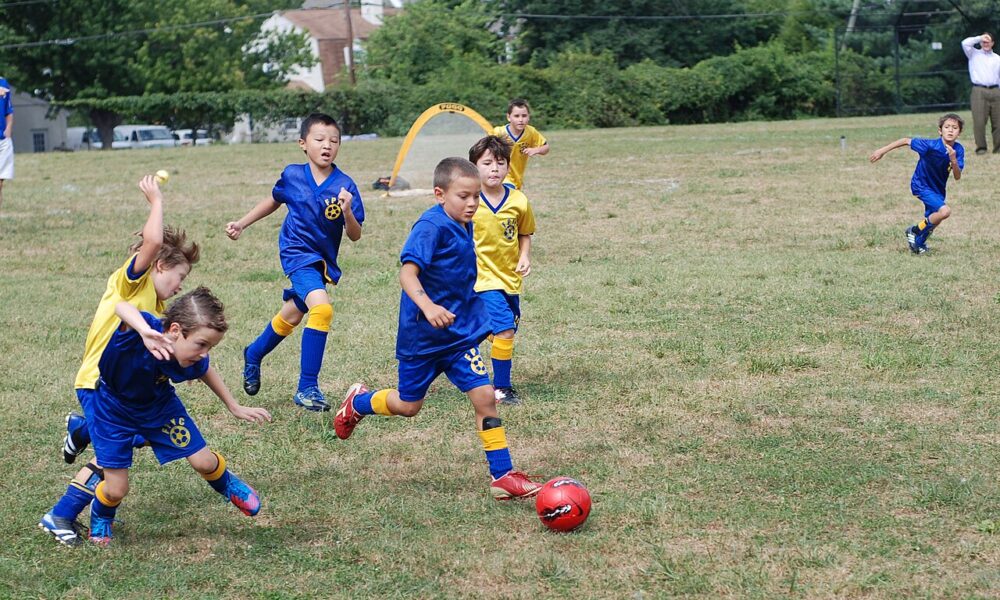

In U.S. youth soccer, the build-out line is a field marking used in many U9–U10 7v7 leagues to give young players time and space to play from the back. When a goalkeeper has possession or the defending team takes a goal kick, the opposing team is generally required to retreat behind the build-out line until the restart conditions in that competition’s rules have been met.
The important qualification is that local league rules control the details. Soccer organizations may differ on exactly when opponents can advance, how the line affects offside and what happens if a goalkeeper punts. The published NSYSA small-sided rules approved August 18, 2025, for example, contain a dedicated U9–U10 7v7 section. Coaches should compare their league’s current handbook with the principles below before their next game.
What is a build-out line in soccer?
A build-out line is a marking across the pitch, normally positioned between the penalty area and the halfway line. It is intended to discourage immediate high-pressure challenges against a young goalkeeper or defender trying to pass out. Instead of simply clearing the ball upfield, players can practice scanning, opening their body, creating passing angles and choosing between short and longer passes.
On a small-sided pitch, there are usually two such lines—one in each half. The 2025 NSYSA U9–U10 regulations place the line halfway between the top of the penalty area and the midfield line; if a field lacks the line, those rules substitute the midfield line for build-out purposes. Another state or competition may specify a different fallback.
When must opponents go behind the build-out line?
In common U.S. 7v7 implementations, an opposing team retreats behind the appropriate build-out line when the goalkeeper prepares a qualifying release or the defending team takes a goal kick. The intent is to give the team with the ball the chance to initiate play in a controlled manner. Once the ball is properly in play under the local competition’s rule, opponents may advance and apply normal pressure.
Do not automatically apply a rule remembered from a different season or league. Some local handbooks say opponents may cross once the ball is kicked and clearly moves; others specify additional goalkeeper-possession conditions. The NSYSA 2025 rules, for example, say a goal kick is live when kicked and clearly moves, without requiring the ball to leave the penalty area, while imposing specific build-out positioning restrictions on opponents. Coaches should use the referee’s and competition organizer’s guidance for borderline cases.
What if a defender passes to the goalkeeper?
The build-out line is not automatically triggered every time the defending team passes the ball backward. The relevant question is whether the specific youth rule describes a goalkeeper in possession or a designated restart, rather than a routine pass being played while the ball remains live. A keeper receiving an ordinary back-pass does not turn the match into a new goal kick. The soccer back-pass rules are a separate issue.
Does the build-out line change offside?
In many developmental 7v7 models, yes: the line can be used as the threshold beyond which offside position is assessed, rather than using the regular halfway-line approach. This reduces needless offside stoppages during play in the middle of a short field. However, local exceptions are real: the 2025 NSYSA U9–U10 document contains separate provisions on its build-out line and its offside line, so it is especially important not to assume the two are the same everywhere.
Offside still requires an offense under the applicable rules; simply standing ahead of a teammate is not always penalized. Our offside rule guide explains the usual concepts of position, involvement and timing. The small-sided build-out-line adjustment concerns where offside assessment begins in a particular youth competition.
Can U9–U10 goalkeepers punt or drop-kick the ball?
Many U.S. 7v7 development leagues ban goalkeeper punts and drop-kicks as part of their build-out approach. Rather than driving the ball the length of the field, the goalkeeper is encouraged to distribute by rolling, throwing or passing to a nearby player. The exact remedy for an illegal punt is league-specific; do not assume every competition awards the same free kick or restart.
Under the cited 2025 NSYSA U9–U10 text, if a goalkeeper punts or drop-kicks, play is stopped, the ball is returned to the keeper and the referee instructs the player to throw or roll it. Other competitions may have different enforcement. Coaches should prepare players for the actual local procedure rather than arguing with an official using a rule from another state.
A simple 7v7 build-out sequence
- Goalkeeper scans: identify the nearest safe passing option and the position of the opposition beyond the line.
- Defenders create width: the two widest defenders move where a short pass can reach them, instead of standing in one straight line.
- Central player checks into a passing lane: a midfield player becomes an available second option, but not directly behind an opponent.
- First pass is controlled: the keeper plays a firm, accurate ball to a teammate, preferably one already facing a useful next pass.
- Support changes as pressure arrives: once opponents can advance, the receiver may pass inside, return the ball or play longer if the defense closes rapidly.
These ideas complement our guide to 7v7 formations for U9–U10. A 3-2-1 or 2-3-1 diagram may help organize roles, but the build-out line concerns rules of pressure and restart rather than forcing one formation.
Three practical drills for a U9–U10 team
1. Goalkeeper plus two outlets
Mark a small area in front of goal with a realistic build-out line. Set a goalkeeper, two wide defenders and a central midfielder against two attackers who start behind the marked line. On the coach’s signal, the keeper passes to a defender. Attackers can then move according to the training rule. Give the attacking team a point for connecting three passes, and the defenders a point for winning possession legally.
2. First touch away from pressure
Have a defender receive a short goalkeeper pass with an opponent approaching from one side. Coach the receiver to check over a shoulder before the pass and take the first touch into open space. Rotate the approaching opponent so players learn to look rather than memorize one scripted direction.
3. Decide: short pass or safe clearance
Set two passing outlets at different distances. A teammate signals one is open and the coach adds varying pressure. Teach the goalkeeper that short play is a skill to develop, not a mandatory decision when the pass is obviously unsafe. The best choice depends on positioning, rules and field conditions.
Common errors by parents and coaches
- Assuming all U10 leagues use identical rules: find the actual published competition handbook and check the season.
- Treating the line as a permanent no-press zone: the retreat obligation ends at the moment specified by local regulations.
- Confusing the offside line with the build-out line: check how the competition defines each one.
- Forcing every pass short: building from the back should teach decision-making, not create a predictable turnover.
- Forgetting goalkeeper restrictions: ask your referee about punts, drop-kicks and the proper remedy before kickoff.
FAQ
How far is the build-out line from the goal?
It depends on the youth field dimensions and local regulations. A frequently used position is halfway between the penalty area and the halfway line. There is no single yardage that applies to every pitch.
Do you have a build-out line in 9v9 soccer?
Many build-out-line initiatives focus on younger 7v7 age groups, but competition rules vary. For U11–U12 9v9 soccer, check the specific league rulebook rather than assuming the 7v7 line is in effect.
Can the other team press once the first pass has been made?
Often yes, subject to the local wording that governs when the ball is in play or the keeper releases it. Some versions use additional conditions. Your referee’s interpretation of your competition’s rule is decisive.
Why are goalkeepers asked not to punt?
The developmental intent is to create more opportunities for players to receive, pass and make decisions under gradually increasing pressure, rather than skipping midfield with every goalkeeper possession.
Where can I check my league’s actual build-out rule?
Look for the 7v7 or U9–U10 division in the competition handbook, state youth soccer rules or the tournament’s published modifications. Check the effective date and any local exceptions.
Source and verification: NSYSA 2025 approved small-sided rulebook; checked October 11, 2026. This article is a U.S. youth soccer explainer, not a substitute for the reader’s own 2026 league rules. Featured photograph: Fairfax Police Youth Club youth soccer match by Jarek Tuszyński, Wikimedia Commons, CC BY-SA 3.0. Real scene illustrating youth soccer, not an official field marking.


