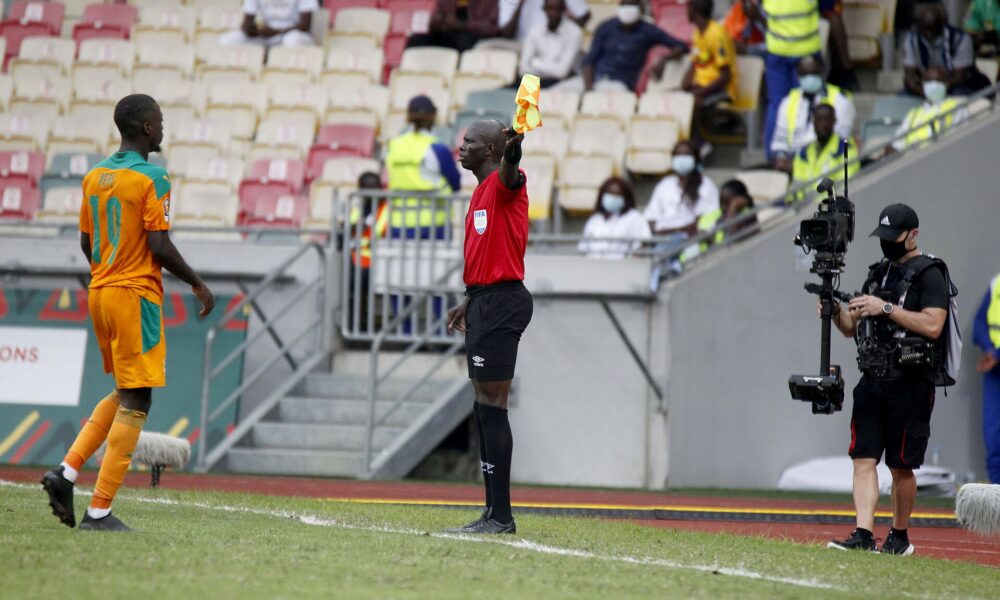

Offside in soccer is about where an attacker is when a teammate plays the ball and whether the attacker then becomes involved in active play. Being beyond the defenders is not automatically a foul. Under Law 11 of the 2026/27 IFAB Laws of the Game, the player must be in the opponents’ half and nearer the goal line than both the ball and the second-last opponent, then interfere with play or an opponent, or gain an advantage in a way the law defines.
This beginner-friendly explanation walks through the exact moment offside is judged, three common exceptions, defender touches, VAR decisions, and realistic examples you can use when watching a match.
Offside rule in one sentence
An attacker is penalized for offside when they are in an offside position at the moment a teammate plays or touches the ball and then actively participate in the play in a prohibited way. The position and the eventual offence are two separate questions. If neither part is satisfied, the referee should not award offside.
What counts as an offside position?
- Look at the attacking half. A player must have part of the head, body or feet in the opponents’ half, beyond the halfway line; an attacker in their own half cannot be in an offside position.
- Locate the ball. The attacker must be closer to the opponents’ goal line than the ball.
- Locate the second-last opponent. The attacker must also be closer to the goal than the second-last opposing player. Often that player is a defender, but a goalkeeper can be out of position; the rule counts opponents, not job titles.
- Exclude arms. Hands and arms do not determine the position. A player’s head, torso or foot can matter, with the upper arm boundary defined at the bottom of the armpit.
- Freeze the right moment. For most passes, assess position when the teammate first makes contact with the ball; IFAB provides a specific last-contact exception when a goalkeeper throws it.
If the attacker is exactly level with the second-last opponent, the attacker is onside. Level with the last two opponents is also onside. Being one step ahead of a defender at the time you receive a through ball is not enough for an offside decision; the critical comparison occurs at the teammate’s touch.
Four examples that make offside easier to understand

| Scenario | Decision | Why |
|---|---|---|
| Striker is ahead of the second-last opponent when a teammate passes, then receives the ball. | Offside | The striker was offside at the pass and became involved by playing the ball. |
| Striker starts level with the second-last opponent, then sprints beyond and receives a pass. | Onside | Position was legal when the teammate touched the ball. |
| Striker stands offside while a shot goes wide, without blocking anyone’s view or making a relevant challenge. | Usually no offside offence | Offside position alone is not enough; actual involvement matters. |
| Striker receives the ball directly from a teammate’s throw-in. | No offside offence | Law 11 explicitly exempts direct receipt from a throw-in. |
These are simplified teaching scenarios. Real decisions depend on ball contact, opponents’ movements, interference and the relevant restart. A referee might wait to see whether the attacker truly becomes involved before stopping play.
Three restarts where you cannot be offside directly
IFAB Law 11 lists exactly three direct-receipt exceptions: a goal kick, throw-in and corner kick. That means a teammate can be far behind the second-last opponent and directly receive the ball from one of those restarts without an offside offence. Once another teammate touches the ball in regular play, normal offside considerations resume at that new touch.
| Restart | Offside from a direct receipt? | Common misunderstanding |
|---|---|---|
| Throw-in | No | An attacker may stand near the byline to receive it directly. |
| Corner kick | No | A ball played by a teammate after the corner may create a new offside moment. |
| Goal kick | No | The exception is direct receipt, not every subsequent pass in the attack. |
| Free kick | Normal offside rules apply | A free kick is not one of the three listed exceptions. |
Why a forward can be flagged without touching the ball
A player in an offside position may still offend by interfering with an opponent. Examples include clearly blocking a goalkeeper’s line of sight to the ball, challenging an opponent for it, or making an obvious attempt to play a nearby ball that affects an opponent. A player who merely runs in the direction of the ball without interfering is not necessarily guilty.
When watching a disputed goal, ask: was the forward within the goalkeeper’s field of view and obstructing the shot, or simply standing nearby? Did the attacker challenge a defender? Did the movement clearly influence an opponent’s ability to play? These details often matter more than an isolated freeze-frame.
Does a defender touching the ball cancel offside?
Not always. IFAB distinguishes a defender’s deliberate play from a rebound, deflection or deliberate save. If a defender has control and deliberately plays the ball, an attacker previously in an offside position who receives it is not normally considered to have gained an advantage. But an accidental deflection or a save does not automatically reset offside.
For instance, if a cross unexpectedly hits a defender’s shin and rolls to an attacker who was offside at the cross, that may still lead to an offside offence. If a defender sees the ball, has time to control it and deliberately tries to clear it but makes a poor pass, the law may treat the action differently. Officials evaluate control, visibility, distance, speed and reaction time, not simply whether contact occurred.
When is the offside line drawn for VAR?
Video officials review certain match-changing incidents under the competition’s VAR protocol, including goals involving possible offside. The legal test is still Law 11. When an attack is evaluated, video officials must determine the teammate’s relevant ball touch and the playable body positions at that moment. Modern replay graphics can make tiny gaps seem enormous; avoid treating a televised overlay as a separate rulebook.
VAR is not present at every professional or amateur match. Where no video review is available, match officials apply the same law using their positioning and judgement. The assistant referee’s raised flag is a signal to the referee, not an entirely separate final authority.
What happens after the referee calls offside?
The defending team receives an indirect free kick at the place where the offside offence occurred. Under the law, that location can even be in the attacker’s own half if the player returned from an offside position before becoming involved. Offside by itself is not normally a yellow card; separate misconduct may require a sanction, but do not confuse the two issues.
Because offside decisions can develop after the initial pass, assistants may delay their signal while a clear scoring opportunity unfolds, depending on the competition and officiating procedures. The intention is to identify the offence correctly rather than punish the mere appearance of being behind a defender.
How attackers stay onside
- Start your run from level with the defender. Watch the teammate about to pass rather than only the open space behind the back line.
- Time your acceleration. You may run beyond defenders after the teammate has played the ball.
- Stay level with or behind the ball when possible. Being behind the ball prevents an offside position even if defenders are farther from goal.
- Be aware of the whole back line. The second-last opponent may be a goalkeeper or out-of-position player, not always the nearest center-back.
- Do not interfere if stranded offside. Leaving a ball alone can avoid an offence when an onside teammate can reach it, provided you do not affect an opponent.
Coaches can practice offside with a freeze-frame drill: stop the ball at the instant the passer contacts it, check player and ball positions, then restart and judge whether the runner actually becomes involved. This teaches two-stage decision-making better than simply shouting at forwards to stand behind defenders.
Offside in soccer: FAQs
Is it offside if you are behind the goalkeeper?
Only the actual position of the ball and second-last opponent matters. The goalkeeper need not be the last opposing player. A forward behind the goalkeeper might be onside or offside depending on the remaining defenders and ball.
Can you be offside in your own half?
You cannot be in an offside position in your own half. But an offside offence can occur after running back from the opponents’ half if you were offside at the relevant teammate touch. IFAB’s restart provision explicitly accounts for this.
Does a backward pass always prevent offside?
No. The direction of a pass is not itself the rule. The attacker’s position relative to both ball and second-last opponent, followed by active involvement, decides the offence. An attacker who is behind or level with the ball when it is played is onside by position.
Can you be offside from a free kick?
Yes. A free kick is not one of the direct-receipt exemptions. Offside position and involvement are assessed when a teammate takes the kick.
What is the simplest offside test when watching a match?
Pause at the attacker’s teammate’s ball touch. Is the receiver ahead of both the ball and second-last opponent in the attacking half? If yes, see whether they touch the ball, interfere with an opponent or gain an advantage as defined by Law 11. If no, they were onside when the pass was played.
Rules checked against IFAB Law 11 (2026/27) on October 11, 2026. Editorial featured photograph by Happiraphael via Wikimedia Commons, CC BY-SA 4.0; original photo unmodified.

Other Articles

Basketball Positions Explained: All 5 Roles, Skills and Numbers
Soccer Formations Explained: 4-3-3, 4-4-2, 4-2-3-1 and 3-5-2
