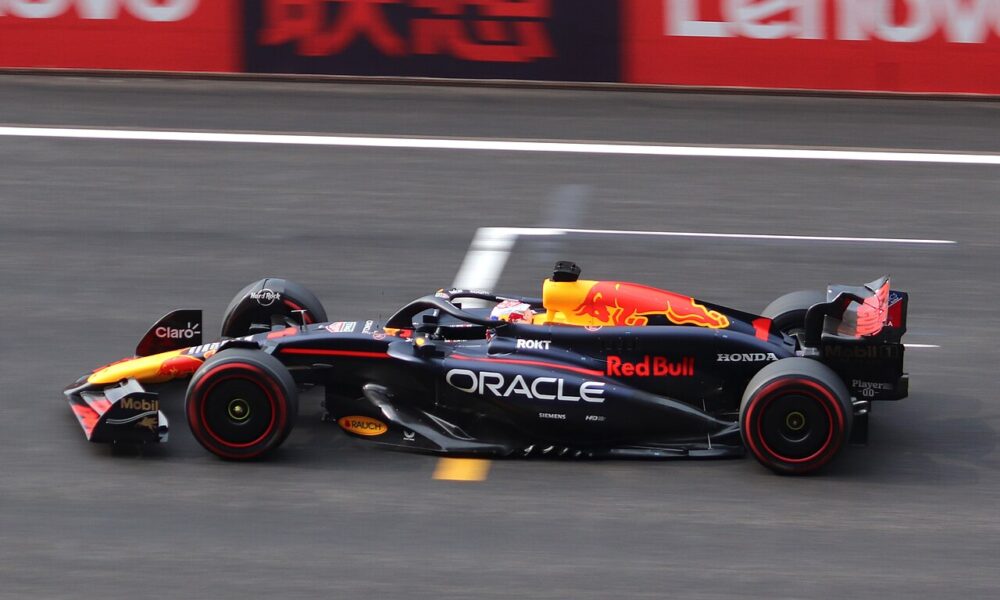

F1 track limits determine whether a Formula 1 driver has stayed within the defined racing surface. Under the FIA’s 2026 driving standards guidance, the white lines at the edge of the track are part of the track, but kerbs are not. A car has left the track when no part of it remains in contact with the track. In practice, viewers often describe this as all four wheels going beyond the white line. The consequences depend on the session and circumstances: a qualifying lap may be deleted, while a race infringement can add to the driver’s track-limits strike count.
That distinction is set out in the FIA’s 2026 Formula 1 Driving Standards Guidelines, dated February 26, 2026. The document explicitly says these are guidelines, not the regulations themselves; the stewards make decisions under the sporting regulations, informed by the guidelines and the circumstances of each incident.
What counts as leaving the track in F1?
The white boundary line is included in the defined track. A painted or raised kerb beyond that line does not extend the legal track merely because a car can physically drive on it. So a car straddling the white line with part of a wheel still in contact may be within the limit, while one entirely beyond it cannot claim that a red-and-white kerb is still part of the track.
| What the car does | Track-limits interpretation |
|---|---|
| At least some of the car remains in contact with the track, including its white boundary line. | Generally within the track as defined. |
| No part of the car remains in contact with the track; all wheels are beyond the line. | Leaves the track, subject to the stewards’ assessment and any justifiable reason. |
| The driver runs wide to avoid another car or an incident. | The context matters. FIA guidance identifies several situations where a strike need not be applied. |
| The driver cuts a corner and retains a lasting competitive advantage. | A separate advantage-related infringement may be considered; giving the advantage back can be relevant. |
The rule is not based on an imaginary barrier at the outer edge of the kerb. This explains why fans sometimes see a car visibly riding a large kerb while still being judged to have left the track.
What happens to a lap time in qualifying?
In regular qualifying and Sprint Qualifying, the FIA’s 2026 guidance says the offending lap time is deleted. The following lap may also be deleted if the stewards judge that exceeding the limit could have helped the driver on that next lap—for example, by allowing a better exit and faster starting speed.
That is especially consequential near the end of a session. A driver can briefly appear to have improved before the time is removed, and a later clean attempt might be needed to secure a grid position. It does not mean the driver is automatically disqualified or moved to the back of the grid; those are different sanctions.
What happens when a driver exceeds track limits during a race?
The 2026 FIA guidance normally uses a three-strikes approach before a black-and-white warning flag or a penalty. The wording is important: it describes a normal procedure, not an automatic mathematical guarantee of precisely the same sanction in every incident. Stewards can consider the nature of the infringement, any benefit gained, and whether exceptions apply.
Do all excursions count as strikes?
No. FIA guidance includes cases such as obvious loss of control, leaving the track to avoid a collision, being forced off by another driver, or an incident already penalized for gaining an advantage or unsafe rejoining. The stewards also retain discretion in overtaking situations where leaving the track clearly gave no advantage.
What does the black-and-white flag mean?
In this context it is a formal warning about the driver’s behavior or track-limits record, not the chequered flag that ends the session. Continued offending may lead to a time penalty. A particular race director’s event notes and the stewards’ decisions determine the exact application.
Track limits vs. gaining an advantage
These questions overlap, but they are not identical. Track limits ask whether the car left the prescribed track without sufficient justification. Gaining a lasting advantage asks whether using the area outside the track improved a driver’s competitive position.
If a driver passes another car by cutting a corner, the stewards may assess the advantage even if it was the first such incident. The FIA notes that a driver should rejoin safely and without retaining a lasting advantage. When a defending driver leaves the circuit and returns in the same position, the guidance says that may generally be treated as retaining an advantage, in which case surrendering the position can matter.
Why do some corners attract more penalties?
Wide exit kerbs, fast bends, and corners where running a little wider preserves speed create strong incentives to test the white line. Driver sightlines and camera angles can also make a marginal case hard for spectators to judge. A television replay is useful, but an apparent crossing in one angle is not always the same as a definitive steward finding.
Track-limits violations are distinct from slowing for F1 blue flags, from the pace restrictions during a Safety Car or Virtual Safety Car, and from tactical decisions around the undercut and overcut. All can affect track position, but they involve different rules or strategy choices.
Three examples to test your understanding
Example 1: Qualifying lap runs fully outside the exit line
The driver’s fastest lap can be deleted even if no overtake occurred. If running wide also helped the car approach the next lap faster, that later lap can be scrutinized under the FIA guidance.
Example 2: Race driver is pushed beyond the white line
A driver forced off by a rival is not necessarily assigned a routine track-limits strike. The stewards look at why the car left the circuit and whether another offense occurred.
Example 3: Driver shortcut preserves an overtake
Even without a buildup of prior strikes, retaining a competitive advantage by going off track can prompt separate action. The driver should not assume the first three departures carry a free pass.
FAQ
Are F1 kerbs part of the track?
The FIA’s 2026 wording says the white lines are part of the track, but kerbs are not. Driving on a kerb alone does not necessarily keep the car within track limits.
Is every four-wheel excursion an automatic penalty?
No. The session, evidence, reason for leaving the track, and the stewards’ assessment all matter. Qualifying often brings lap deletion; race infringements may count as strikes unless an exception applies.
How many track-limits warnings can F1 drivers receive?
The 2026 driving standards guidance normally describes three strikes before a black-and-white flag or a penalty, while preserving steward discretion and listing exceptions. Always check event-specific notes and decisions.
Can a driver give a place back to avoid a penalty?
Giving back a lasting advantage can be relevant when a driver gained a position by leaving the track, but the race director and stewards retain the authority to judge the incident. Returning a position is not a guaranteed cure for every offense.
Does a deleted lap mean disqualification?
No. Deleting an invalid lap time and disqualifying a driver from a session are different actions. The remaining valid lap times and applicable regulations determine the qualifying result.
Verified: October 11, 2026, against FIA 2026 Driving Standards Guidelines (February 26, 2026); the sporting regulations and event decisions take precedence over explanatory guidance. Image: Max Verstappen at the 2024 Chinese Grand Prix, by Liauzh, via Wikimedia Commons, CC BY-SA 4.0. Unmodified file, illustrative historical photo—not an image of a specific 2026 incident.

Other Articles