
A quality start (QS) in baseball is credited to a starting pitcher who pitches at least six innings and allows three earned runs or fewer. Both conditions must be met. The definition is the same whether the pitcher’s team wins, loses or finishes with a no-decision. It is a simple way to describe a reasonably effective start, not an official declaration that the pitcher was brilliant.
Major League Baseball’s official Quality Start glossary defines QS by these two thresholds. Below are worked examples, the difference between a quality start and a pitcher win, and the situations where QS can mislead fans.
What counts as a quality start in MLB?
Start with the pitcher’s individual line, not the team’s final score. The pitcher must have recorded at least 18 outs as the starting pitcher—that is six full innings—and must not have been charged with more than three earned runs. Six innings with three earned runs qualifies. Five innings with no runs does not. Seven innings with four earned runs does not, even if it may still have been a useful outing.
| Starting pitcher line | Quality start? | Why? |
|---|---|---|
| 6.0 IP, 3 ER | Yes | Meets both minimum innings and maximum earned runs. |
| 6.0 IP, 0 ER | Yes | Six innings, no earned runs. |
| 5.2 IP, 0 ER | No | One out short of six complete innings. |
| 7.0 IP, 4 ER | No | Exceeds the three-earned-run limit. |
| 8.0 IP, 2 ER | Yes | Exceeds six innings without exceeding three earned runs. |
| 9.0 IP, 4 ER | No | A long outing, but four earned runs disqualify it. |
| 6.1 IP, 3 ER | Yes | Six innings plus one out, at most three earned runs. |
What does 5.2 IP mean?
Baseball’s innings-pitched notation is not ordinary decimal math. 5.2 IP means five complete innings plus two outs in the next inning—17 outs overall—not 5.2 times three outs. The pitcher still needs one more out to reach 6.0 innings and qualify for QS. Similarly, 6.1 IP means six full innings plus one out.
This difference is easy to overlook when you are looking at a box score. A starter removed with two outs in the sixth inning might have pitched extremely well, but the stat remains no quality start because the six-inning threshold is absolute.
Does a quality start mean the pitcher won?
No. A quality start measures only the starter’s innings and earned runs; a pitcher win is a separate scoring decision tied to when the team takes or retains the lead and other official criteria. A pitcher can record a QS and still receive a loss, while a starting pitcher can earn a win without a quality start.
Example: six strong innings, team loses
Suppose the starter allows one earned run in seven innings, leaves with the team behind 1–0, and the final score remains 1–0. The pitcher recorded a quality start but also takes the loss. QS describes the pitching performance in those two specific measures; it does not erase the team result.
Example: five shaky innings, team wins
Now imagine a starter completes five innings and allows four earned runs, but the offense scores six and the bullpen protects the lead. Under applicable scoring rules, the starter can receive the win without reaching either QS threshold. MLB’s glossary uses the terms tough loss and cheap win to discuss the difference.
Quality start vs. ERA, WHIP and other pitching stats
QS is a threshold counter: each start either qualifies or does not. Earned run average (ERA) estimates earned runs allowed per nine innings; WHIP measures walks and hits per inning pitched. Those rate statistics describe different aspects of pitcher performance and can separate two starts that both register a QS.
| Statistic | Answers this question | Main limitation |
|---|---|---|
| QS | Did this starter complete at least six innings with no more than three earned runs? | Binary cutoff ignores how different qualifying starts may be. |
| ERA | How many earned runs did the pitcher allow per nine innings? | Affected by defense, scoring judgments and context. |
| WHIP | How many hits and walks did the pitcher allow per inning? | Not all hits or walks create the same danger. |
| Pitcher W/L | Which pitcher received the official win or loss decision? | Depends heavily on team scoring and relief pitching. |
Learn to compute the rate stats in our ERA formula explainer and WHIP guide. The important point is not to substitute a QS total for a broader evaluation of talent or effectiveness.
How do you calculate a quality start?
- Verify that the player started the game. A relief pitcher does not receive a QS.
- Read the official innings-pitched entry. Is it 6.0 IP or more?
- Read the earned runs column, not merely the total runs scored while that pitcher was on the mound.
- If the answer to both questions is yes—at least six innings, at most three earned runs—add one QS to the player’s season total.
A quality start has no special formula involving strikeouts, pitch count, fielding-independent metrics or the final score. Those can inform a richer assessment, but do not enter the official definition.
What is the ERA for the minimum qualifying quality start?
Six innings and three earned runs imply an outing ERA of 4.50, because ERA is earned runs multiplied by nine, divided by innings pitched: 3 × 9 ÷ 6 = 4.50. That is an arithmetic illustration, not a claim that a pitcher’s season ERA will be 4.50. Allowing one run in eight innings also registers one quality start, despite being considerably more effective in run prevention.
This is one reason QS is useful as a quick minimum-duration-and-runs screen but imperfect as a ranking of pitcher excellence. A pitcher who repeatedly goes 5.2 scoreless innings may produce many strong outings but no quality starts under the strict definition.
Why does QS matter more in some contexts?
The statistic can be helpful to fans tracking how frequently starters work into the later innings without allowing too many runs. Fantasy baseball leagues sometimes award points or use QS as a scoring category, especially where managers prefer an indicator less directly tied to run support than pitcher wins. Scoring systems differ, so inspect your fantasy league’s settings before making lineup decisions.
MLB’s glossary credits sportswriter John Lowe with introducing the term in 1985. The idea was to measure whether a starting pitcher delivered a baseline quality performance at his two broad jobs: getting outs and limiting runs. In a game with a pitch clock and variable game length, inning depth still means something, but QS alone does not tell you why a manager removed a pitcher.
FAQ
Is five innings and three earned runs a quality start?
No. The starting pitcher must record at least six full innings, regardless of how many earned runs were allowed.
Does six innings and three runs always count?
It counts only if no more than three of those runs are earned and the starter completed at least six innings. The QS criterion is based on earned runs, so unearned runs do not count against the three-earned-run limit.
Can a pitcher get a QS and lose?
Yes. The team’s offensive support and bullpen performance do not change whether the starting pitcher’s individual outing met the two QS thresholds.
Do relievers receive quality starts?
No. QS is a statistic for starting pitchers; a long relief appearance is not a quality start.
What does QS mean on an MLB box score?
QS is short for quality start. It records a qualifying outing by a starter who pitched at least six innings with three or fewer earned runs.
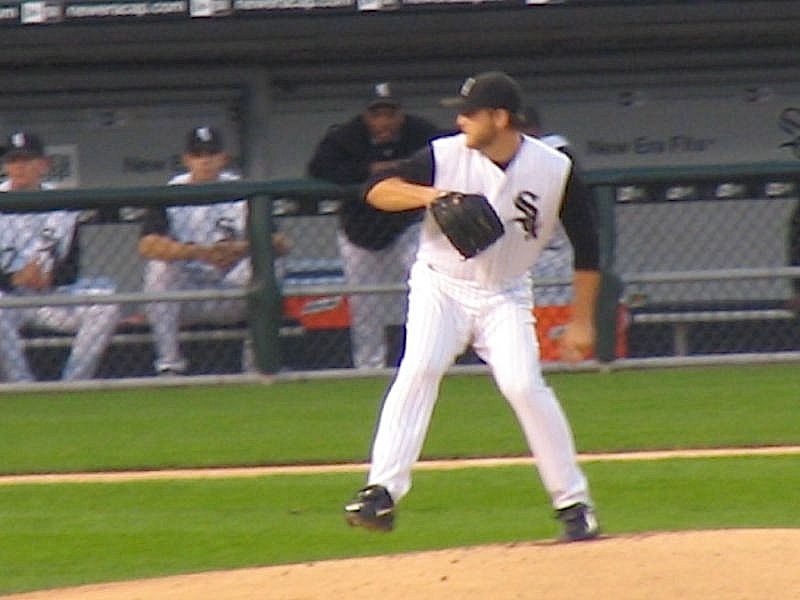
Source verification: MLB official statistical glossary, checked October 11, 2026. The innings and earned-run examples here are hypothetical, not accounts of real games. Featured photograph: Mark Buehrle pitching in 2005, by mcclouds / Wikimedia Commons, CC BY-SA 2.0. This historical photo is illustrative, not a claim about a specific recorded quality start.