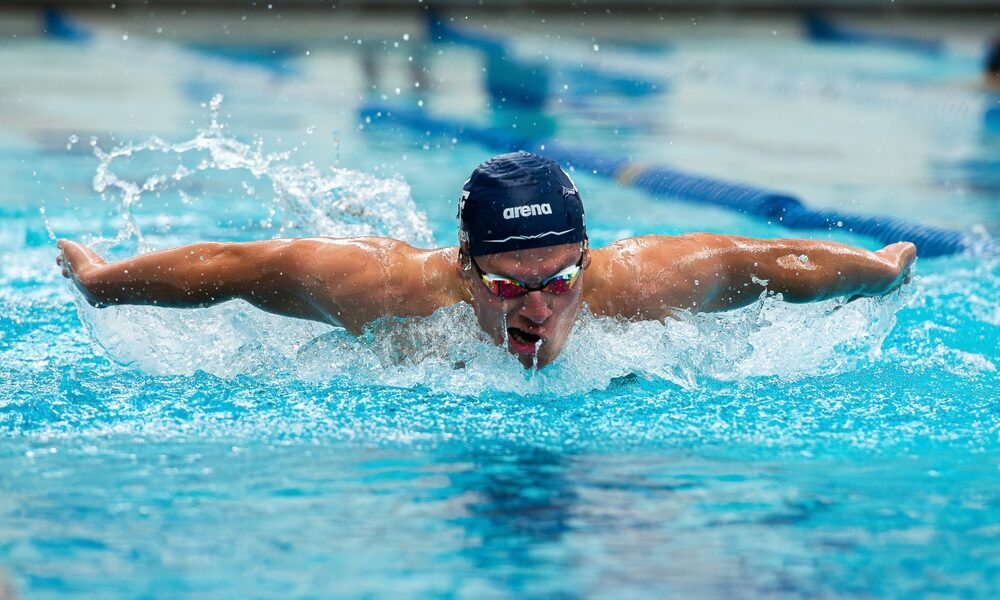

Quick answer: The four swim strokes used in standard pool competition are front crawl (normally used in freestyle), backstroke, breaststroke and butterfly. Front crawl uses alternating arms and a flutter kick while facing down; backstroke uses alternating arms while lying face-up; breaststroke uses a simultaneous arm action and whip kick; butterfly uses both arms together and a dolphin kick. They demand different breathing, timing and coordination, so the best stroke to learn first depends on your confidence in the water—not simply on which one looks fastest.
Below you’ll find a side-by-side comparison, simple technique cues, a progression for new lap swimmers and explanations of the important difference between freestyle as an event and front crawl as a technique.
Swim strokes compared: the four main styles
| Stroke | Body position | Arm action | Leg action | Main breathing challenge |
|---|---|---|---|---|
| Front crawl / freestyle | Face down with body rotation | Arms alternate | Alternating flutter kick | Turning sideways without lifting the head excessively |
| Backstroke | Face up with body rotation | Arms alternate | Alternating flutter kick | Maintaining a steady rhythm and straight path |
| Breaststroke | Face down; torso rises to breathe | Simultaneous, compact sweep | Whip kick followed by a glide | Timing breath, arm recovery and leg drive |
| Butterfly | Face down with body undulation | Both arms recover together | Simultaneous dolphin kick | Coordinating breath with pull and kick without forcing the neck |
This table concerns the four standard competition strokes. Recreational swimmers may also learn sidestroke or elementary backstroke, which are useful skills but do not replace one of these four in a normal individual-medley event.
1. Front crawl: efficient alternating-arm swimming
Front crawl is the stroke most people mean when they say they “swim freestyle.” Start from a long, horizontal body line. One arm extends forward as the other pulls water toward the hip, with small alternating flutter kicks. Your torso rotates smoothly; your head follows the rotation for a brief side breath rather than rising straight forward.
Three useful front-crawl cues
- Look down, not forward, to avoid pushing the hips lower in the water.
- Exhale underwater instead of holding your breath until the head turns.
- Reach long and rotate rather than windmilling stiff arms above the surface.
Common error: lifting the whole head for air. Correction: practice a supported side-breathing drill with a coach or at a lifeguarded pool before adding more speed. For a full sequence of fixes, see our freestyle swimming technique guide.
2. Backstroke: alternating arms while facing up
Backstroke is the only one of the four swum predominantly on the back. Keep the body extended, eyes toward the ceiling or sky and ears near the waterline. Alternate the arms in a continuous rhythm, rotating the shoulders and hips gently while maintaining a narrow flutter kick.
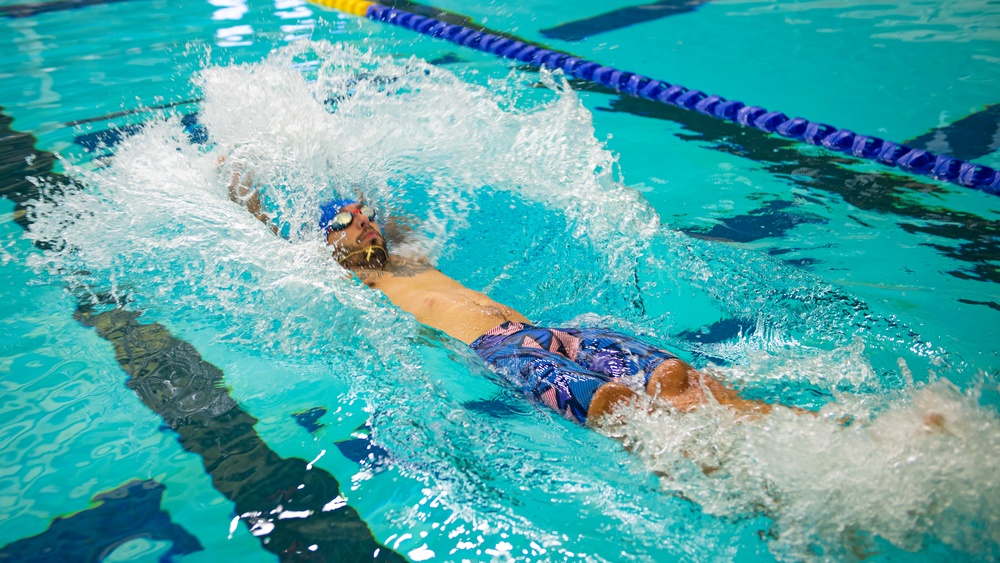
This photograph documents a real backstroke swimmer—not an illustration of a swimming position.
Three useful backstroke cues
- Keep the head quiet while the torso rotates.
- Kick from the hips with a relaxed ankle rather than bicycling the knees high out of the water.
- Count strokes between the backstroke flags and the wall during coached practice to learn safe wall approaches.
Backstroke allows relatively straightforward breathing because the face remains above water, but it makes lane direction harder to monitor. Always check the lane and wall with appropriate supervision. Our backstroke drills guide covers body alignment, arms and a beginner pool session.
3. Breaststroke: pull, breathe, kick, glide
Breaststroke uses a simultaneous arm movement and a whip-style leg action rather than a flutter kick. A useful beginner rhythm is: pull and breathe → shoot the hands forward → kick → glide. The hands return in front of the shoulders while the legs recover; a narrow, coordinated kick provides propulsion without forcing the knees apart unnecessarily.
Common error: keeping the head lifted all the time, which increases drag and may strain the neck. Practice looking down during the glide, then lifting only as needed to breathe. Breaststroke can feel approachable for some beginners, but the whip kick is a technical skill and is not automatically the easiest or safest choice for every swimmer. See our breaststroke technique and kick timing guide for a more focused progression.
4. Butterfly: simultaneous arms and dolphin kick
In butterfly, the two arms move together and recover forward above the water. The legs drive in a synchronized dolphin kick as a wave passes through the trunk and hips. Swimmers usually coordinate two kicks with one complete arm cycle; the exact timing depends on the skill level and drill.
Unlike front crawl, butterfly asks for a more complex combination of upper-body power, body rhythm and breath timing. It is normally introduced after swimmers can already float, streamline, kick and control breathing confidently. Instead of attempting repeated full lengths on day one, start with supervised dolphin kicks in streamline and short, relaxed arm-and-kick drills.
Common error: trying to lift the chest dramatically to breathe, which often stalls the hips. Think of a gentle body wave and a low, timely forward breath. The featured photograph shows a real butterfly stroke in competition.
Which swim stroke should you learn first?
| Your situation | Useful starting focus | Why |
|---|---|---|
| New to the pool, not yet comfortable floating | Water safety, supported floating and breathing before formal laps | A controlled body position is more important than choosing a stroke name |
| Comfortable floating face-down but struggling to breathe | Front-crawl side-breathing drills in short repeats | Breathing control is often the limiting skill, not arm strength |
| Comfortable lying face-up | Backstroke balance and flutter kick | Lets you work on alignment while breathing regularly |
| Want a different rhythm and a brief glide | Breaststroke timing with a coach | Emphasizes coordination rather than nonstop alternating arm action |
| Already comfortable with the other strokes | Butterfly dolphin kick and short coordinated sets | Reduces fatigue-driven technique breakdown |
No single recommendation applies to everyone. Children, anxious new swimmers and anyone with mobility restrictions need instruction adapted to their safety and comfort. Swim only with an appropriate lifeguard or instructor present if you are learning; do not practice breath-holding challenges or hyperventilation.
Freestyle versus front crawl: are they identical?
Not technically. In a freestyle event, the rules permit different forms of swimming (subject to event-specific restrictions), while front crawl describes the familiar alternating-arm technique used almost universally in top freestyle racing. In an individual medley, the freestyle leg cannot simply repeat backstroke, breaststroke or butterfly. That’s why learning the stroke vocabulary makes race descriptions less confusing.
Swim medley stroke order: individual versus relay
The four strokes also appear in two distinct race formats:
| Race | Stroke sequence |
|---|---|
| Individual medley (one swimmer) | Butterfly → Backstroke → Breaststroke → Freestyle |
| Medley relay (four swimmers) | Backstroke → Breaststroke → Butterfly → Freestyle |
The order changes because the relay’s opening backstroke leg begins in the water rather than from a forward racing dive. This distinction matters when you watch a race or try to understand official results. For rule-specific questions, consult the current World Aquatics competition regulations; recreational lessons do not need to enforce every elite-racing technicality.
A simple 20-minute stroke sampler for confident swimmers
This optional session is for people already able to swim short lengths safely; it is not a learn-to-swim substitute. Rest whenever your breathing or form deteriorates.
- Minutes 0–5: relaxed warmup and streamline glides with normal breathing.
- Minutes 5–9: short front-crawl repeats focusing only on smooth side breathing.
- Minutes 9–13: short backstroke repeats to practice a calm head and straight path.
- Minutes 13–17: slow breaststroke coordination, leaving a controlled glide after each kick.
- Minutes 17–20: relaxed kick or drill work; butterfly dolphin-kick drills only if already competent, otherwise easy cooldown.
The goal is quality of movement rather than maximum distance. If any stroke causes pain or unusual discomfort, stop and ask a qualified instructor for technique assessment.
Frequently asked questions
What are the four main swim strokes?
Front crawl/freestyle, backstroke, breaststroke and butterfly are the four primary strokes used in standard pool competitions.
Which stroke is usually fastest?
Front crawl is normally the fastest in competitive pool swimming, which is why most freestyle racers use it. Individual ability and technique still matter.
Is breaststroke always the easiest for beginners?
No. Some beginners like its breathing rhythm, while others find the whip kick difficult. A teacher may introduce body balance and basic front crawl or backstroke skills first.
Which stroke lets you breathe most freely?
Backstroke keeps the face upward during ordinary swimming, making regular breathing straightforward. But swimmers still need correct balance, awareness of the wall and safe lane control.
Are there only four swimming strokes in total?
No. The four are standard pool-competition categories, but sidestroke, elementary backstroke and other practical movement patterns also exist.
Should a beginner learn butterfly right away?
Usually not as a complete stroke. Learners normally build floating, breath control, streamline and dolphin-kick skills before trying coordinated butterfly lengths.
Key takeaway: compare the arm pattern, leg action and breathing rhythm rather than judging a stroke by speed alone. Learn safe water skills first, then pick a repeatable technique and build from short, controlled lengths.


