

Quick answer: The Big Combo is a 1955 American film noir directed by Joseph H. Lewis, photographed by John Alton, and starring Cornel Wilde as police lieutenant Leonard Diamond and Richard Conte as crime boss Mr. Brown. It is remembered for its unusually severe use of shadow, inventive sound design, and a fog-filled final confrontation. The original film is generally treated as public domain in the United States, but a modern restoration can have separately protected elements.
This guide distinguishes the film’s verified production facts from interpretations of its ending. Major plot spoilers begin below the first overview.
The Big Combo (1955) at a glance
| Question | Answer |
|---|---|
| Original release | 1955 |
| Director | Joseph H. Lewis |
| Screenplay credit | Philip Yordan |
| Cinematography | John Alton |
| Original music | David Raksin |
| Principal leads | Cornel Wilde, Richard Conte and Jean Wallace |
| Genre | American crime thriller / film noir |
| Typical running time | Approximately 88 minutes; editions and listings vary slightly |
| 2026 viewing note | Ignite Films offers a 70th-anniversary 4K restoration; bonus materials and formats vary by edition |
What is The Big Combo about? (spoiler-free)
Police lieutenant Leonard Diamond is fixated on bringing down a powerful organized-crime leader known only as Mr. Brown. Diamond’s superiors doubt that years of surveillance have produced enough evidence, and the case has become personal. Susan Lowell, Brown’s companion, is caught between Brown’s influence and Diamond’s persistent attempts to free her from it.
Instead of relying on one ingenious heist or a long investigation montage, the film builds tension through uncomfortable confrontations. Diamond follows clues about Brown’s earlier associates, while Brown uses intermediaries to keep his own hands apparently clean. Every apparent opening in the investigation comes with a personal cost.
Who plays whom?
| Actor | Role | Why the role matters |
|---|---|---|
| Cornel Wilde | Lt. Leonard Diamond | Detective whose pursuit of Brown strains professional judgment |
| Richard Conte | Mr. Brown | Gang leader whose control depends on intimidation and secrecy |
| Jean Wallace | Susan Lowell | Woman whose choices ultimately affect the outcome |
| Brian Donlevy | Joe McClure | Brown’s ambitious lieutenant |
| Lee Van Cleef | Fante | One of Brown’s two close enforcers |
| Earl Holliman | Mingo | Fante’s partner; crucial to the investigation’s resolution |
| Helen Walker | Alicia Brown | Link to Brown’s hidden history |
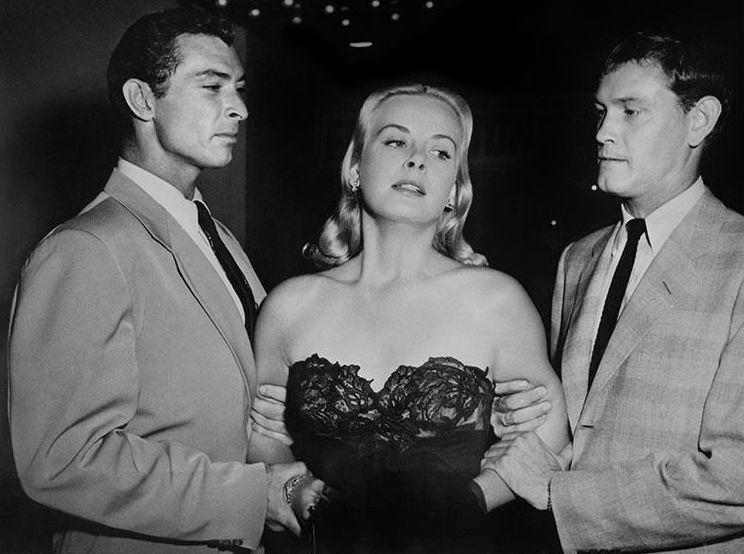
The photograph above is an original-era publicity image of the film’s cast, not a frame from a recent adaptation or a generated illustration.
The Big Combo ending explained (full spoilers)
The ending is not an unresolved cliffhanger: Mr. Brown is cornered and arrested at a foggy airfield after Susan turns the light against him. Diamond and Susan remain standing together as silhouettes in the mist. The crime plot reaches a definite outcome even though the image leaves the characters’ longer-term relationship open to interpretation.
1. Alicia is the missing link
Diamond initially suspects a disappearance connected to Brown’s earlier criminal dealings. A photograph of Alicia taken where snow is visible undermines the story that she has been living abroad. Following that inconsistency leads him to a living witness rather than the murder victim he first anticipated. Alicia’s knowledge is threatening because it can connect Brown to crimes in his past that his current organization has concealed.
2. Brown’s own attempt to eliminate witnesses backfires
Brown has enforcers Fante and Mingo murder McClure after the latter schemes against him. Later, Brown gives the pair a box presented as payment, but it contains an explosive device. Fante dies; Mingo survives. Mingo’s grief and sense of betrayal make him willing to implicate Brown. The central irony is that Brown destroys the loyalty he depends on through the very act meant to protect him.
3. Susan changes the outcome at the airport
Brown brings Susan to a private airfield in the hope of escaping, but the getaway fails. In the fog, Brown relies on poor visibility to evade Diamond. Susan directs a powerful light toward him, exposing his position and breaking the visual advantage that had protected him. Diamond can then apprehend Brown rather than kill him. Susan is therefore an active participant in Brown’s defeat, not merely someone waiting to be rescued.
4. What does the final fog image mean?
Alton and Lewis make the last shot visually memorable because the silhouettes carry several meanings at once. Brown’s immediate power is over, Diamond has the arrest he wanted, and Susan has acted against her captor. Yet the fog obscures where the two survivors will go next. The film resolves the criminal case while refusing to pretend that obsession, coercion and personal loss can be cleared away just as neatly.
Three techniques that make the film unusually memorable
Light becomes part of the action
The climax turns a familiar noir visual device into a plot mechanism: illumination physically reveals the antagonist’s hiding place. This is more pointed than using dramatic black-and-white lighting merely to create atmosphere. Long stretches of darkness also isolate faces and hands, making characters’ reactions feel trapped inside the frame.
Sound disappears when McClure can no longer hear
In the execution of McClure, Brown removes his hearing aid and the soundtrack falls silent around the shots. Viewers suddenly experience the event from an auditory perspective that belongs to the victim. This is a formal choice: the absence of sound is the most disturbing aspect, not an accidental fault in an old print.
Violence is often conveyed indirectly
When Brown’s men kill Rita instead of Diamond, the film emphasizes abrupt visual consequences and suspense rather than a long depiction of injury. Turner Classic Movies notes that its treatment of violence drew censorship attention at the time. That historical context helps explain why the film’s suggestion and framing are as important as what is directly shown.
What changed with the modern 4K restoration?
In 2026, Ignite Films has a 70th-anniversary restoration available in multiple disc editions. According to the restoration publisher’s product details, its team worked from a 35 mm fine-grain answer print and an optical sound negative. The Grainery handled the 4K picture work, and audio was sourced from a UCLA restoration funded by The Film Foundation. The company lists new and archival bonus features, including commentary and specialist essays.
| What you’re comparing | Older circulating copies | 2026 restoration |
|---|---|---|
| Image | Quality varies; scratches, softness and contrast shifts may appear | New restoration from identified film elements |
| Audio | Condition depends on the surviving transfer | Restoration-derived audio specified by the publisher |
| Extras | Usually minimal or none | Edition-dependent commentaries, interviews and other materials |
| Rights | Original underlying film’s US public-domain status is a separate question | New supplemental features and restoration contributions may carry separate rights |
Do not assume every online upload labeled “restored” is Ignite’s version, or that every edition includes identical extras. Check the precise disc package before making a purchase.
Is The Big Combo public domain?
The underlying 1955 film is documented as public domain in the United States. The Wikimedia Commons record for a complete copy notes the invalid original copyright notice and the lack of a known renewal; the film’s history also describes the U.S. Copyright Office rejecting the notice in 2007. The film’s public-domain status does not mean that every later release, newly commissioned commentary, artwork, subtitle translation, or remastering contribution can automatically be redistributed. Copyright rules also differ outside the United States.
For those reasons, a historic frame from the original film and a screenshot taken from a modern distributor’s paid interface should not be treated as having identical reuse terms. This article uses verified original-era material and avoids presenting a newly produced commercial image as a public-domain historical artifact.
What to watch after The Big Combo
If the way Lewis and Alton use shadow is what caught your attention, try two already-covered noir films with different artistic priorities. Scarlet Street (1945) centers on deception, guilt and the cost of self-delusion; Detour (1945) is a more stripped-down tale of bad decisions and an uncertain narrator. Neither should be mistaken for a direct sequel to The Big Combo.
Frequently asked questions
Is The Big Combo a sequel?
No. It is a standalone 1955 crime film. “Combo” refers to the criminal organization, not to an installment number.
Who is the villain?
Mr. Brown, played by Richard Conte, is the central antagonist. He exercises power through his criminal network and his control over Susan.
Does Mr. Brown die at the end?
No. Diamond arrests him at the airfield after Susan helps reveal his location.
Who dies in the story?
Among the plot’s casualties are Rita, McClure and Fante. Mingo survives the explosion long enough to disclose what Brown has done.
Why is the silent killing scene famous?
It removes audible gunfire when a character’s hearing aid is taken away, tying soundtrack perspective to the character’s experience.
Can I watch any copy for free?
There are public-domain circulating copies of the original film in the United States, but verify the host’s rights and the particular transfer. Free access to an older copy does not mean the 2026 restored editions or their added features are free to distribute.
Bottom line: The Big Combo earns its noir reputation through the combination of a completed crime story and unusually expressive technique. Its fog-bound ending works because Susan finally acts, Brown loses control, and Lewis leaves the emotional cost visible even after the arrest.


