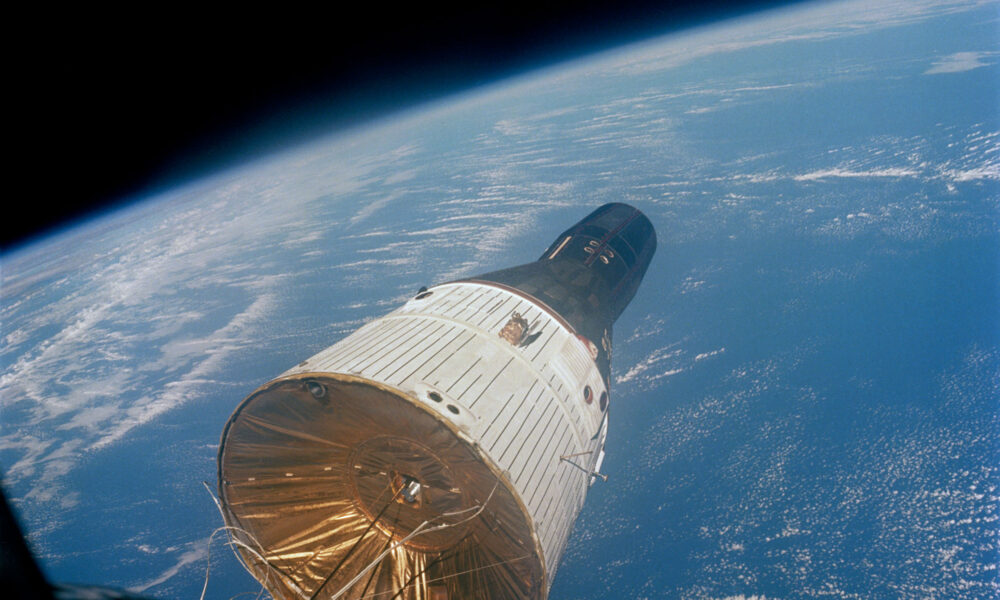

Quick answer: The Gemini spacecraft was NASA’s two-person orbital capsule used between the Mercury and Apollo programs. Gemini flights tested longer stays in space, rendezvous, docking, spacewalks and precise reentry—capabilities that had to work before crews attempted a lunar landing. The real spacecraft photographs in this guide show Gemini 7 during the first rendezvous of two crewed spacecraft on December 15, 1965; they are not computer-generated mission art.
Gemini spacecraft: key facts
| Feature | Verified explanation |
|---|---|
| Program | NASA Project Gemini, between Mercury and Apollo |
| Typical crew | Two astronauts in one capsule |
| Launch rocket | Titan II for Gemini spacecraft flights |
| Flight program | 10 crewed spacecraft missions and 2 uncrewed test launches |
| Primary flight period | 1965–1966 for crewed Gemini flights |
| Historic rendezvous | Gemini VI-A and VII, December 15, 1965 |
| First docking in orbit | Gemini VIII with Agena, March 16, 1966 |
| Final crewed Gemini mission | Gemini XII, November 1966 |
What made the Gemini capsule different?
Gemini was not designed to land on the Moon. It was designed to turn spaceflight from a brief trip into a set of repeatable procedures. Mercury carried one astronaut; Gemini carried two. That second crewmember made teamwork, complex orbital maneuvers and long-duration operations possible under realistic flight conditions. Apollo then expanded the architecture for lunar missions, including a three-person command module and a separate lunar module.
The Gemini spacecraft consisted of a crewed reentry module and an equipment-and-adapter section. Unlike Apollo’s lunar module, Gemini was never meant to land on another world. After completing its Earth-orbit mission, the crew returned through Earth’s atmosphere and splashed down under parachutes for recovery.
What do the actual 1965 photographs show?
NASA photograph S65-63220, used here as the featured image, shows Gemini 7 above Earth as seen from Gemini VI-A during their December 15, 1965 rendezvous. A different archival NASA frame, S65-63198, appears below. Both depict the real spacecraft in orbit, not a scale model or artistic reconstruction. They show different viewpoints and moments, which is why published descriptions can give different separation distances between the vehicles.

Gemini 7 had launched earlier, on December 4, carrying Frank Borman and James Lovell for a long-duration mission. Gemini VI-A launched on December 15 with Walter Schirra and Thomas Stafford. The two crews demonstrated that separately launched spacecraft could approach one another and hold controlled positions in orbit. These are authentic rendezvous images; the celebrated first successful docking happened on another mission three months later.
Rendezvous versus docking: the crucial distinction
Rendezvous means bringing spacecraft into close proximity while matching their motion. Docking means making a physical connection, using compatible mechanical interfaces and tightly controlled relative motion. Gemini VI-A and VII performed the former. Gemini VIII, flown by Neil Armstrong and David Scott, performed the first physical docking with an uncrewed Agena target on March 16, 1966.
That first docking was quickly followed by an emergency: a stuck thruster caused the joined vehicles, then the separated Gemini capsule, to rotate dangerously. Armstrong and Scott regained control using the reentry control system and returned early. The outcome mattered because Apollo crews would later depend on docking and on the ability to manage unexpected spacecraft behavior.
Five Gemini achievements and why Apollo needed them
| Gemini flight | Demonstration | Why it mattered |
|---|---|---|
| Gemini IV (June 1965) | Ed White completed the first American spacewalk | Helped NASA learn how people and equipment behaved outside a spacecraft |
| Gemini V (August 1965) | Eight-day flight using fuel-cell power | Tested endurance and longer-duration systems |
| Gemini VI-A/VII (December 1965) | First rendezvous of two crewed vehicles | Showed separate launches could converge in orbit |
| Gemini VIII (March 1966) | First docking with Agena | Demonstrated physical joining and emergency response |
| Gemini XII (November 1966) | Practiced spacewalk tasks and tethered work | Improved techniques for useful extravehicular activity |
How did a Gemini spacewalk work?
During Gemini IV on June 3, 1965, Edward White opened the hatch and traveled outside while attached to the spacecraft. His maneuvering oxygen-jet gun provided limited propulsion, after which the astronaut worked using his tether and body motion. Later Gemini crews learned that moving outside the vehicle was physically demanding and required careful practice, handholds and pacing.
How long could Gemini crews remain in orbit?
Long flights were a primary design goal. Gemini VII remained in space for 13 days, 18 hours and 35 minutes in December 1965. The mission helped show that crews could operate for roughly the period expected for a lunar expedition. It also raised practical questions about cramped living space, fatigue and routine tasks that short flights could not reveal.
Gemini vs Mercury vs Apollo: a practical comparison
| Program | Crew per main spacecraft | Main learning goal |
|---|---|---|
| Mercury | 1 | Can an American astronaut fly, live briefly in space and return? |
| Gemini | 2 | Can astronauts maneuver, rendezvous, dock and work for longer periods? |
| Apollo | 3 in command module | Can crews travel to lunar distance, perform lunar landings and return? |
These are simplified program goals, not claims that every individual flight performed every objective. Some missions were demonstrations and some had to change their plans because of equipment problems or weather. The full program succeeded through accumulated experience rather than one perfect flight.
Why the Gemini name is easy to confuse
Project Gemini is NASA’s 1960s spacecraft program. It is unrelated to Google’s modern Gemini artificial-intelligence product. When looking for historical photographs, search for NASA Gemini mission numbers, flight dates or NASA archive image identifiers rather than expecting an AI-app screenshot to illustrate the spacecraft.
If you want context about modern vehicles, our X-37B spaceplane explainer distinguishes experimental orbiters from Gemini’s crewed capsules. Our Artemis II science-data guide shows a later era of NASA lunar-flight records. Those are related reading, not claims that Gemini carried today’s instruments.
Frequently asked questions
How many astronauts flew inside a Gemini spacecraft?
Two per crewed mission. NASA flew ten crewed Gemini missions plus two earlier uncrewed test flights.
Did the Gemini spacecraft go to the Moon?
No. Gemini spacecraft operated around Earth and tested critical methods later used by Apollo’s lunar missions.
What is the difference between Gemini 7 and Gemini 8?
Gemini 7, flown by Borman and Lovell, set a long-duration flight record and participated in the first crewed rendezvous. Gemini 8, flown by Armstrong and Scott, completed the first docking with an Agena target and then returned early after a thruster malfunction.
Are all Gemini photos found online authentic?
No. Historical archives include real spacecraft photographs, studio hardware pictures, diagrams and artist’s concepts. A NASA mission photo ID helps identify actual camera records.
Where can I verify these photographs?
NASA catalogs its Gemini images by reference numbers such as S65-63220 and S65-63198. Its mission pages supply the historical context.
Official references: NASA Project Gemini gallery and NASA Gemini VII mission record. Last reviewed: October 15, 2026.


