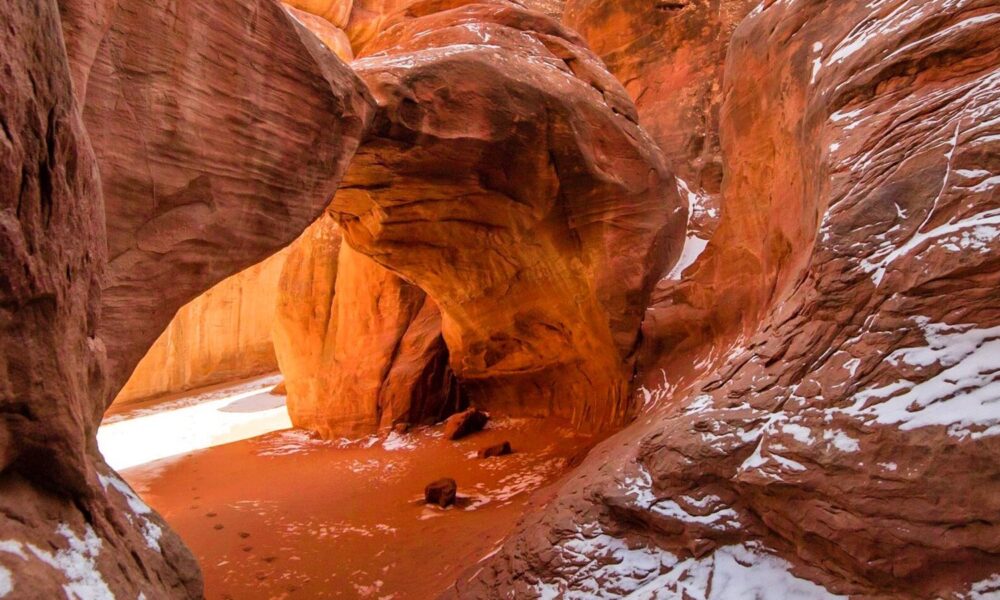

Quick answer — checked October 13, 2026: Sand Dune Arch is an easy, short trail in Arches National Park, Utah, near the park’s northern scenic drive. The National Park Service lists the out-and-back walk as 0.4 mile (0.6 km) round trip, usually taking 15–30 minutes. Although the walk is largely level, it goes through deep, loose sand and a very narrow rock passage, so it is not wheelchair-accessible. Dogs cannot use this trail. In 2026, Arches does not require advance timed-entry reservations, although you still need a park entrance pass.
For visitors comparing easy arches, Sand Dune Arch is especially rewarding because you reach a real sandstone arch through a shaded corridor of towering fins without committing to a long desert hike. The key practical catch is that the short distance can make it sound easier for all mobility levels than it is. Below are the official route numbers, parking and access rules, extensions to nearby Broken Arch, and what to do when the trailhead is crowded.
Sand Dune Arch trail: key facts for 2026
| Planning detail | Official or practical answer |
|---|---|
| Where | Arches National Park near Moab, Utah |
| Sand Dune Arch round trip | 0.4 mile / 0.6 km |
| Typical walking time | 15–30 minutes, excluding longer photo stops |
| Difficulty | Easy overall, with deep sand and a narrow passage |
| Elevation change | NPS lists 0 ft for the short out-and-back |
| Trailhead | Signed Sand Dune Arch / Broken Arch parking on the park road |
| Wheelchairs and most wheeled aids | Not accessible due to loose sand and a pinch point |
| Dogs | Not allowed on trail; trained service animals have different rules |
| Advance timed entry, 2026 | Not required at Arches, but a valid park pass still is |
| Nearby hike extension | Broken Arch out-and-back or Broken Arch Loop |
These route figures are from the NPS Sand Dune Arch Trail page, last updated August 15, 2026. Some independent guides still describe a 0.3-mile hike. To avoid mixing measurement conventions, this article uses the current NPS round-trip distance of 0.4 mile for the standard approach.
Where is Sand Dune Arch, and how do you get to the trailhead?
Sand Dune Arch is inside Arches National Park, northeast of Moab in southeastern Utah. Enter the park from the signed entrance off US Highway 191, continue through the entrance area and follow the park’s paved scenic drive toward Devils Garden. Watch for the signed Sand Dune Arch / Broken Arch Trailhead. The trailhead is on the northern part of the drive; it is not the same parking area as Delicate Arch, The Windows, or Devils Garden.
Use the official park map rather than only a search-engine pin: Arches maps and directions. Download a map before driving because cellular coverage can be unreliable inside the park. If a navigation app sends you onto an unpaved or unsigned shortcut, return to the signed paved park route.
How much parking is available?
There is a designated parking area for Sand Dune Arch and Broken Arch, but it is not a large visitor center with unlimited spaces. Availability changes with the hour, season, weather and park traffic. NPS warns that popular Arches trailhead lots can fill and instructs visitors not to block the road, stop in the travel lane, park on vegetation, or wait in a queue for a full lot. If the lot is full, move on and try again later rather than creating an unsafe roadside stop.
For the best chance of an unhurried visit, an early morning or late-afternoon arrival can be useful. The official traffic guidance also recommends arriving outside peak hours and avoiding the busiest holiday periods. No particular arrival time guarantees a space.
Is there a restroom at Sand Dune Arch?
The current NPS trailhead listing shows vault/composting toilet facilities among amenities. Treat that as a facility listing, not proof that a specific restroom is operational on every day. Carry water before departing the visitor center or other established refill points. Do not expect a store, drinking-water fountain or cell signal at the arch itself.
How to hike Sand Dune Arch step by step
- Park only in a marked space at the signed Sand Dune Arch / Broken Arch trailhead. Review the posted signs for any current closures or reroutes.
- Follow the Sand Dune Arch direction. The approach leaves the main parking area and soon enters an area of sandstone fins. Do not mistake the longer Broken Arch route for the shorter arch visit.
- Walk carefully through soft sand. Your feet may sink, even though the official elevation change is negligible. The sandy tread is harder than pavement for strollers, small children who tire easily, and anyone with balance or mobility challenges.
- Pass through the narrow rock corridor. The official accessibility information mentions a boulder and a minimum passage width of 19 inches (48 cm) at one point. Do not force a wheelchair, stroller or other equipment through.
- Stop beneath the view of Sand Dune Arch. Look up at the natural opening, the surrounding fins and the play of reflected light on the rock. Do not climb or jump from the arch.
- Return by the same route to complete the 0.4-mile round trip, or return to the signed junction if you planned a separate Broken Arch extension.
Because the arch sits amid rock walls, the scene can feel surprisingly sheltered, but the approach and the parking area remain exposed to high-desert conditions. Sand does not protect against excessive heat, lightning or severe storms. Plan for changing conditions even when the trail itself is short.
Is it really an easy hike?
Easy in length and elevation, not necessarily easy underfoot. NPS marks it Easy with 0 feet of net elevation change for the designated short route. This does not mean a flat, hard, step-free path. Deep sand requires additional effort, and the narrow passage affects accessibility. Bring shoes with secure traction; sandals that fill with sand can make the walk less comfortable.
Is Sand Dune Arch good for families with children?
Often, yes, because the standard hike is brief, memorable and less physically demanding than a longer rock trail. Children should stay in sight, especially between tall rock fins where visibility can be limited. Keep them away from any climbing or jumping on the arch or adjacent high rocks. NPS emphasizes avoiding damage to the arch and protecting soil and habitats. Bring extra water and sun protection for the rest of the day’s park stops, not just the short walk.
Sand Dune Arch vs Broken Arch: which trail should you choose?
These two arches share a trailhead, but the hiking options are not the same. Their names and route lengths can be confused when planning quickly.
| Trail option | NPS round-trip distance | Time | Best for |
|---|---|---|---|
| Sand Dune Arch only | 0.4 mi / 0.6 km | 15–30 minutes | A short sandstone-fin experience |
| Broken Arch out-and-back | 1.2 mi / 1.9 km | 30–60 minutes | One more arch with an easy trail |
| Broken Arch Loop | 2.3 mi / 3.7 km | About 60 minutes | A longer loop with campground section and scrambling |
The NPS Broken Arch Trail description lists a shorter out-and-back and a longer loop. The loop route includes a campground section and moderate scrambling. Do not combine all three options into a single mileage claim: if you visit Sand Dune Arch as a side trip, you will walk additional distance beyond whichever Broken Arch route you choose.
Should you do both arches on the same stop?
If you have enough daylight, water and comfort walking on desert surfaces, visiting Sand Dune Arch and continuing toward Broken Arch can make the most of one parking stop. However, the short 0.4-mile arch walk and 2.3-mile loop are very different commitments. For someone with limited time, a toddler, fatigue or heat sensitivity, the shortest route may be the more sensible choice.
Broken Arch is not literally broken in two
Despite its name, Broken Arch is an intact natural arch with a visible crack. According to the NPS description, visitors view a stone opening over a landscape of piñon and juniper. It offers a more open setting than the narrow fins around Sand Dune Arch. Photograph them as separate features; a picture of Broken Arch should not be labeled Sand Dune Arch.
Sand Dune Arch accessibility: the important restrictions
This is the most important limitation to understand before visiting. The short mileage may appear accessible in a generic hiking app, but the park says otherwise. The NPS mobility-accessibility page describes the surface as bedrock and deep sand, a boulder obstruction, a maximum grade steeper than the typical grade, and a minimum tread width of 19 inches. It explicitly lists Sand Dune Arch among the trails prohibited for the park’s all-terrain wheelchair program.
Even visitors using a stroller or other wheeled equipment should not rely on the distance alone. If accessible paved viewpoints are essential, check NPS recommendations for alternatives such as the Park Avenue viewpoint or other explicitly designated accessible areas. Check the accessible route’s current conditions in the NPS visitor center rather than assuming every arch trail has a firm surface.
Can you bring a dog?
No pets on Sand Dune Arch Trail. NPS lists dogs as not permitted on this or the Broken Arch Trail. A trained service animal that meets the park’s definition is treated differently from a pet or emotional-support animal. Consult Arches pet regulations if an animal is part of your trip. Do not leave pets unattended in a hot vehicle while hiking.
Do you need reservations to visit Sand Dune Arch in 2026?
No advance timed-entry ticket is required to enter Arches National Park in 2026. The park’s official 2026 planning update states this clearly. You still need a valid entrance pass or to pay the park entrance fee. Removing timed-entry does not ensure a parking space, and entrance roads may be managed or temporarily diverted during unusually heavy traffic.
Reservations that still apply elsewhere: Devils Garden Campground and ranger-led or self-guided Fiery Furnace visits have their own reservation or permit rules. A Sand Dune Arch walk does not become a Fiery Furnace permit simply because both places involve sandstone fins. Always review the current official fees and passes before visiting; pricing and eligibility for resident/nonresident passes can change.
What is the entrance fee?
The park lists its own entrance fees and accepted federal passes on the official fees page. In 2026, a standard private vehicle entrance pass is listed at $30, with different rates for motorcycles and people arriving on foot or bicycle. This is a park entrance fee, not an extra ticket sold at Sand Dune Arch. A single valid pass can cover multiple trails during its applicable period. Before paying, review the current fee page because annual passes and non-U.S.-resident rules differ from standard vehicle admission.
Best time of day and season to see Sand Dune Arch
The arch lies among tall rock walls, which provide a different experience from Arches’ wide, exposed viewpoints. For photos, the most attractive light is often indirect or reflected off surrounding orange sandstone. Its sheltered character does not mean constant shade along the entire walking route or protection from the weather.
Spring and fall
These are popular seasons for comfortable high-desert walks. Expect other visitors, especially on weekends and around mid-morning. NPS warns that Arches is particularly busy from March through October. Arrive early or later in the day where possible, and plan additional time for entering and parking.
Summer
Temperatures can exceed 100°F (38°C), and dehydration is a serious hazard across the park. Choose cooler hours, carry adequate water, use sunscreen, and avoid turning a quick photo stop into several hours of exposure. The short trail can still be exhausting in deep sand during severe heat. If thunderstorms approach, avoid canyon-like passages and seek safe shelter rather than waiting below rock walls.
Winter
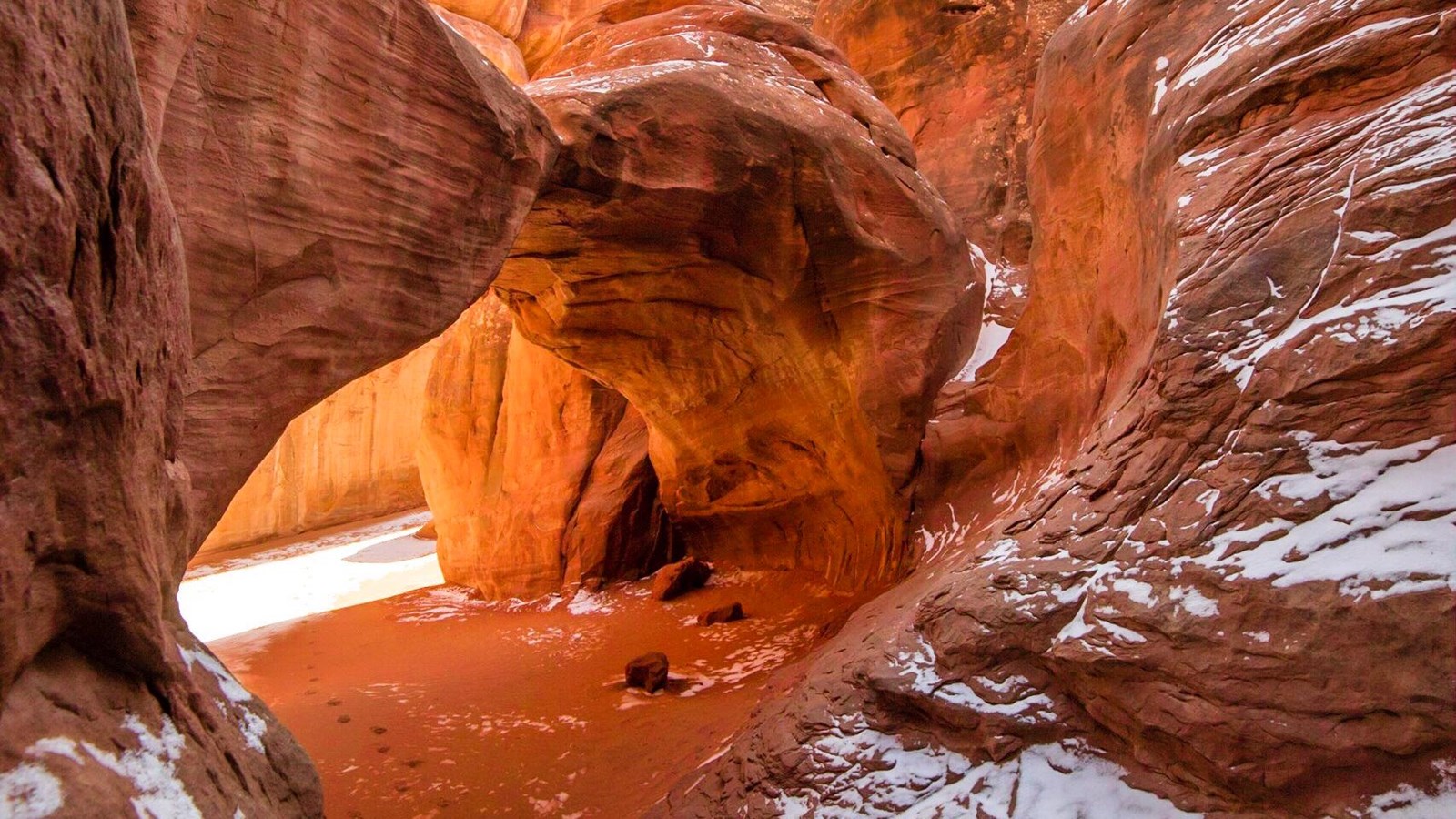
Arches is generally open year-round, but winter ice, snow and temporary road closures can change access. The photo above shows Sand Dune Arch after snowfall, which is **not its everyday appearance**. If conditions are icy, traction aids and careful footing matter more than the trail’s official Easy rating. Check current hours and conditions before the drive.
Safety and Leave No Trace at Sand Dune Arch
- Do not climb the arch. NPS says not to climb or jump from Sand Dune Arch; climbing, standing on or rappelling from natural arches is prohibited in the park.
- Protect biological soil crusts. Stay on marked trails, bare rock or the established sandy route. Do not walk over dark, knobby soil alongside the trail.
- Watch the weather. Flash floods can develop quickly after remote storms; lightning is dangerous around exposed rock and high places. If thunderstorms threaten, return to your vehicle rather than standing beneath an overhang.
- Carry water even for short trails. NPS recommends planning for arid conditions throughout a park visit, not assuming a 15-minute walk needs no supplies.
- Keep emergency access clear. Park only in marked spaces and do not block the road while waiting for a full lot.
- Take photographs, not rock souvenirs. Do not carve, mark or scratch the sandstone, move stones or build unauthorized cairns.
For current hazard instructions, consult NPS safety guidance. Regional flash floods and temperatures can change faster than static guide articles can be updated.
How does Sand Dune Arch compare with other Southwest canyon experiences?
If you are choosing between Utah and Arizona stops, it helps to understand the access difference. Sand Dune Arch is a self-guided trail inside a national park, with a short approach and park entrance fee. By contrast, many visits inside Antelope Canyon near Page, Arizona involve a separately booked guided experience on Navajo land; the two destinations do not share entrance rules, route lengths or operators.
For travelers also considering West Texas, the Santa Elena Canyon Trail guide explains why temporary road access and flood conditions matter at another desert destination. Those challenges are not identical to Sand Dune Arch, but checking official site-specific alerts is important for both.
Common planning mistakes
- Calling the hike 0.3 mile without checking the version. The current NPS record is 0.4 mile round trip for the short Sand Dune Arch approach; app distances may use different start points or rounding.
- Assuming Easy means wheelchair accessible. The actual trail has sand, a narrow pinch point and a rock obstruction.
- Confusing a park pass with timed entry. Arches does not require 2026 timed-entry reservations, but park admission is still required.
- Taking a photo from Broken Arch and labeling it Sand Dune Arch. The two attractions share access but are distinct arches with different settings.
- Arriving when the lot is full and waiting on the roadway. NPS advises moving on instead of obstructing travel lanes or vegetation.
- Letting children climb the arch. That can be unsafe and violates the park’s rules.
FAQ: Sand Dune Arch Trail
How long is the Sand Dune Arch hike?
NPS currently lists 0.4 mile (0.6 km) round trip, generally taking 15–30 minutes. Allocate longer if you want photographs or if your group walks slowly in sand.
Is Sand Dune Arch the same as Broken Arch?
No. They are separate natural arches accessed from the same general trailhead. You can hike only to Sand Dune Arch or plan an additional walk to Broken Arch.
Can you see Sand Dune Arch without hiking?
No roadside viewpoint is presented by NPS as an equivalent to walking into the Sand Dune Arch area. The natural opening sits among rock fins and is reached by a short trail through sand. For a very limited-mobility trip, ask at the visitor center about accessible alternatives.
Is Sand Dune Arch open all year?
Arches is normally open year-round, and the short trail is usually available, but snow, ice, closures or road access can affect your visit. Check official NPS alerts close to the day you go.
Are dogs allowed at Sand Dune Arch?
No pets are permitted on Sand Dune Arch Trail. Service animals are covered by different rules; read the current park policy.
Do I need an Arches timed-entry reservation in 2026?
No. Advance timed-entry is not required for Arches in 2026, according to NPS. You still need an entrance pass and must follow any temporary traffic instructions.
Can I climb on top of Sand Dune Arch?
No. NPS explicitly says not to climb or jump from the arch, and natural-arch climbing is prohibited throughout the park.
Is there shade at the arch?
The sandstone fins may offer shade depending on the sun angle and season, but there is no guaranteed shaded route or protection from storms. Wear sun protection, and do not use an overhang as shelter in lightning.
Is the short trail suitable for a stroller?
It is not recommended as a reliable stroller-friendly route. Deep sand and a rock passage with a narrow spot make wheeled travel difficult. Consider carrying small children if you can do so safely, or choose an accessible viewpoint instead.
Official information to check before leaving
- NPS: Sand Dune Arch Trail — route length, difficulty, pet restrictions and Broken Arch Loop.
- NPS: Physical / Mobility Accessibility — sand, grades, narrow passage and all-terrain wheelchair restrictions.
- NPS: Plan Your Visit — the official 2026 no-timed-entry rule.
- NPS: Traffic & Travel Tips — parking behavior and peak traffic guidance.
- NPS: Safety — dehydration, lightning, heat, flash floods and winter hazards.
Editorial fact-check date: October 13, 2026. This is a research-based guide using park publications, not a claim that AVARIXO staff personally hiked the route. Current closures, access and fees can change; NPS remains the authoritative source on the day of your visit.

Other Articles