
Quick answer — reviewed October 13, 2026: Yes, dinosaurs pooped. Just like every other animal that eats and digests food, non-avian dinosaurs produced waste. Some of that waste was buried and mineralized instead of decomposing, becoming coprolites—fossilized feces. Genuine dinosaur coprolites are unusually useful: scientists can examine bone chips, plant fragments, chemical signatures, and geological context to learn what prehistoric animals ate. But not every odd-shaped rock is fossil poop, and not every coprolite came from a dinosaur.
If you have ever wondered what a T. rex dropping looked like, how big dinosaur poop could get, or why paleontologists take it seriously, this guide separates the findings researchers can actually demonstrate from entertaining guesses. It uses documented National Park Service and museum evidence and explains the uncertainties that clickbait articles often skip.

What is dinosaur poop called?
The scientific term is coprolite (pronounced roughly KOP-ruh-lite), from roots meaning dung and stone. It refers to preserved feces, usually mineralized over geological time. Dinosaur poop is a special subset of coprolites; scientists also identify fossil droppings from fish, crocodile relatives, mammals, and many other organisms. The National Park Service groups coprolites among trace fossils because they preserve evidence of what an animal did rather than bones or other portions of its body.
That distinction matters in a museum display. A dinosaur leg bone demonstrates that a specific skeletal element was preserved. A coprolite can preserve evidence of a meal, a digestive system, or other organisms interacting with feces, but it often cannot identify the producer to an exact species.
| Word | What it means | Important limitation |
|---|---|---|
| Feces / dung | Animal waste after digestion | Normally decays rapidly |
| Coprolite | Fossilized feces | Could have come from many different animals |
| Dinosaur coprolite | Droppings attributed to a dinosaur | Attribution can range from well supported to uncertain |
| Trace fossil | Evidence of an organism’s activity | Does not automatically identify the producer |
| Pseudocoprolite | Non-fecal rock that resembles fossil droppings | Shape alone can be misleading |
| Cololite | Fossilized intestinal contents preserved in place | Not the same as feces deposited outside the body |
For an authoritative overview of trace fossils, see the National Park Service fossil glossary and examples.
What does real dinosaur poop look like?
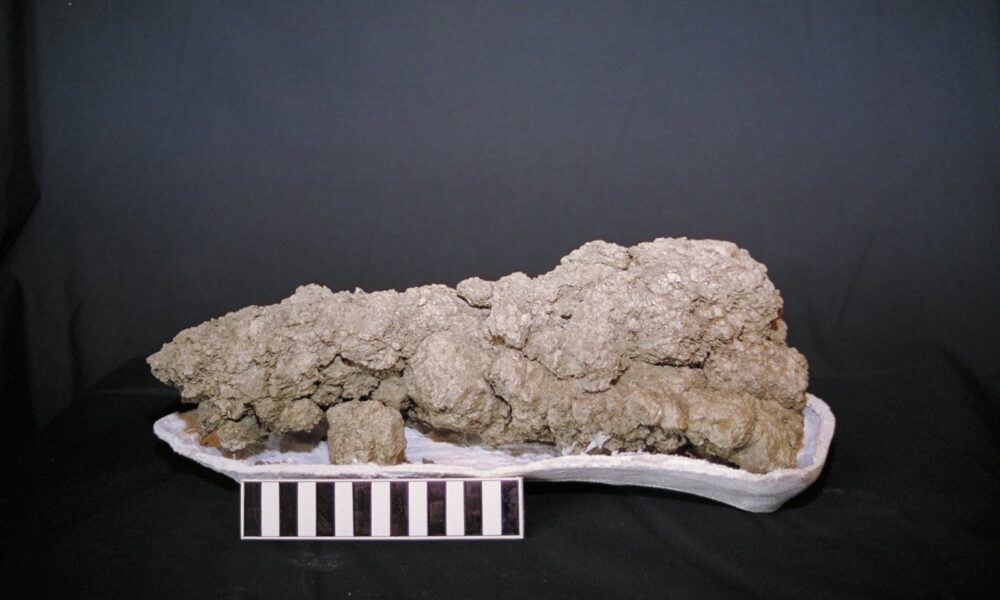
Real fossilized feces may look like an ordinary rock, an irregular sausage-shaped mass, a broken nodule, or a darker piece of stone with embedded fragments. Its original color and smell do not survive as normal fresh waste would. What you see is a fossil: a material changed by burial, chemistry and time.
The photograph above is a genuine fossilized dropping attributed to a carnivorous dinosaur from southwestern Saskatchewan, Canada. The U.S. Geological Survey photograph includes a scientific scale bar measuring 15 centimeters (about 6 inches). The fossil is real, not an AI reconstruction, not a prop, and not a picture of modern animal waste. The label does not claim the producer was individually identified as T. rex; that would be more specific than the original image documentation allows.
Could you identify fossil poop just by looking at it?
Usually not with confidence. Some mineral concretions weather into shapes that resemble dung. Scientists look for more than outlines: preserved food remains, microscopic features, chemical composition, sedimentary layer and age, and the other organisms known from the same rock formation. A photo of a vaguely brown lump is not sufficient proof that it was produced by a dinosaur.
Are all coprolites brown?
No. A coprolite’s appearance depends on the minerals involved, staining, burial conditions, weathering and the rock surrounding it. A polished or cut specimen might have a very different appearance from an unprepared field sample. Color is not a reliable way to identify the original animal or diet.
How did dinosaur poop become stone?
Most dung is destroyed quickly by microbes, rain, scavengers and other organisms. For a coprolite to survive, exceptional circumstances help: the material is deposited, buried relatively quickly, and chemically stabilized before it loses its shape and contents. Over time, minerals can preserve details of the mass, often with phosphate-rich material in vertebrate examples.
Step 1: Waste is deposited in an ancient environment
The dinosaur lived, ate and deposited feces into a landscape such as a floodplain, river margin, coastal area or another depositional setting. That fecal material could contain plant fragments, bone pieces or other undigested meal remnants. Just as in ecosystems today, many other animals and microorganisms may have interacted with it.
Step 2: Sediment buries the material
Sand, mud or another sediment can cover the dung, reducing exposure to weather and scavengers. Burial alone is not a guarantee of fossilization; chemistry, oxygen, microbial activity and the physical durability of the material also matter.
Step 3: Minerals preserve internal structure
Under favorable conditions, mineral-rich fluids and chemical reactions stabilize or replace original organic material. Tiny bones or plant fragments may persist inside, giving paleontologists evidence from an ancient meal. A fossil can preserve a distinctive shape even when little recognizable original fecal matter survives.
Step 4: Geological forces expose the fossil
Millions of years later, erosion can uncover the rock layer. Paleontologists carefully document the formation, location, orientation and associated fossils before extracting specimens. That context may be more valuable than a coprolite’s appearance in isolation.
For a field-based explanation of this kind of evidence, the National Park Service trace-fossil guide from Denali describes fossilized dinosaur dung alongside footprints, burrows and skin impressions.
What did meat-eating dinosaurs leave in their poop?
For large predatory dinosaurs, the best evidence comes from fossil droppings containing recognizable bone fragments. A famous Late Cretaceous Canadian tyrannosaur coprolite examined in scientific research contained a significant mass of fragmented bone. That supports the idea that the animal consumed and processed bone, not only flesh.
Such evidence can be more direct about a meal than teeth alone. Sharp, strong teeth show what an animal was equipped to bite, whereas bone fragments preserved inside dung show that at least some hard material passed through its digestive tract. But a coprolite cannot automatically tell us whether its producer hunted an animal alive or scavenged an existing carcass.
Was the poop in the picture definitely from T. rex?
No exact species is identified in the USGS image’s documentation. It is described as coming from a carnivorous dinosaur found in southwestern Saskatchewan. Even famous tyrannosaur coprolites are often described as attributed to or likely from a large tyrannosaur. Species identification requires more context than the image alone provides.
Could a fossilized dropping contain teeth?
Some coprolites preserve teeth, scales, bone splinters or shell fragments from consumed organisms. A preserved tooth inside a coprolite may identify a prey animal, rather than the predator that made the waste. Scientists use multiple lines of evidence before assigning a fossil to a particular producer.
What did plant-eating dinosaurs leave behind?
Herbivorous dinosaurs produced dung as well. Preserved plant tissues, wood fragments and other traces can reveal what was eaten in particular ancient settings. Some late Cretaceous samples attributed to large plant-eating dinosaurs contain decayed wood and associated crustacean shell material. These findings remind us that diets were not always perfectly simple categories of “plants only” and “meat only.”
However, identifying a plant fragment inside a coprolite does not prove every dinosaur of the same species ate exactly the same foods. One specimen records a limited meal or time period. Seasonal changes, local habitats and individual behavior can affect what an animal consumes.
Could dinosaur poop help scientists understand ancient grasses?
Yes. Microscopic silica bodies known as phytoliths can be preserved in some coprolites. Their shapes may help researchers infer what kinds of plants were present or consumed. Fossil evidence from Cretaceous settings has contributed to discussions of grass evolution, though phytolith identification and which dinosaur produced the sample must be established carefully. A phytolith in waste is a clue about feeding, not a complete census of an entire ancient forest.
How big was dinosaur poop?
There is no reliable universal “average dinosaur poop size.” Dinosaurs ranged from small bird-sized creatures to enormous sauropods; their droppings would have varied with body size, diet and digestive anatomy. In addition, preservation preferentially saves some feces and destroys much of the rest. The fossils we find are not a random sample of all ancient poop.
Public displays sometimes claim individual specimens broke a “world record,” but identification of the producer and even whether a rock is a true coprolite can be debated. Be especially skeptical when an auction item or very large rounded concretion is presented as dinosaur dung without geological or laboratory evidence.
| Question | What scientists can say | What a fossil alone often cannot prove |
|---|---|---|
| Who made it? | Likely group based on age, fauna, shape and contents | Exact dinosaur species or individual |
| What did it eat? | Some swallowed material, such as bones or plants | Every food eaten during its lifetime |
| How big was the animal? | Sometimes a broad inference from ecological setting | A precise body weight from the poop’s dimensions |
| Did it hunt prey? | Some prey remains passed through the gut | Whether the animal hunted or scavenged |
| How old is it? | Estimated from dated geological formations | An exact calendar date of defecation |
Did dinosaurs poop like birds or crocodiles?
Birds are the living descendants of theropod dinosaurs, and crocodilians are their closest living non-avian relatives. That makes modern animals useful for understanding extinct dinosaur biology. Birds and crocodilians have a cloaca, a common opening associated with digestive, urinary and reproductive systems. Anatomical comparisons support a cloaca in non-avian dinosaurs too, but details of stool consistency or everyday elimination habits are generally not preserved in bones.
Do not assume a large Jurassic herbivore’s droppings looked exactly like a chicken’s, or that all dinosaurs eliminated waste with the same frequency. Fossil evidence is simply not detailed enough for those generalizations. Bird droppings illustrate one living dinosaur lineage, not an exact template for all extinct groups.
Did dinosaurs pee?
They eliminated metabolic waste and had physiological systems for managing water and nitrogen. Whether a particular extinct species discharged liquid urine independently of feces, how much, and how its excretory anatomy worked in detail are questions that cannot usually be settled from a fossilized dropping. Reconstructions based on living birds and crocodilians are informative but not direct recordings of every extinct dinosaur.
How do scientists tell dinosaur coprolites from fake fossil poop?
Professionals test a combination of observations, not a single visual trick. Common approaches include examining the specimen’s geological setting, identifying internal inclusions, microscopic study of a cut surface when suitable, and chemical analysis. X-ray and CT imaging can reveal structures inside specimens while limiting physical damage.
- Geology: Determine whether the sample was found in a rock layer and environment where a dinosaur or another candidate animal could have lived.
- Composition: Some vertebrate coprolites are phosphate-rich, though phosphate alone is not proof of fecal origin.
- Internal inclusions: Crushed bones, scales, plant remains or other recognizable food fragments may support a digestive origin.
- Structure: Surface folds or internal layering can help distinguish certain types, but many different producers leave similar shapes.
- Associated fossils: Tracks, skeletons, eggs, habitat and geological age help narrow possible producers.
- Alternative explanations: Mineral concretions and irregular rock nodules must be ruled out before announcing a significant coprolite discovery.
Even after careful work, specialists may write “probable dinosaur coprolite” rather than naming an exact species. That is responsible scientific uncertainty, not a weakness of the research.
Where have scientists found real dinosaur poop?
Dinosaur coprolites have been described from multiple fossil-bearing regions worldwide. Well-known research includes Late Cretaceous settings in Canada and the United States, where dinosaur bones and trace fossils preserve parts of ancient ecosystems. The NPS also documents fossilized dinosaur dung among the trace fossils displayed and studied in Denali National Park, Alaska.
It is important not to make the opposite mistake and call every coprolite from these areas “dinosaur poop.” Fossil fish, croc-line reptiles and other animals also left feces. The fossil’s age and the local ecosystem are crucial to interpretation.
Can you collect dinosaur poop from a U.S. national park?
Do not remove fossils from national parks. Federal park rules protect archaeological, geological and paleontological resources. Even a small fossil is part of its site’s scientific record and may contain important context. Photograph, note the location without disturbing the specimen, and inform a ranger or qualified park staff member instead. See NPS paleontology resources for more on protecting park fossils.
What coprolites can reveal that skeletons cannot
A skeleton describes body structure: bone shape, joint relationships and adaptations. Coprolites can document behavior, particularly feeding and digestion. They can also preserve evidence of organisms that lived on or in fecal material, including possible insect or parasite remains, or record how ancient nutrient recycling worked.
But the record is biased. Hard bones and microscopic mineral structures may survive better than soft tissues, and samples that were buried rapidly are more likely to persist. A fossilized meal should never be treated as a complete menu for a species.
Frequently asked questions about dinosaur poop
Is dinosaur poop real?
Yes. Many authentic fossil droppings, called coprolites, have been documented scientifically. The USGS fossil photo used here shows a genuine specimen attributed to a carnivorous dinosaur.
Can you smell fossil dinosaur poop?
Not in the way you could smell modern feces. After millions of years of burial and mineralization, a coprolite is effectively a fossilized mass. Any smell from present-day minerals, soil or museum preparation is not proof of its original odor.
Why does dinosaur poop sometimes look like a rock?
Because the original material became preserved or mineralized during fossilization. Most ordinary waste disappears, so what remains may look like a stone with inclusions or unusual textures.
Could a dinosaur coprolite contain bones?
Yes. Some carnivorous-dinosaur coprolites preserve small bone fragments from consumed prey, which can reveal something about ancient diets and digestion.
Did T. rex leave fossil poop?
Large coprolites have been attributed to tyrannosaurs, including specimens thought likely to have been produced by T. rex or relatives. Because the exact individual animal is not preserved with the dropping, attribution may remain probabilistic.
Did herbivorous dinosaurs poop?
Yes. Plant-eating dinosaurs needed to eliminate digested waste too. Some coprolites preserve plant or wood fragments, helping paleontologists understand ancient vegetation and feeding behavior.
How old is fossilized dinosaur poop?
Age depends on the specific rock formation. Dinosaur coprolites associated with non-avian dinosaurs come from Mesozoic rocks, spanning broad periods before the end-Cretaceous extinction about 66 million years ago. A laboratory uses geological context and dating methods rather than judging a fossil’s age from its appearance.
Are fossil coprolites valuable?
They can be scientifically valuable, especially with well-recorded excavation context. Commercial value varies widely and does not establish authenticity. Fossils collected illegally from protected land should not be bought or removed.
Did dinosaurs poop out one huge log?
There is no evidence that all dinosaurs produced dung in one characteristic shape. The size and form likely varied considerably, and many fossil samples are broken, compressed or incomplete.
Official sources and further reading
- National Park Service — Trace Fossils: definition, fossil dung and what trace fossils can tell scientists.
- Denali National Park — Trace Fossils: documented dinosaur dung among local traces; feeding and preservation examples.
- Smithsonian National Museum of Natural History — Coprolite specimen: museum fossil record and contextual information about fecal fragments.
- USGS public-domain photograph of a carnivorous dinosaur coprolite: primary provenance of the exact illustrated fossil, documented as found in Saskatchewan.
- NPS Fossils and Paleontology: resource protection and scientific context.
If you enjoy research explainers grounded in primary sources, browse the AVARIXO News & Explainers archive for related factual guides.
Editorial review: October 13, 2026. This is a science explainer based on geological and museum sources; we did not excavate the specimen, conduct microscopy, or independently test any fossil. Where the identity of a dinosaur producer is uncertain, the text explains that uncertainty explicitly.