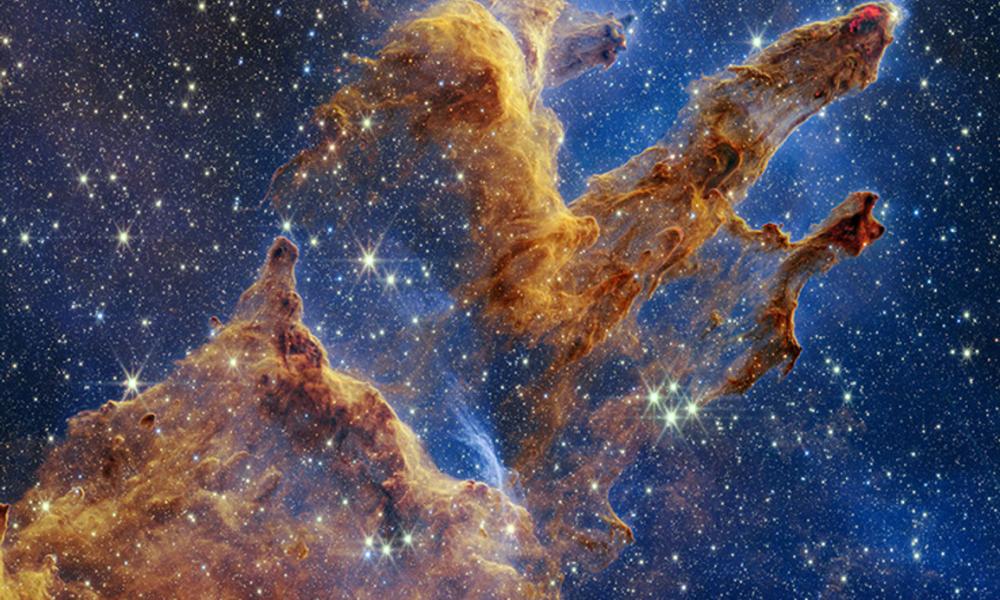

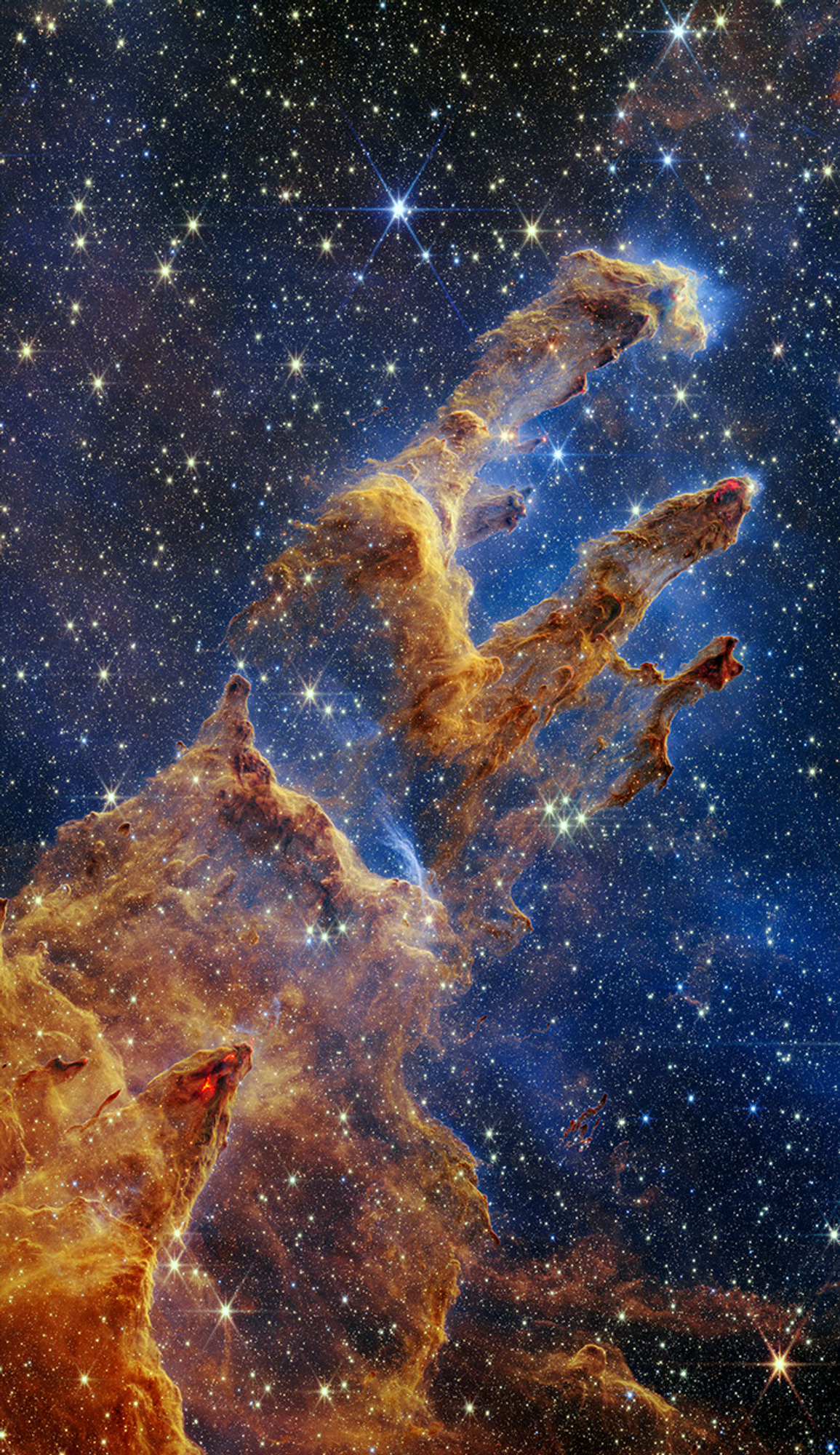
The Pillars of Creation are giant columns of cold gas and dust inside the Eagle Nebula (Messier 16), about 6,500 light-years from Earth in the constellation Serpens. They are not stone formations or a digital illustration. Their familiar dark, finger-shaped outlines emerge where denser clouds survive in an energetic star-forming region. NASA’s Hubble telescope made the scene famous in 1995, returned in 2014, and the James Webb Space Telescope photographed it again in infrared light in 2022.
This guide uses two real Webb telescope observations uploaded to AVARIXO—not generic space artwork: the NIRCam near-infrared view and the MIRI mid-infrared view. They show the same dust columns in strikingly different ways because their detectors observe different wavelengths. Here is what the pillars are, how far away they lie, why red dots appear near the tips, what their colors mean, and why the clouds will not look exactly like the pictures to the naked eye.
Pillars of Creation at a glance
| Question | Verified fact |
|---|---|
| Location | Eagle Nebula (M16), constellation Serpens |
| Distance | Approximately 6,500 light-years from Earth |
| Type | Dense molecular gas and interstellar dust in a stellar nursery |
| Scale | Some pillars are several light-years tall; NASA describes prominent columns as roughly five light-years high |
| Original famous photograph | Hubble Space Telescope, 1995 |
| Sharpened Hubble follow-up | 2014 observations, released 2015 |
| Webb NIRCam observation | August 14, 2022; released October 19, 2022 |
| Webb MIRI view | Released October 28, 2022 |
Where are the Pillars of Creation?
The columns are part of the much larger Eagle Nebula, an active star-forming complex in the Milky Way. It is cataloged as Messier 16, or M16. NASA’s NIRCam image documentation lists their distance as 6,500 light-years and their constellation as Serpens. A light-year is a unit of length, not time: these observations show the region as its light left thousands of years ago.
The pillars are only one particularly photogenic section of M16. The Eagle Nebula also contains bright stars, ionized gas and extensive dark clouds. Seeing the pillars in a close-up photo does not mean the whole nebula is only a few columns wide; the wider cloud complex is far larger than the framed picture.
Why do the gas clouds look like fingers or columns?
Hot young massive stars flood the surrounding region with energetic ultraviolet radiation. Radiation and stellar winds erode lower-density gas and dust faster than especially dense pockets. The surviving material can form elongated ridges and protruding tips. This process of photoevaporation and erosion shapes the striking skyline, while gravity within dense knots can eventually lead to the formation of new stars.
NASA’s explanation of the 2022 Webb view notes that young stars often appear as bright red orbs and that wavy red edges can trace outflows from newly forming stars. Those boundaries can resemble lava in color photographs, but there is no molten rock flowing along the pillars. The color and shape reveal interactions among dust, gas and energetic young objects.
Webb NIRCam versus MIRI: why two different pictures?
The NIRCam image records near-infrared wavelengths, which pass through some dusty structures more effectively than visible light. It reveals numerous young stellar sources, especially toward pillar tips, while showing translucent-looking brown and rust-colored gas. The second genuine telescope image below comes from MIRI, Webb’s mid-infrared instrument, and appears much moodier: dust dominates the scene, with opaque gray-blue clouds and comparatively few bright stars.
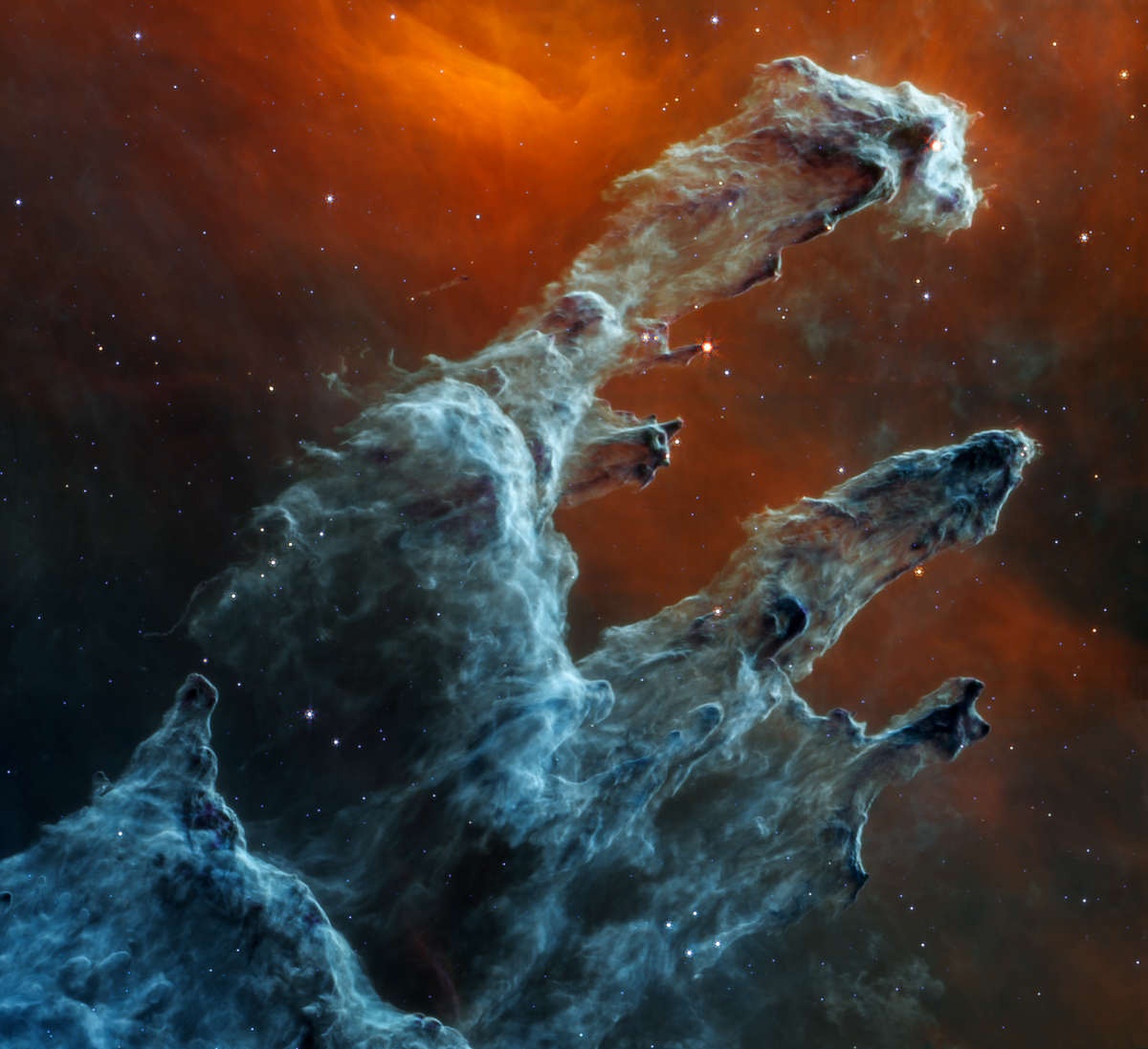
In NASA’s MIRI image record, three filters are mapped to visible blue, green and red colors. The NIRCam composite uses six filters. They are both real data products, not two invented artistic interpretations. Webb cannot capture infrared in colors that human eyes directly perceive, so scientists assign visible colors to preserve meaningful differences among measurements.
How do Webb’s photos compare with the famous Hubble image?
Hubble’s 1995 visible-light portrait first gave the Pillars of Creation international fame. In 2014 the telescope returned with sharper views through Wide Field Camera 3, released publicly in January 2015. Those photographs show darker dust standing against colorful glowing gas. Webb’s 2022 infrared observations complement Hubble rather than simply replacing it.
In visible light, dense dust blocks many background stars. Near-infrared can reveal additional embedded stars and more delicate structure, while mid-infrared can emphasize the dust itself. NASA provides an official Hubble–Webb comparison. Looking at both is useful because star formation happens within material that one wavelength alone cannot describe completely.
Are stars being born inside the pillars?
Yes, the surrounding star-forming region contains young stellar objects. Dense knots can collapse under gravity, warm up and eventually become protostars. NASA notes that some objects traced by Webb are only a few hundred thousand years old. That age refers to young stars, not the age of every grain of dust in the nebula.
Researchers investigate stars at different stages of formation by analyzing color, brightness, gas chemistry and the shape of outflows. A bright point in an image is not automatically a newly born star—it could be an unrelated foreground or background object—so scientists use multiple wavelengths and observations to classify each candidate.
How tall are the Pillars of Creation?
They extend over several light-years. NASA’s Hubble description cites roughly five light-years for prominent pillars, while the 2022 Webb NIRCam image covers a field roughly eight light-years across. The latter is a property of the framed image, not the precise height of one individual column. Avoid confusing a picture’s field of view with the actual physical height of each dust feature.
For scale, one light-year is roughly 5.9 trillion miles (9.46 trillion kilometers). A five-light-year cloud column is therefore enormous, even though its very low gas density makes it unlike any dense solid structure on Earth.
Are the Pillars of Creation already destroyed?
Some popular claims say the pillars were destroyed by a supernova long ago and that Earth has not yet seen it. That is not established as a confirmed event. Gas and dust can be gradually eroded by radiation from nearby stars, and researchers study whether shocks have influenced the region, but there is no reliable observational basis for declaring the entire structure definitely gone now.
Because the light takes roughly 6,500 years to reach Earth, any sudden recent event there would not yet appear here. This is a normal consequence of astronomical distances, not evidence for a specific unobserved explosion.
Can you see the Pillars of Creation with a backyard telescope?
Amateur telescopes can reveal the surrounding Eagle Nebula under favorable conditions. The detailed finger shapes, however, are far harder to see visually than in long-exposure professional telescope images. Dark skies, a suitable aperture and nebula filters improve visibility, but the high-contrast Webb colors are assigned from infrared measurements and cannot be seen directly through an ordinary eyepiece.
If you enjoy comparing different kinds of stellar nurseries, our Rosette Nebula guide explores another cloud region, while our Horsehead Nebula guide explains how dust can form an especially dramatic silhouette.
Frequently asked questions
What are the Pillars of Creation made of?
Gas—especially molecular hydrogen—and dust, with local changes caused by radiation and the birth of new stars.
Is the Pillars of Creation picture a real photo?
Yes. Hubble and Webb recorded genuine astronomical light. The colors in infrared composites are assigned to instrument filters so people can visualize wavelengths our eyes cannot see.
Where are the Pillars of Creation located?
Inside the Eagle Nebula, also known as Messier 16, in the constellation Serpens about 6,500 light-years away.
What is the difference between Hubble and Webb images?
Hubble’s best-known views use visible light and near-infrared, while Webb’s NIRCam and MIRI explore other infrared ranges that reveal stellar sources and dust in different ways.
Why do Webb images contain red glowing points?
Some correspond to young forming stars or star-associated outflows, displayed through assigned infrared colors, not tiny red lights in space.
Are the pillars solid objects?
No. They are clouds of interstellar matter with extremely low densities compared with rock or buildings on Earth.
Do they still exist today?
There is no confirmed observation that the whole feature has been destroyed. We see light that left the region thousands of years ago.
Official image records and scientific sources
The two images are separate genuine 2022 JWST observations from NIRCam (released October 19) and MIRI (released October 28). Credits: NASA, ESA, CSA, STScI; image processing by Joseph DePasquale, Anton Koekemoer and Alyssa Pagan as specified in each official source. Both were uploaded to AVARIXO Media Library with ALT text and credit metadata; no external hotlinks or publisher watermarks were added. Additional primary context comes from NASA’s Hubble–Webb comparison and Hubble image science record. No NASA endorsement is implied.

Other Articles