The Orion Nebula, also known as M42 or NGC 1976, is a huge cloud of glowing gas and dust where thousands of young stars are forming. Located roughly 1,300 light-years from Earth, it appears in the constellation Orion below the three bright stars of Orion’s Belt, in the region called Orion’s Sword. The central Trapezium cluster contains hot, massive young stars whose ultraviolet radiation illuminates and shapes the cloud. Under reasonably dark skies, observers can see a fuzzy patch with unaided eyes; binoculars or a small telescope reveal more structure.
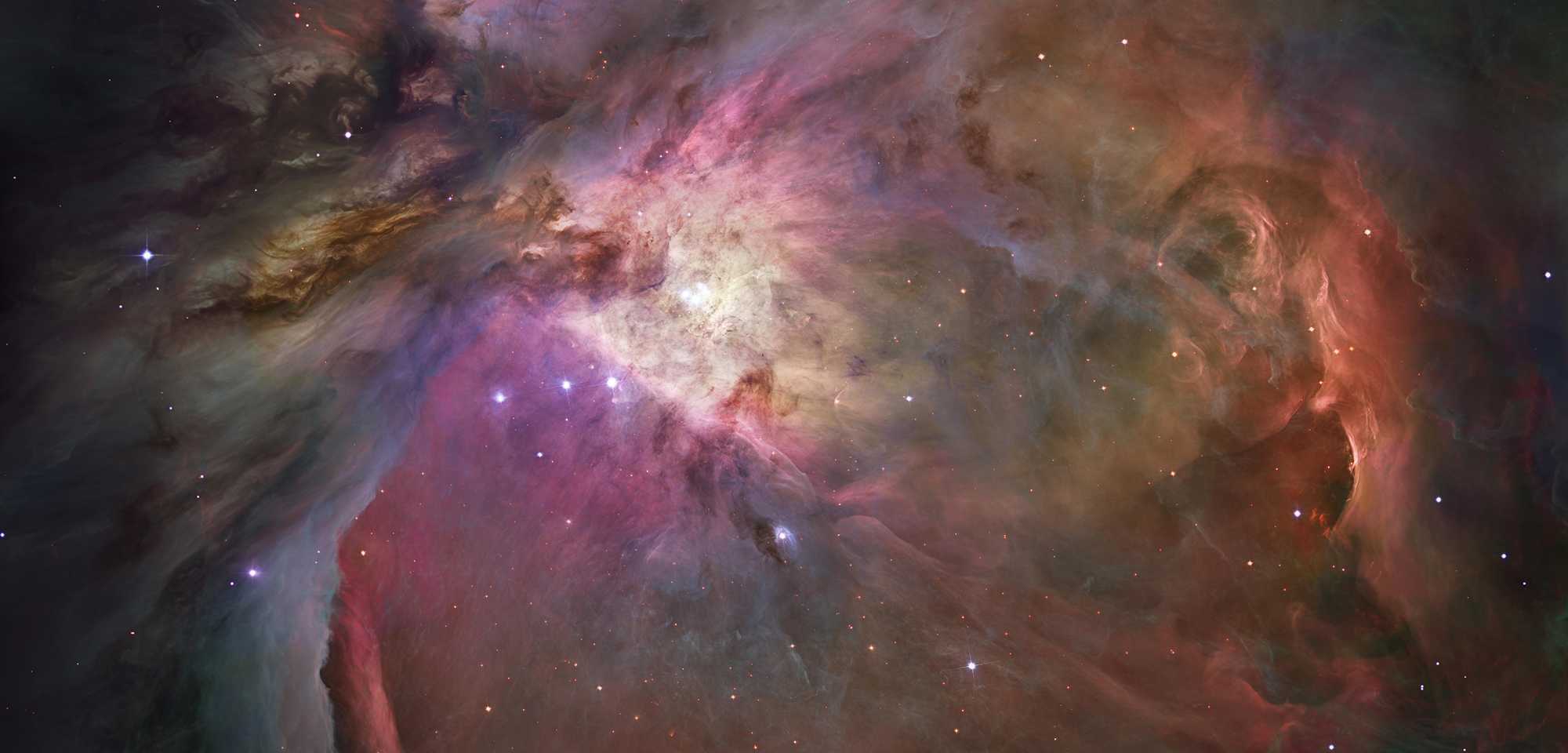
The images in this article are real NASA Hubble Space Telescope observations, not generic fantasy images: a wide 2006 Treasury mosaic made from more than 500 exposures and an earlier close-up of star-surrounding disks called proplyds. We’ll explain why some published distances say 1,300 while older references say 1,500 light-years, what makes the cloud shine, what can actually be seen from a backyard, and how newborn stars reshape the surrounding material.
Orion Nebula M42: essential facts
| Fact | Details |
|---|---|
| Catalog designations | Messier 42, M42, NGC 1976 |
| Constellation | Orion |
| Distance used by NASA’s 2006 Hubble description | Approximately 1,300 light-years |
| Object type | Emission nebula / active star-forming region |
| Location in the sky | Orion’s Sword, below Orion’s Belt in typical Northern Hemisphere evening views |
| Major central cluster | The Trapezium stars |
| 2006 Hubble photo technique | 520 exposures through five Hubble filter bands, plus ground-based images |
| Especially interesting feature | Young stars with protoplanetary disks, called proplyds |
NASA’s Hubble Orion Nebula description provides these values and explains the individual features of the 2006 Treasury mosaic. Distances quoted in older NASA image captions may be closer to 1,500 light-years, reflecting historical estimates and rounding rather than the cloud’s sudden movement.
Where is the Orion Nebula in the sky?
Look first for Orion’s Belt, the well-known diagonal line of three bright stars. Beneath the Belt is the shorter line of stars and fuzzy light known as Orion’s Sword. M42 sits in this sword region. Its orientation changes with time of night and observer position, so use a sky map rather than a fixed “look left” or “look right” instruction.
For observers at northern middle latitudes, winter evenings are often the easiest season to find Orion high enough for comfortable viewing. The cloud can appear as a soft misty glow without optics when the sky is dark enough. With binoculars, that glow takes on a more distinctive diffuse shape, while a telescope can reveal the central bright area and star cluster.
Why does the nebula glow?
The Orion Nebula is an H II region, meaning its gas includes hydrogen ionized by energetic ultraviolet light. Massive hot stars near its center supply radiation that excites gas and pushes into the surrounding clouds. When electrons recombine with ions or atoms emit at characteristic wavelengths, the gas produces visible light, including the red hydrogen glow common in astrophotography.
The brightest region includes stars of the Trapezium cluster, whose intense radiation is carving out a cavity and sculpting nearby gas and dust. Their stellar winds—streams of charged particles—also create arcs and complex structures. These stars illuminate the cloud, but they do not turn the entire nebula into a solid object. The gas density is tiny by everyday terrestrial standards.
What are the Trapezium stars?
The Trapezium consists of four especially bright massive young stars near the center of M42, arranged in a roughly trapezoidal shape when viewed in a small telescope. They are embedded in a larger cluster of young stars. Their ultraviolet output affects whether disks around smaller neighboring stars survive long enough to develop into planetary systems.
Even in an amateur telescope, the Trapezium can be a satisfying target. It looks like several tiny points amid the brightest nebulosity; with better optics and seeing, observers may resolve more than four components in the region. NASA’s image team studied stellar motions and population statistics to understand how this stellar nursery evolves.
How did Hubble make the famous 2006 picture?
A photograph of the Orion Nebula is not just one simple camera exposure. The Treasury team used 520 Hubble images in five color bands, assembling them into a very large panorama. Ground-based images were used to fill gaps in coverage. NASA says the view contains more than 3,000 stars, some previously difficult or impossible to detect in visible light, and covers about the apparent angular area of the full Moon.
The image’s orange, green and reddish colors reflect emissions from hydrogen, oxygen and sulfur, along with infrared-filter observations. It therefore captures real telescope measurements but does not guarantee that an observer looking into an eyepiece would see the same saturated colors. Our featured photograph is a genuine NASA/ESA Hubble data product, locally stored in the AVARIXO media library and labeled with its source and credits.
What are proplyds and why are they important?
Many newborn stars in Orion retain disks of gas and dust left from their formation. These disks are called protoplanetary disks, or proplyds for short. Over time, particles within some disks can collide and grow, potentially creating planets, moons and smaller bodies. At the same time, strong ultraviolet radiation from nearby hot stars can heat the disk surface and remove gas—a process that may affect its future evolution.
The next image shows a distinct, real Hubble close-up taken in December 1993 and released in 1994, long before the more famous full-nebula panorama. It shows several young stars and surrounding small disks, some bright and some silhouetted, within a field only a small fraction of a light-year across. This is a close observation of a specific piece of the Orion Nebula, not a cropped generic substitute.
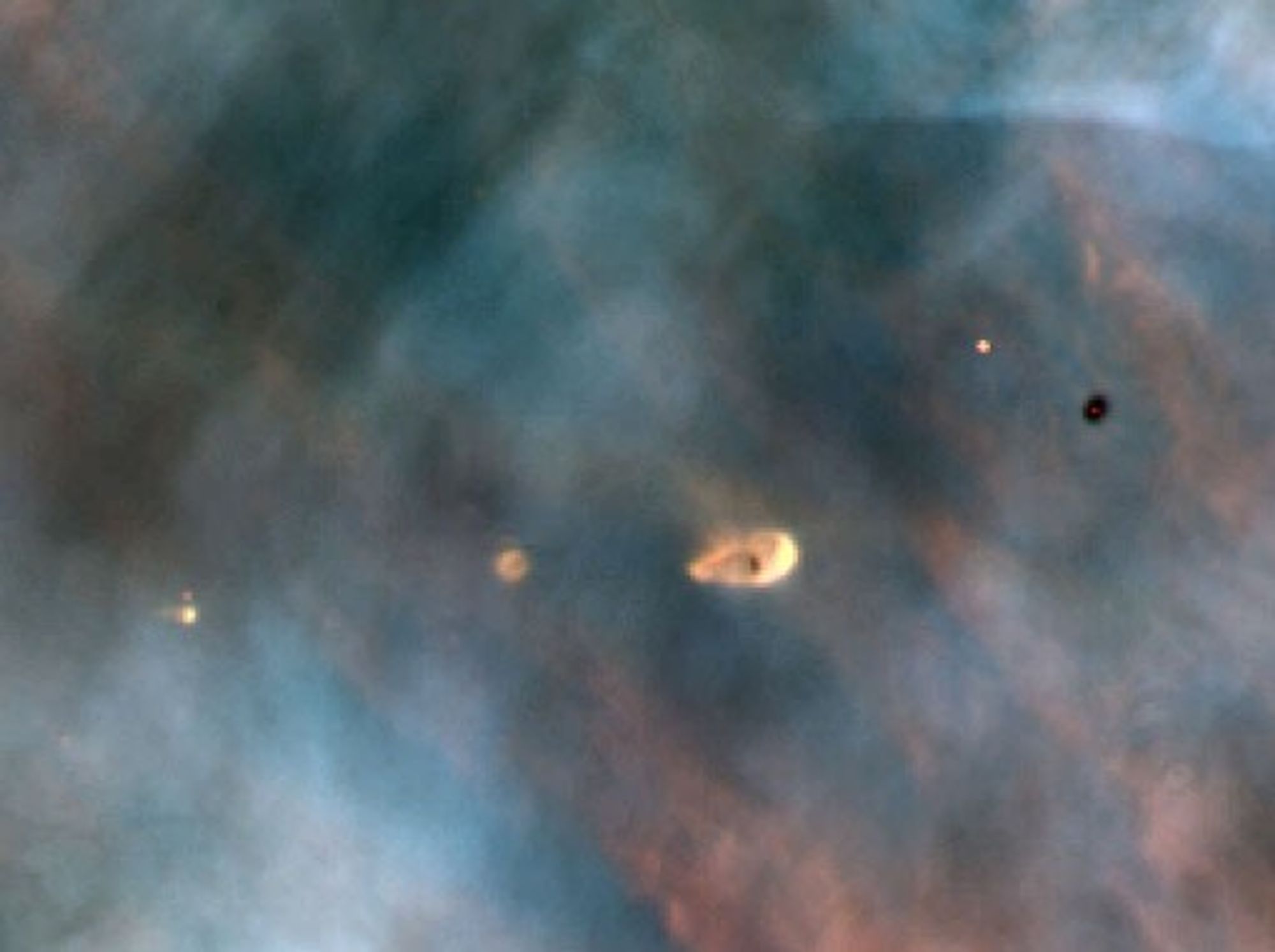
NASA’s 1994 proplyds source page describes five stars and four with visible dusty surroundings. This matters because the Orion Nebula is not merely decorative gas: it is an environment in which researchers can inspect some of the earliest stages of planetary-system formation.
Is the Orion Nebula the same as the Horsehead Nebula?
No. Both occur within Orion’s broader molecular-cloud complex, but they are separate areas. M42 is the famous bright emission region in Orion’s Sword. The Horsehead Nebula (B33) is a much darker silhouetted cloud near the belt star Alnitak, visible against the emission region IC 434. They can appear in wide astronomical panoramas of Orion but should not be labeled interchangeably.
For its real Hubble images and sky position, see our Horsehead Nebula guide. Our Rosette Nebula guide explains a different emission region where young stars also sculpt clouds.
How bright is the Orion Nebula and can I photograph it?
The Orion Nebula is bright for a deep-sky object, which makes it a common beginner astrophotography target. In dark locations, a smartphone attached to a stable telescope may capture some of its bright central region, but a tracking mount and camera allow longer exposures and more detailed outer clouds. The bright core can easily become overexposed before the faint edges become visible.
One practical method is to combine shorter exposures for the brilliant central Trapezium area with longer exposures for the faint outer nebulosity, documenting how the final image was assembled. Atmospheric seeing, light pollution, optics, tracking accuracy and image processing all affect results. Avoid presenting a composite as an unaided-eye view: human visual perception at low light tends to show far less vivid color than many long-exposure photographs.
Orion Nebula frequently asked questions
Can you see M42 without a telescope?
Under reasonably dark skies, yes: it looks like a soft fuzzy patch in Orion’s Sword. Binoculars make it far more obvious.
How far away is the Orion Nebula?
NASA’s 2006 Hubble description uses about 1,300 light-years, while some older references use 1,500; the values are approximations from different estimates.
Why is M42 called a stellar nursery?
Because its dense gas and dust are producing new stars, including the youthful Trapezium cluster and other young stellar objects.
What is the Trapezium?
A bright group of massive young stars near M42’s center that illuminate and reshape the surrounding gas.
Are proplyds actual planets?
No. They are disks of material around newborn stars in which planets may eventually form.
Is Orion Nebula an entire galaxy?
No. It is one star-forming region inside our Milky Way, not a separate external galaxy.
Are Hubble’s colorful images real?
Yes, but they are processed combinations of real filtered light data; their colors need not exactly match an eyepiece view.
Official NASA references and image provenance
The two distinct real images come from the 2006 Hubble Orion Treasury mosaic (NASA, ESA, Robberto and Orion Treasury Project) and 1994 Hubble proplyds photograph (C.R. O’Dell/Rice University and NASA). Both were uploaded to AVARIXO Media Library and retain source and credit details in their attachment metadata. They have not been drawn or generatively modified; no NASA endorsement is implied.