Northern Elephant Seals Explained: Real Photos, Size, Deep Dives and When to See Them

Northern elephant seals (Mirounga angustirostris) are large Pacific Ocean mammals, not sea lions. They spend most of their lives at sea, dive hundreds of meters in search of prey, and return to beaches in California and Mexico to give birth, breed, and molt. Adult males have an enlarged nose called a proboscis; females are much smaller and do not develop the same trunk-like feature.
If you want to see these animals in the wild, the most reliable mainland viewing areas include Año Nuevo, Piedras Blancas, and Point Reyes in California. The best time depends on whether you want to see newborn pups, competing adult males, or molting animals. Always check local access and keep your distance; a resting seal is still a protected wild animal.
Northern elephant seal facts at a glance
| Topic | What to know |
|---|---|
| Scientific name | Mirounga angustirostris |
| Animal family | Phocidae, the true seals; no external ear flaps |
| Range | Northeastern Pacific, from Baja California to the Gulf of Alaska during migrations |
| Adult size | NOAA lists an overall weight range of approximately 1,300–4,400 pounds; adult males are much larger than females |
| Diet | Squid, fish, and other marine prey, including some rays and sharks |
| Typical time at sea | Roughly nine months in a year, according to NOAA Fisheries |
| Typical dive | About 1,000–2,500 feet deep, usually in 20–30-minute intervals |
| Protected under | U.S. Marine Mammal Protection Act |
These figures are species-level summaries; size, dive depth, and behavior vary by age, sex, and individual. The primary species profile is NOAA Fisheries: Northern Elephant Seal.
How can you identify a northern elephant seal?
The male’s enormous nose
The name comes from the male’s expandable nose. When an adult bull gives a loud territorial call, the nose helps amplify the sound. Females have comparatively ordinary-looking seal muzzles, so the shape of the nose alone can mislead beginners looking at a female or younger animal.
True seals, not sea lions
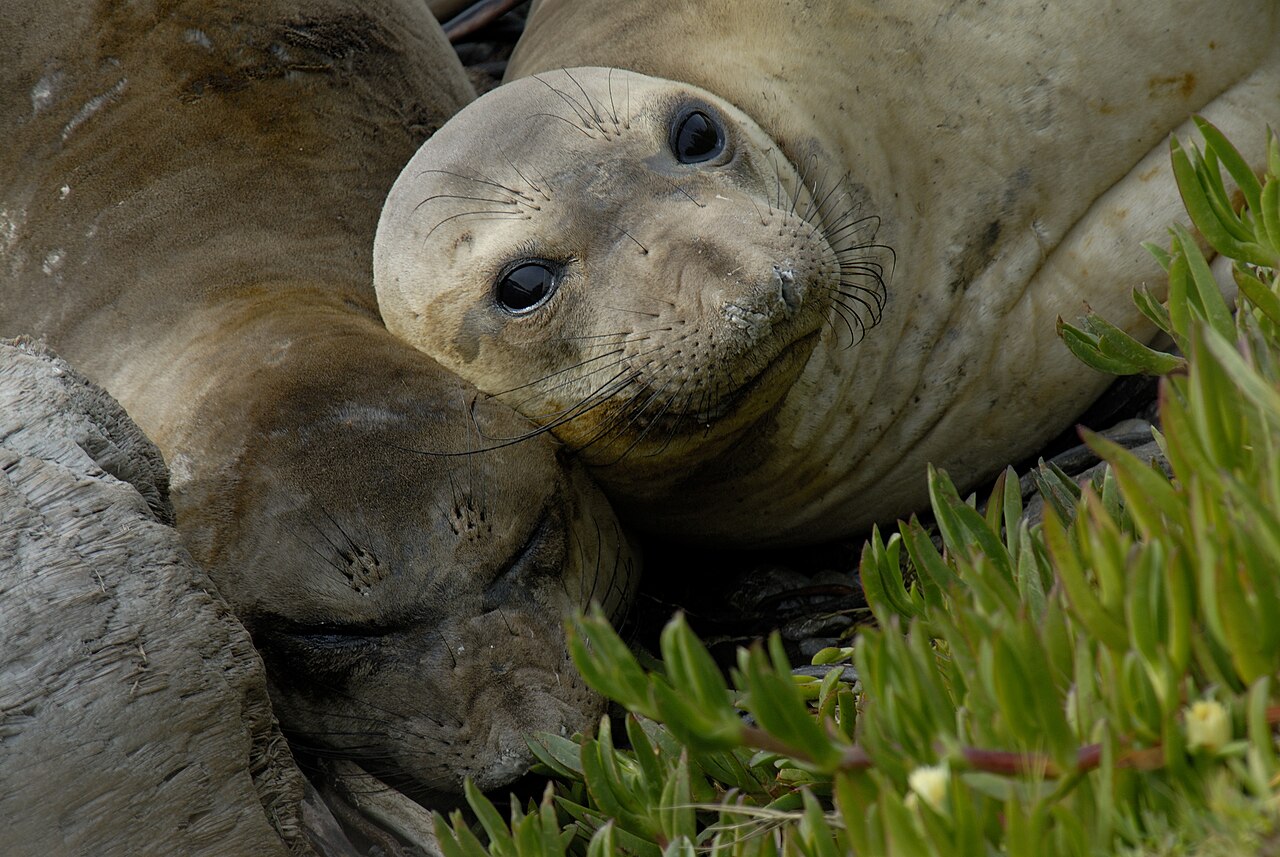
Elephant seals lack the protruding external ears typical of sea lions. They move on land with a heavy, undulating belly-and-flipper motion instead of the upright walking motion you may associate with a sea lion. Both are marine mammals, but they belong to different seal families.
Why males and females look so different
Adult males can exceed 13 feet in length and approach 4,400 pounds in NOAA’s summary. Females are smaller, and young animals may have dark or silvery coats depending on their age and molt. That pronounced difference between the sexes is called sexual dimorphism. In a breeding colony, a massive male bull may dwarf several nearby females.
Where do northern elephant seals live?
The species breeds mainly along the west coast of North America, particularly in California and Baja California. Important breeding colonies occur on offshore islands, but visitors can also view seals from public areas at several mainland locations. Their ocean journeys extend far beyond their breeding beaches.
Tracking research summarized by the National Park Service shows that males often travel north along the continental shelf toward the Aleutian Islands and the Gulf of Alaska, while females spend more time foraging in the open northeastern Pacific. The location of a beach colony is therefore only a small part of an individual seal’s annual range.
When is the best time to see elephant seals in California?
| Season | Common behavior | Visitor tip |
|---|---|---|
| December–March | Breeding, birth, nursing and adult male competition | Use designated viewing areas; access restrictions can change around pups |
| Spring | Some females and younger seals return to molt | Look for resting groups and patches of shedding fur |
| Summer | Adult males may return to molt | Do not assume a seal lying motionless is stranded |
| Autumn | Juveniles and other age groups appear at some haul-out sites | Numbers vary by colony and week |
This is a seasonal guide, not a prediction of the number visible on any date. Site restrictions, weather, and animal movements change. Before traveling, check Point Reyes National Seashore or the official state park pages for Año Nuevo and nearby seal-viewing areas.
What happened during the 2025–26 Point Reyes breeding season?
According to the National Park Service’s 2025–26 breeding-season summary, adults departed the beaches for their ocean feeding migrations after the winter season, while weaned pups prepared for their first trips offshore. The agency also explains how researchers use colored flipper tags to understand movement, survival, and returns to breeding colonies.
The same NPS summary cites an estimated 194,903 northern elephant seals in 2023, based on a NOAA photographic survey and population-estimation corrections. That is an estimate for 2023 reported in a later park article—not an invented live population count for October 2026. Population estimates carry uncertainty, and a count on one beach is not the same as a global species estimate.
How deep can they dive—and how do they breathe?
Northern elephant seals forage far below the surface. NOAA describes routine dives of about 1,000–2,500 feet, commonly lasting 20–30 minutes. The animals breathe air at the surface, then store and manage oxygen to stay submerged. Their diving adaptation does not mean they breathe underwater like fish.
Researchers have documented occasional substantially deeper and longer dives, but a record dive should not be presented as the average. Elephant seals also spend remarkably little time on the surface between many dives, making them difficult to observe from boats despite their great size.
What do elephant seals eat?
Squid and fishes feature prominently in their diet. NOAA also lists rays and sharks among prey. Males and females often search in different parts of the ocean, so their feeding opportunities and prey composition can differ. Their blubber reserves help them survive periods spent fasting on breeding beaches. Breeding adult males can lose a large fraction of their body mass while guarding territory rather than feeding.
For more on other ocean animals that use very different survival strategies, read our guide to deep-sea jellyfish and bioluminescence.
Are northern elephant seals endangered?
They are protected under the Marine Mammal Protection Act in U.S. waters, but legal protection does not itself mean a species is currently classified as endangered. Historical hunting greatly reduced the species; protection allowed a notable recovery. Modern threats include entanglement in fishing gear, boat strikes, marine debris, changing prey distribution, and beach disturbances. Check the current NOAA conservation profile for status wording and updates instead of assuming that all large marine mammals have the same classification.
Safety: how close can you get to a resting seal?
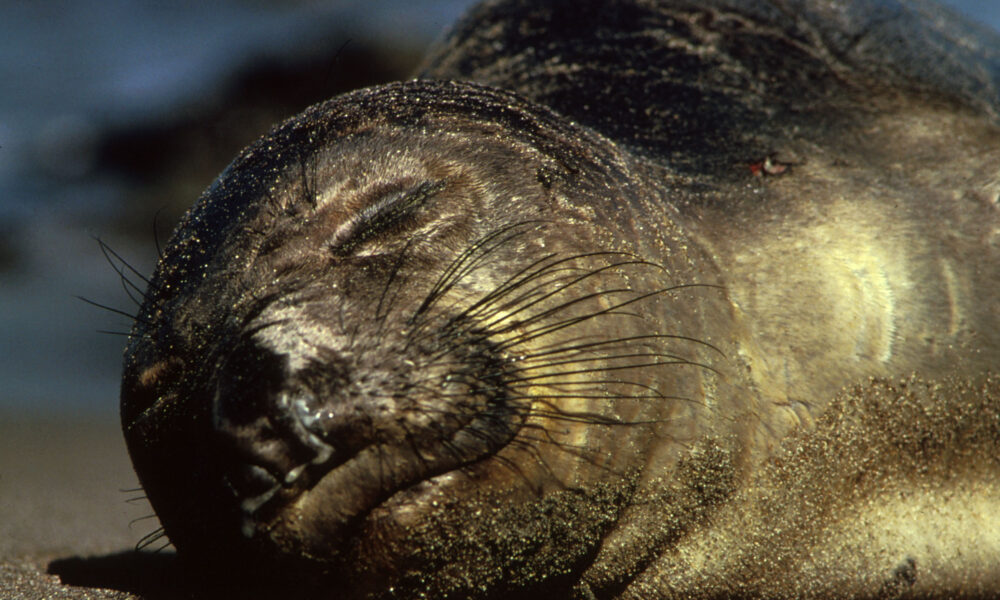
Follow local viewing signs and agency staff directions. Never block an animal’s direct path to the ocean, stand between a mother and pup, feed a seal, or approach for a close-up selfie. Use binoculars or a telephoto lens. A seal may suddenly lunge even when it appeared asleep moments before.
If you believe a seal is injured or stranded, do not touch or move it. Contact the local park rangers or the regional marine mammal stranding-response organization. Many seals resting on land are simply hauling out for normal reasons.
Frequently asked questions
Are northern elephant seals found in the Arctic?
They forage in the North Pacific, including waters near Alaska, but their core breeding beaches are much farther south, especially California and Baja California. Their name does not mean they breed on Arctic ice.
Can an elephant seal swim?
Yes. Elephant seals are specialized swimmers and deep divers. They appear clumsy on land but travel enormous distances through the ocean.
Do elephant seals have tusks?
No. The male’s distinctive feature is a fleshy enlarged nose, not an elephant-like trunk containing tusks.
How long does a pup stay with its mother?
Mothers typically nurse their pups for several weeks before weaning. Site conditions and individual animals vary, so avoid assigning an exact birthday or weaning date to a pup you see.
Why are so many seals lying on a beach?
Gathering on land to breed or molt is normal. During molting, animals may look scruffy; do not treat normal shedding as evidence of illness.
Fact checked against NOAA Fisheries and NPS species and 2025–26 monitoring guidance. Information reviewed October 2026; public access can change.