Quick answer (fact-checked October 16, 2026): A humpback whale (Megaptera novaeangliae) can grow to about 60 feet (18 meters) long and weigh as much as 40 tons, according to NOAA Fisheries. Adult females are generally larger than males. A newborn humpback calf measures about 13–16 feet (4–5 meters) long. These are species-level descriptions—not measurements of every individual whale.
Humpbacks are huge, but they are not the largest animals in the sea: blue whales can be much longer and heavier. Understanding whale size also means distinguishing a whale’s body length from its long pectoral fins, knowing why mass estimates are less precise than a tape-measure length, and recognizing that dramatic breaching photos do not give an exact scale. Here is a source-based size guide using NOAA information.
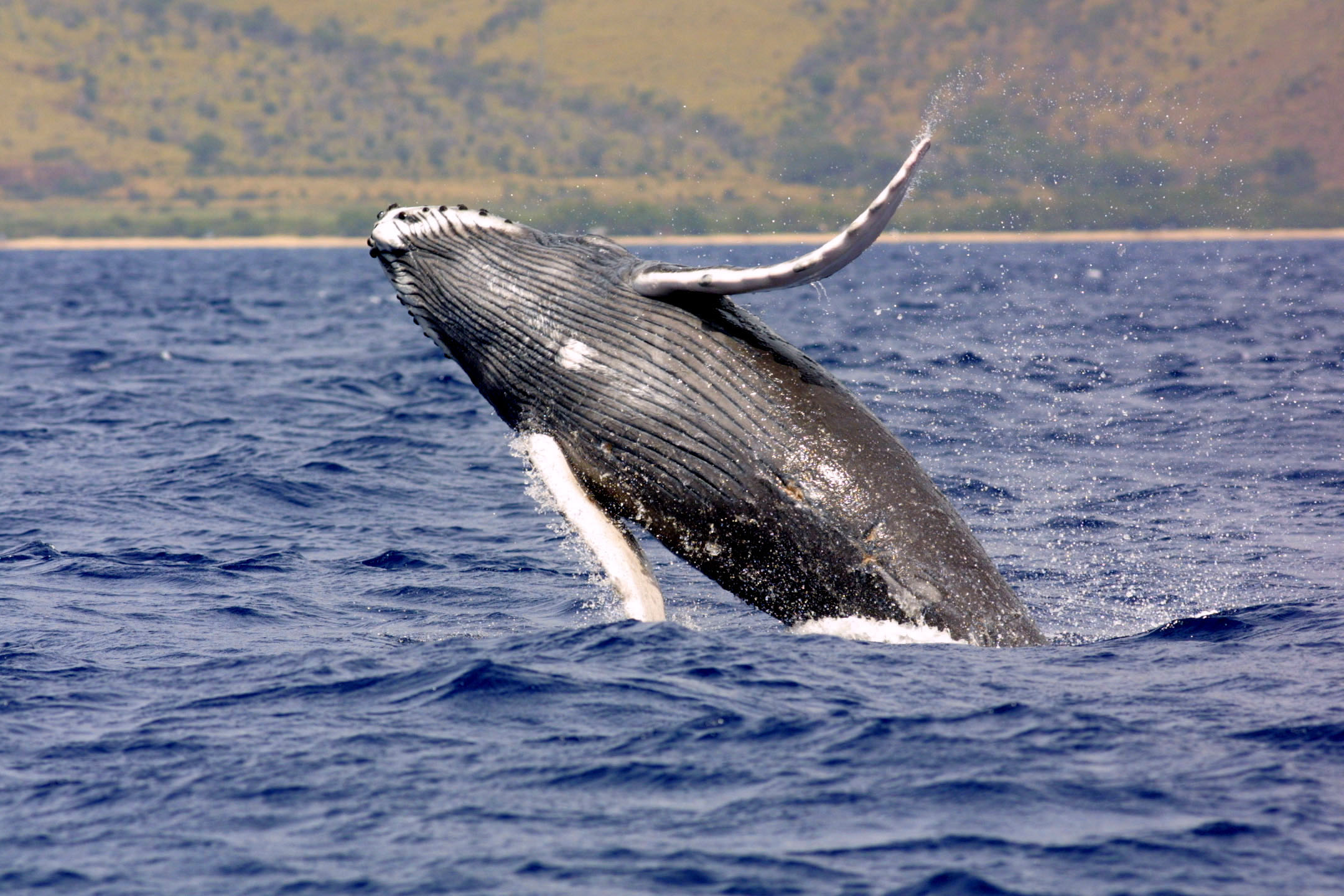
The photograph is a real NOAA image of a humpback whale breaching, not a rendered illustration or photo of a blue whale. The image alone cannot establish the individual whale’s exact length or weight.
Humpback whale size: the most important numbers
| Measurement | NOAA-supported figure | How to interpret it |
|---|---|---|
| Adult maximum body length | About 60 feet (18.3 m) | Upper species estimate; not all adults reach it |
| Adult maximum body weight | About 40 tons | Approximate upper figure; real mass varies among animals |
| Newborn calf length | About 13–16 feet (4–5 m) | Length at birth, not adult length |
| Adult male vs. female | Females generally larger | A general biological pattern, not a rule for every pair |
| Adult lifespan | Roughly 80–90 years | NOAA lifespan estimate, unrelated to size alone |
| Species name | Megaptera novaeangliae | The genus name refers to conspicuously long flippers |
NOAA’s whale fact sheet specifically gives the 60-foot and 40-ton maxima and says females are larger. Its species profile gives the 13–16-foot calf length. Do not confuse the maximum with a scientifically established worldwide average: different populations and age groups can have different size distributions.
How long is a humpback whale?
When biologists report the body length of a whale, they are referring to a standardized anatomical measurement from the front of the animal toward the tail, rather than counting a splash or an extended flipper as extra length. The often-quoted 60 feet represents a very large humpback. Individual whales can be considerably shorter, including young animals that have not reached adult size.
A visual comparison can help: a whale close to the maximum length is longer than many passenger cars parked end to end, but which cars you choose changes the comparison. A photograph of a whale beside a boat can also exaggerate or shrink apparent size because the objects may be different distances from the camera.
Is every humpback whale 60 feet long?
No. The 60-foot figure is a maximum or upper-end benchmark. It does not mean a random adult is exactly that length. Reports of an “average” should state the population, sex, age and method of measurement; otherwise, they may silently mix calves, young adults and mature whales across different parts of the world.
Are female humpbacks bigger than males?
Generally, yes. As NOAA notes, female humpbacks are typically larger than males. This is an example of sexual size dimorphism. However, the difference is not an instant field-identification test: looking at two animals from a whale-watching boat generally cannot establish their sex with confidence simply by guessing which is longer.
Do humpback whales keep growing forever?
Like other mammals, humpback whales grow rapidly when young and approach adult dimensions as they mature. Their length is not a direct measure of their age once they are grown. A healthy whale can change body condition and mass seasonally through feeding or reproduction without dramatically increasing its body length.
How much does a humpback whale weigh?
NOAA describes the largest humpbacks as weighing up to about 40 tons. This is an approximate maximum, not a weight recorded for every animal. Measuring the mass of a free-swimming whale is challenging: researchers may use body dimensions, photogrammetry, established relationships between volume and weight, or documented measurements from animals in special circumstances.
The term ton also needs care. A metric tonne is not identical to a US short ton, and some popular fact sheets do not explicitly define which unit they mean. For that reason, quoting NOAA’s “up to 40 tons” is more faithful than claiming every source agrees on one exact kilogram figure.
Why can whales have different weights at the same length?
Mass depends on girth, body condition, stomach contents, reproductive status and stored energy. A humpback feeding heavily in productive waters may build fat reserves that help sustain it through a breeding season with little feeding. Two animals of similar length can therefore have noticeably different masses.
Can you estimate a whale’s weight from one photograph?
Not reliably. Distance, perspective, how much of the whale is submerged, posture and lens choice all affect apparent size. Trained researchers sometimes use calibrated aerial images and geometric models to estimate length and body condition, but a dramatic photo of a breach has no built-in measuring tape. This article’s NOAA photograph is an authentic observation, not a measured weigh-in.
How big is a baby humpback whale?
A newborn calf is already a very large mammal. NOAA reports a birth length of approximately 13 to 16 feet, which translates to roughly 4 to 5 meters. That is smaller than an adult but much larger than almost any land mammal’s newborn.
NOAA also describes an approximately 11-month gestation. A female normally produces one calf at a time and typically gives birth every two to three years on average, although intervals can vary. Calves generally stay close to their mothers and may nurse for much of their first year.
Do whale calves swim as soon as they are born?
They need to reach the surface to breathe air and keep up with their mothers, so they begin swimming early. Mother-calf pairs stay close, and physical contact can help with coordination and protection. A young whale’s length increases rapidly as it feeds on its mother’s milk, but a precise growth rate differs by individual and conditions.
Does a baby humpback weigh several tons?
You may see exact birth-weight numbers repeated across the internet, but published summaries vary in how they define the figure. The 13–16-foot birth length is firmly described in NOAA’s main species facts. Without a cited, comparable dataset for birth mass, do not turn an approximate internet number into a supposed universal weight of all calves.
Humpback whale vs blue whale: which is bigger?
The blue whale is the larger animal. NOAA’s blue whale profile gives a maximum length of about 110 feet and a maximum mass of about 330,000 pounds. Those values describe especially large blue whales, not the size of every adult. Compare that with the humpback’s NOAA upper-end figures of around 60 feet and 40 tons.
| Size feature | Humpback whale | Blue whale |
|---|---|---|
| Maximum length in NOAA fact sheets | About 60 ft (18 m) | Up to 110 ft (34 m) |
| Maximum mass in NOAA fact sheets | About 40 tons | Up to 330,000 lb |
| Notable appearance | Very long pectoral fins, knobby head, conspicuous fluke | Longer, more streamlined body, blue-gray mottling |
| Primary feeding approach | Filter-feeding, sometimes coordinated bubble nets | Filtering enormous quantities of water for krill |
| Are females generally larger? | Yes | Yes |
The table shows maximum figures from NOAA rather than average animals. It also does not compare equivalent mass units directly, because the NOAA sources express their maxima differently. For a separate treatment of the blue whale’s proportions, see our blue whale size guide with real NOAA photographs.
Can a large humpback look bigger than a blue whale?
In a photograph, yes. A breaching humpback near the camera can fill a frame, while a blue whale photographed from farther away may look smaller. That does not overturn the biological size distinction. Compare measured lengths rather than apparent pixel counts in unrelated photos.
What are humpback whales’ long flippers for?
Humpback whales are known for their extremely long pectoral fins, which project from the sides of the body. The scientific name Megaptera means “big wing,” a reference to these large appendages. Their broad surface area and distinctive leading-edge bumps help them maneuver in water. They are not wings for flight, even though whales sometimes lift them high above the sea during surface behavior.
A breaching photograph can make the flipper look disproportionately long because it is extended toward the camera. The whale’s body length is measured separately from the flipper’s reach. This is one reason an authentic action photo works well for identifying a humpback but poorly for estimating precise body dimensions.
Why do humpbacks slap the surface?
Humpbacks sometimes slap the water with their pectoral fins or tails. Scientists study these behaviors as potential forms of communication, display, movement or interaction. The reason can vary with context, and a single photo does not prove exactly why the animal was behaving that way.
What are the bumps on the head?
The humpback’s head has distinctive fleshy bumps called tubercles, many associated with sensory hairs. Their pattern helps distinguish humpbacks from sleek-bodied blue whales. Also look for the shape of the body, the long fins and the tail flukes when identifying a whale in a photograph.
Does a whale’s size change how it eats?
Humpbacks are baleen whales. Instead of using teeth to grab large fish one by one, they take in water containing krill or schooling fish and strain it through baleen plates. Their huge mouth and expandable throat pleats allow them to engulf water and prey during powerful feeding movements.
In some populations, humpbacks create bubble nets: they swim beneath schools of fish, release bubbles to concentrate prey, and then lunge upward with their mouths open. NOAA notes that the behavior can involve coordinated groups of whales and regional differences. This is a remarkable example of how large body size, feeding anatomy and social behavior work together.
How can a 40-ton whale live on tiny prey?
Small prey can occur in enormous dense patches in productive ocean waters. Filtering many thousands of small organisms can supply a large animal with considerable energy. Humpbacks therefore rely on productive feeding areas and migration patterns instead of routinely swallowing very large animals whole.
Where do humpback whales live, and how far do they swim?
Humpbacks inhabit all major oceans. Many migrate between high-latitude feeding areas and warmer breeding and calving regions. NOAA reports that some populations travel as much as 5,000 miles between seasonal habitats, while North Pacific humpbacks may travel from Alaska to Hawai’i.
Migration distance is not a measurement of whale length, and the same animal’s size does not increase with the miles it swims. But maintaining blubber and enough energy reserves can be especially important when animals travel thousands of miles and feed less during certain breeding-season periods.
Can you tell the same whale apart in different years?
Researchers use photographs of the tail flukes, whose underside pigmentation and markings can be distinctive. Photo-identification helps study repeat sightings, migrations and survival. A single image is not an accurate weighing method, but a collection of identifiable photos over time can be scientifically valuable.
How to identify a humpback whale in a real photograph
- Check the long pectoral fins. Humpbacks have unusually long, often contrasting fins, an important clue when a whale rolls or breaches.
- Look at the head. Distinctive bumps and a knobby outline are more characteristic than the smoother head of some other whales.
- Observe the body shape. Humpbacks have a stocky profile and recognizable curved back in many surfacing views.
- Examine the fluke. A humpback often raises its broad tail flukes during a deep dive, revealing distinctive markings.
- Avoid measuring by perspective. A close whale does not become a record-breaking giant just because it fills more of the picture.
The image used in this article shows the real humpback whale species, a breaching behavior and long pectoral flipper, which together support the image’s identification. The picture is not altered to insert a comparison object or advertise another website.
Frequently asked questions about humpback whale size
How big is a full-grown humpback whale?
NOAA says the species can reach about 60 feet long and 40 tons. Those are approximate maximum values, not a promise that every adult reaches them.
How long is a baby humpback whale?
Approximately 13–16 feet (4–5 meters) at birth according to NOAA Fisheries.
Are humpback whales larger than blue whales?
No. Blue whales are much larger; NOAA gives blue whales an upper length of about 110 feet, compared with about 60 feet for humpbacks.
Are females bigger than males?
Yes, females are generally larger, although individual animals vary.
Is a humpback whale the size of a bus?
Large humpbacks can be longer than many buses. But buses have different lengths and whales of the same species vary too, so the comparison should not replace an actual numerical measurement.
Can you know the weight from a breaching photo?
No. A photograph lacks dependable scale without calibration. Researchers need much more information to estimate body length or volume reliably.
Do humpbacks have teeth?
No. They are baleen whales that strain small prey from water through baleen plates.
Why are humpback whale fins so long?
Their large pectoral fins help with maneuvering and surface behavior. Their genus name, Megaptera, reflects these conspicuous “big wings.”
Official facts and image sources
- NOAA Fisheries: Humpback Whale — size maxima, calves, reproduction, behavior, migrations and protection.
- NOAA: Fun Facts About Wonderful Whales — maximum length and weight and sex differences.
- NOAA Fisheries: Blue Whale — verified size comparison.
- NOAA humpback photographic record — original real NOAA photo and public-domain provenance.
Editorial review date: October 16, 2026. The article does not claim the illustrated whale was measured or photographed in 2026. Maximum size estimates should not be mistaken for average weights or guaranteed dimensions of every living humpback.