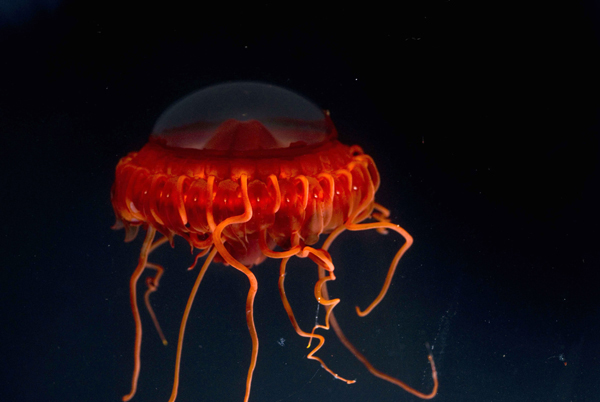

Quick answer: A deep-sea jellyfish is a gelatinous marine animal living in low-light or dark ocean habitats, sometimes hundreds or thousands of meters below the surface. Deep-water jellies are not one species. Scientists have filmed crown jellies such as Atolla, small hydrozoan jellies such as Crossota, and the giant phantom jelly (Stygiomedusa gigantea)—animals that look dramatically different and should not be confused. Some produce their own light, others appear dark red or transparent, and their tentacles and feeding structures vary by group.
If you have watched real remotely operated vehicle (ROV) footage of a glowing ring, a red bell with delicate tentacles, or a huge flowing crimson animal, this guide explains how to interpret what you see without guessing that every unidentified ocean animal is a “monster.” It draws on documented observations from NOAA Ocean Exploration, Monterey Bay Aquarium Research Institute (MBARI) and Woods Hole Oceanographic Institution (WHOI).
What counts as a deep-sea jellyfish?
People often call any floating, translucent animal a jellyfish, but scientists distinguish true jellyfish, other kinds of medusae, comb jellies and siphonophore colonies. The familiar dome-shaped bell and trailing tentacles are useful visual clues, yet appearance alone is not enough to identify an animal to species. The term deep sea describes an environment rather than a single taxonomic group. It is better to ask what kind of gelatinous animal the footage shows and how confidently the researchers identified it.
The ocean’s sunlit upper waters transition to dim and then very dark water. By roughly 1,000 meters, the environment is commonly described as part of the permanently dark bathypelagic or “midnight” zone, although the exact light environment depends on conditions and how the zones are defined. Jellies occur across many depths; an animal photographed at 880 meters does not imply every member of its genus lives at exactly that depth.
A genuine documented encounter at 880 meters
During NOAA’s Windows to the Deep 2018 expedition, researchers recorded a jellyfish assigned to the genus Atolla at 880 meters (2,887 feet). The image came from a water-column transect used to investigate depth-related changes in temperature, oxygen and marine snow. Those observations matter because they provide a documented genus identification, location in the water column and depth—not just a dramatic-looking still circulated without context.
A research image is evidence that an animal was observed, but not necessarily evidence of its precise species, sex or behavior. In particular, one illuminated ROV frame cannot establish whether the jelly was bioluminescing at the instant it was photographed; the vehicle’s lights can make a normally dark animal appear bright.
Three distinctive deep-sea jellyfish groups
| Animal | What an ROV might show | Evidence-backed detail | What not to assume |
|---|---|---|---|
| Atolla (crown jelly) | Round, crown-like bell, often reddish, with marginal tentacles | NOAA documented a specimen at 880 m; WHOI describes defensive blue light flashes | Not every red, circular jellyfish is Atolla |
| Crossota (hydrozoan jelly) | Small bell with extended thin tentacles, sometimes red or orange structures | NOAA identified Crossota in several deep-water expeditions, including 2016 and 2026 records | Color in an ROV image is not enough for species identification |
| Stygiomedusa gigantea (giant phantom jelly) | Very large reddish bell with four extremely long ribbon-like oral arms | MBARI reports bells over 1 m wide and arms over 10 m long | The ribbons are oral arms, not a reason to call it a giant squid |
Atolla: the crown jelly
Atolla is especially recognizable by the groove that creates the appearance of a small crown around its bell. Several species exist within the genus, so a video labeled “Atolla jellyfish” may correctly identify the genus without resolving the animal’s species. The crown shape, radiating tentacles and deep-water environment are useful clues when researchers have matching high-resolution footage.
WHOI describes how some crown jellies emit blue flashes when disturbed. A possible explanation is a defensive “burglar alarm”: the lights might attract a larger predator that interrupts the original attacker. This is an explanatory hypothesis, not proof that the lights invariably scare off predators. The long, extendable tentacle on some Atolla is another reason not to assume all tentacles on a jelly are identical.
Crossota: small jellies that appear in deep ROV footage
Crossota is a genus of hydrozoan jellies that can look striking in close-up video. During NOAA’s 2016 Mariana Islands expedition, a Crossota was filmed at about 3,700 meters. The researchers described two apparent sets of tentacles and a posture suggesting an ambush-feeding strategy. That is an interpretation of observed posture, not a laboratory test of how every Crossota hunts.
NOAA also recorded a Crossota in its 2026 American Samoa expedition and noted that red interior coloration can function as camouflage in deep water. These examples show why a jellyfish’s appearance in one expedition should not be presented as the genus’s only habitat or a complete map of its distribution.
Giant phantom jelly: a very different kind of giant
MBARI describes the giant phantom jelly, Stygiomedusa gigantea, as having a bell more than one meter (3.3 feet) across and four ribbon-like oral arms extending over 10 meters (33 feet). Its huge floating outline is visually distinct from the much smaller crown jellies often shown in deep-sea collections. MBARI has recorded unusual associations between this jelly and a fish living among its arms, an observation that illustrates how open-water animals can provide shelter in an otherwise exposed habitat.
The giant phantom jelly is uncommon in the particular ROV records described by MBARI, but “rarely filmed” does not automatically mean “only a few exist.” The deep ocean is hard to survey. ROVs sample a tiny portion of immense three-dimensional habitats and may miss animals that swim away or occur outside the dive route.
Why are deep-sea jellyfish red, transparent or almost invisible?
The explanation begins with what sunlight can reach. Water selectively absorbs wavelengths of sunlight; red wavelengths disappear relatively quickly as you descend, while blue light can penetrate farther under favorable conditions. In dark deep-water habitats, a red animal illuminated by ordinary white lights can look vivid on camera but much less conspicuous to predators in its normal environment. Deep red coloration can therefore serve as camouflage.
Transparency offers another strategy. An almost clear body has little surface to reflect or silhouette in faint light. Yet transparent animals are not literally invisible: organs, digestive tracts, eggs and prey in the stomach can show through. Some gelatinous predators combine see-through tissues with pigmented internal structures. Which pattern is adaptive depends on the animal and its surroundings.
Why do NOAA videos show bright colors from the dark sea?
ROVs carry lights so researchers can observe animals and the seafloor. Those lights reveal colors that a human observer would not see under natural deep-water illumination. When a photo caption says a jelly is red or orange, it usually describes the color under the camera’s illumination, not a claim that the animal glows red on its own. To decide whether a jellyfish was actually producing light, look for a source explicitly documenting bioluminescence in darkness.
Do deep-sea jellyfish glow in the dark?
Some do, but not all jellyfish emit light in the same way. Bioluminescence is light made by a chemical reaction inside an organism, rather than reflected light from a vehicle or the sun. NOAA describes bioluminescence as common in the ocean’s water column, including among many gelatinous animals. Different species can use light for defense, camouflage, signaling or feeding; assigning a single purpose to every glowing animal would be an overstatement.
NOAA’s explanatory material notes that roughly 80% of observed animals between 200 and 1,000 meters in the ocean’s pelagic zone are bioluminescent. This estimate refers to a particular depth range and survey context, not to 80% of all jellyfish, all ocean animals or every species at every depth.
The difference between fluorescence and bioluminescence
Fluorescence requires incoming light of an appropriate wavelength; a fluorescent animal or material absorbs that light and re-emits some of it at another wavelength. Bioluminescence produces light chemically. A creature that looks neon green or blue under an ROV light is not necessarily bioluminescent. A viral clip can be visually beautiful without demonstrating which light-producing mechanism is present.
Why can some jellies flash blue?
Blue light generally travels efficiently through clear seawater. Some Atolla jellies are known for circular flashes of blue bioluminescence after disturbance. Researchers have suggested those flashes could disrupt an attacker or call the attention of a larger predator. The important qualification is that a hypothesis about function should not be reported as a universally proven behavior for every jellyfish.
How do deep-sea jellyfish eat without teeth or a brain?
Jellyfish capture food through specialized tentacles or feeding surfaces. Many cnidarian jellies have stinging cells called cnidocytes, which can discharge microscopic structures on contact. The prey is moved toward the mouth and into a relatively simple digestive cavity. They do not require a vertebrate-style brain to coordinate basic bell contractions and feeding responses; their nervous organization differs from a fish or mammal.
The giant phantom jelly’s broad oral arms illustrate how anatomy can differ between species. MBARI describes its diet as presumably consisting of plankton and small fish rather than presenting a complete, experimentally proven feeding list. When sources say “presumably,” the qualifier matters. The difference between directly observed prey capture, stomach contents and plausible prey is important in deep-sea biology.
Is a deep-sea jellyfish a jellyfish, a comb jelly or a siphonophore?
Underwater video labels sometimes group animals by their soft body and drifting movement rather than their family relationships. These three categories should remain separate:
| Group | Broad description | Helpful identification clue |
|---|---|---|
| Cnidarian jellyfish | Includes many familiar scyphozoan and hydrozoan medusae | Bell shape and specialized prey-capturing cells in many species |
| Comb jellies (ctenophores) | Different animal phylum, often gelatinous | Rows of beating ciliary combs that can create rainbow-like optical effects under light |
| Siphonophores | Cnidarian colonies made of highly specialized zooids | Can appear as chains or complex floating colonies rather than one ordinary bell |
NOAA and marine laboratories document colonial siphonophores using bioluminescent structures for feeding, but an account of one colony should not be copied into an article as though it describes the biology of all single-bell jellyfish. If a clip lacks a reliable original identification, “unidentified gelatinous animal” is more accurate than forcing a species name.
How scientists record jellyfish thousands of meters down
A remotely operated vehicle is connected to a ship by a tether and carries cameras, lights and instruments. Researchers can measure water depth, temperature and other conditions while watching an animal at the same time. Some expeditions perform targeted transects through different water layers, such as the NOAA 2018 survey that documented Atolla at 880 meters. These methods preserve information that disappears when someone reposts a cropped screenshot without the source.
What a trustworthy deep-sea jellyfish photograph should tell you
- Who recorded it: an expedition, institution or photographer with a traceable original record.
- When and where: expedition name, year, geographic region and, ideally, depth.
- Identification level: exact species if supported, otherwise genus or broader group.
- Observed versus inferred: what the video visibly shows and what scientists hypothesize.
- Lighting conditions: whether colors come from an ROV lamp or the organism’s own emitted light.
These checks are useful when evaluating “alien jellyfish” headlines and viral compilations. Without the original expedition record, even a genuine deep-sea clip can acquire incorrect locations, depths and species labels.
Where are deep-sea jellyfish found?
Deep-water jellies occur in many ocean basins, but distribution varies by species, water conditions, currents and season. Researchers have documented Crossota in NOAA expeditions in the Pacific and elsewhere; MBARI describes giant phantom jellies in midwater habitats across much of the world. There is no single depth that defines every species in this article, and there is no evidence that all deep-sea jellies gather at a single famous trench.
Ocean habitats are interconnected but not interchangeable. Temperature, oxygen, food particles and circulation can affect what researchers encounter. For related environmental context on another part of the ocean system, see our report on the 2026 Arctic sea-ice minimum; sea-ice measurement and deep-sea jellyfish biology are different research questions, even though both concern Earth’s ocean environments.
Are deep-sea jellyfish dangerous to people?
Many jellyfish species possess stinging structures, but the severity of contact varies enormously. The species in deep-submersible footage live far below normal recreational swimming depths. It would be misleading to assume any deep-sea jellyfish is safe to touch based on a photograph, just as it would be misleading to call all of them deadly. Avoid touching unfamiliar gelatinous animals, and follow local lifeguard or public-health guidance for any jellyfish contact in coastal waters. This guide is an identification and biology explainer, not medical treatment advice.
Frequently asked questions
What is the glowing circular deep-sea jellyfish called?
One well-known example is Atolla, nicknamed the crown jelly. Its flashing ring can be a defensive display, but a glowing circle in an unidentified clip cannot establish its genus on its own.
What is the huge red jellyfish with four long ribbons?
The description can fit the giant phantom jelly, Stygiomedusa gigantea. MBARI documents four long oral arms, a bell that can exceed one meter wide and arms reaching more than ten meters. Verify the footage rather than relying only on color.
How deep was NOAA’s photographed Atolla jellyfish?
NOAA reports 880 meters (2,887 feet) during its 2018 Windows to the Deep water-column exploration. That is the depth of that observation, not the entire genus’s exclusive depth range.
Are comb jellies true jellyfish?
No. Comb jellies are ctenophores, a different group of animals. The soft transparent appearance is a reason they are easily confused in casual captions.
Why are deep-sea jellyfish red?
Red pigmentation can camouflage an animal where little red daylight penetrates. ROV lights make the pigment visible to human viewers; the animal may look far darker in its normal habitat.
Do all jellyfish glow?
No. Bioluminescence is common in many deep-sea organisms, but researchers do not say that every jellyfish species produces light or uses it in the same way.
Can a camera identify a new deep-sea species instantly?
Usually not. Images may support a genus identification, but species-level confirmation can require anatomy, specimen examination and genetic data. The NOAA 2025 Botrynema research update is a useful example of why apparently simple jellyfish classifications can change after careful study.
Primary references and further reading
- NOAA Ocean Exploration: Atolla jellyfish recorded at 880 meters, Windows to the Deep 2018.
- NOAA Ocean Exploration: What is bioluminescence?.
- Woods Hole Oceanographic Institution: Creature feature — Atolla jellyfish.
- NOAA Ocean Exploration: Crossota jellyfish during 2016 Marianas exploration.
- NOAA Ocean Exploration: Crossota jelly footage, 2026 American Samoa expedition.
- MBARI: Giant phantom jelly, Stygiomedusa gigantea.
Editorial fact check: October 13, 2026. This article describes documented observations and clearly separates hypotheses from proven behavior. Individual expedition sightings should not be generalized to all jellyfish.