Napoléon (1927) Explained: Abel Gance’s Epic, Polyvision and Which Restoration to Watch

Quick answer: Napoléon (1927) is Abel Gance’s French silent historical epic about the young Napoleon Bonaparte, played by Albert Dieudonné. It does not dramatize Waterloo or his eventual exile: the story follows his early life, the French Revolution, political struggles in Corsica, his military rise and the beginnings of his Italian campaign in 1796. It is famous for energetic camera movement, rapid montage, striking visual effects and a three-screen finale known as Polyvision. There is no single accurate runtime for every copy: different original edits and later restorations range widely in length.
For a viewer choosing a version today, the most important distinction is between the approximately five-and-a-half-hour Kevin Brownlow/BFI reconstruction and the roughly seven-hour, 2024 Cinémathèque française reconstruction. These are substantial, differently reconstructed presentations—not simply identical films playing at different speeds.
Napoléon (1927) film: key facts
| Question | Answer |
|---|---|
| Original film | Napoléon, also called Napoléon vu par Abel Gance |
| Director | Abel Gance |
| Release period | 1927, with multiple edits and theatrical presentations |
| Lead performer | Albert Dieudonné as the adult Napoleon Bonaparte |
| Style | Silent historical epic; moving cameras, montage, superimposition and occasional tinted imagery in some versions |
| Story ends | Napoleon’s emergence as a military leader at the start of the Italian campaign, not the 1815 Battle of Waterloo |
| Signature technique | Polyvision: three separately projected images arranged across an exceptionally wide screen |
| Approximate modern versions | Brownlow/BFI around 5½ hours; Cinémathèque française 2024 restoration about 7 hours 5 minutes |
Film-historical sources, including the British Film Institute’s restoration history, emphasize how often Gance’s work was recut. Treat a runtime listed without a restoration name as incomplete information.
What is the story of Napoléon (1927)?
Act one: a future leader at school
Gance begins with the young Napoleon at the military school at Brienne. The memorable snowball battle frames him as an outsider who is already thinking tactically: while other students approach the exercise as a game, he uses position, timing and group movement to gain the upper hand. The sequence serves as an introduction to the film’s energetic visual style, not reliable proof that a specific historical snowball encounter happened exactly as shown.
Act two: Corsica and revolutionary France
As Napoleon grows older, the story moves through volatile revolutionary politics and his divided loyalties in Corsica. Gance uses the conflict to contrast the protagonist’s personal conviction with public disorder. For a modern viewer, it helps to remember that the film was made as an epic mythic portrait, not a neutral documentary: events are selected, compressed and dramatized for emotional impact.
Act three: the storm and the struggle for influence
The film’s famous “Double Tempest” contrasts a storm at sea with the political storm engulfing revolutionary France. Gance links the physical motion of the boat and water to intense movement, clashes and instability elsewhere. The montage suggests that a single individual is attempting to chart a course through a turbulent historical moment. This is one reason Napoléon remains important even to audiences who do not follow every character or political reference.
Act four: Toulon and the march toward Italy
Gance presents Napoleon’s growing military reputation, including the Siege of Toulon, and moves toward his command of the Army of Italy. The finale expands into the screen-filling Polyvision triptych. The story does not continue through the creation of the French Empire, the Russian campaign or Waterloo. Viewers expecting a cradle-to-grave Napoleon biography should adjust their expectations before committing to a marathon screening.
Who plays Napoleon in the 1927 film?
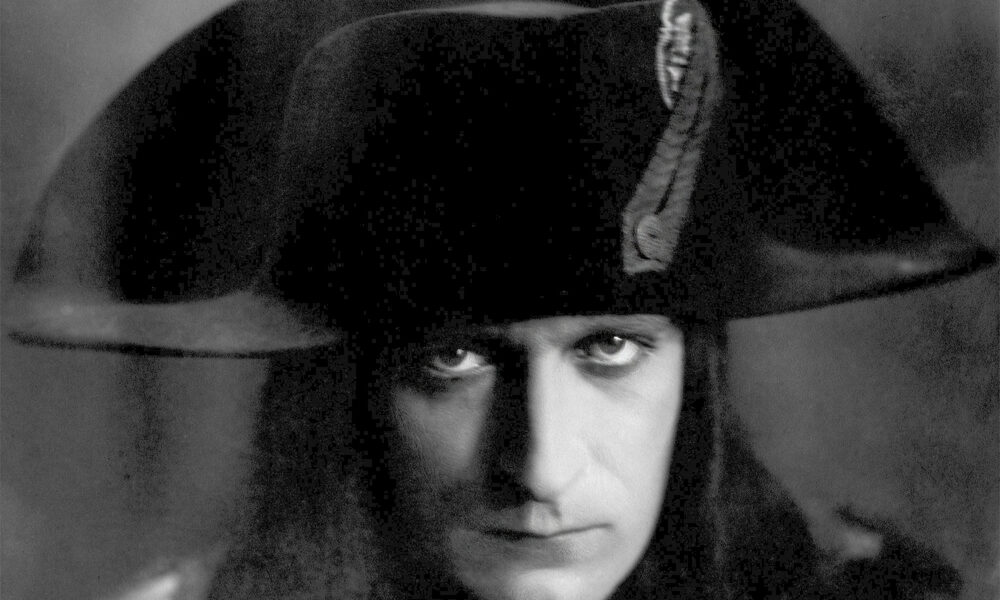
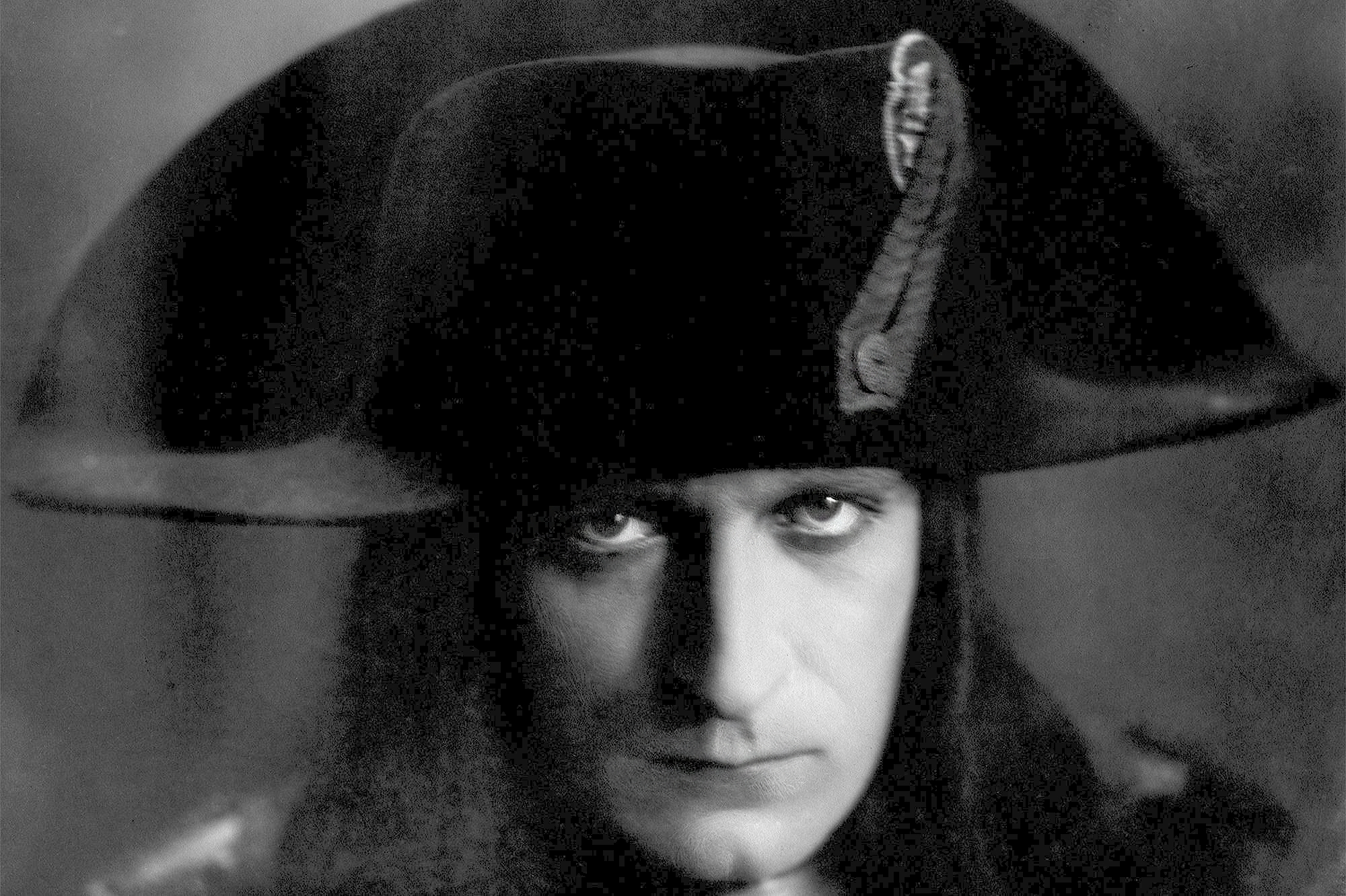
The main adult portrayal is by Albert Dieudonné, whose intense screen presence became closely identified with the character. The authentic publicity still used as this article’s featured image shows him in period costume for Gance’s film; it is not a photographic portrait of the historical Napoleon. Pierre Choumoff made the 1927 photograph. Its image record identifies the original film and performer, which makes it more appropriate here than an unrelated painting of the emperor or a promotional image from a newer adaptation.
Gance relies on physical acting, framing and editing to communicate without ordinary recorded dialogue. Silent films were not necessarily experienced in silence: screenings could incorporate music and other live elements, but the score accompanying one modern restoration is not interchangeable with a different restoration’s presentation.
What made Abel Gance’s Napoléon revolutionary?
Polyvision: a three-part picture instead of a normal widescreen image
For the most spectacular passages, Gance designed a system with three film images projected side by side. Together they produced a panorama impossible to reproduce faithfully on an ordinary, narrow single projection. At other moments, the panels could juxtapose different views rather than behaving as one continuous landscape. That difference matters: a streaming presentation may crop the outer panels, show them in reduced scale or display only one portion, depending on its source and format.
Physical camera movement in place of static historical tableaux
Gance’s crew experimented with cameras mounted on moving supports and on operators, giving scenes unusual speed and immediacy for their era. The BFI’s production chronology describes mounted cameras, mobile rigs and equipment adapted to capture demanding action. Much of the technique was difficult and sometimes hazardous, long before modern stabilizers and lightweight digital cameras.
Rapid editing and overlapping imagery
Several passages rely on strikingly fast montage or superimposed images, so a viewer feels the crowd, sea, ceremony or battle as a rush of impressions. Such methods made the film more than an illustrated history lesson. They also make it sensible to watch in parts if fatigue would prevent you from appreciating the imagery.
How long is Napoléon (1927)? Comparing the different cuts
The answer depends on the specific historical edition, the surviving elements used and even the projection speed assumed by restoration teams. Do not treat the shortest version as proof that a longer one merely added filler.
| Presentation or reconstruction | Approximate duration | Important distinction |
|---|---|---|
| Paris Opéra premiere-era presentation (1927) | Approximately four hours | A shorter historic edition incorporating dramatic triptych moments. |
| Apollo trade presentation (1927) | Reported at around nine hours or more | A historically long but different cut, generally discussed in archival research rather than available as an intact modern viewing edition. |
| Highly abbreviated U.S. release (1929) | Around 100 minutes | A drastically shortened foreign-market presentation, not a fair substitute for Gance’s intended scale. |
| Kevin Brownlow / BFI restoration (2016) | About five-and-a-half hours | Extensive multi-decade reconstruction, widely associated with Carl Davis’s score. |
| Cinémathèque française restoration (2024) | About 425 minutes (7 hours 5 minutes) | A separate ambitious reconstruction, with its own archival decisions and presentation history. |
These times are approximate historical comparisons. In particular, the long Apollo cut is often described by its original film length and an assumed projection speed; the figure should not be mistaken for a single, complete nine-hour digital release viewers can readily select today. For the archival distinction, see the BFI restoration chronology and the Cinémathèque française’s modern restoration materials.
Which version should you watch first?
If you want a major English-accessible restoration
The Brownlow/BFI reconstruction is a logical starting point when an authorized edition is available where you live. It is long enough to convey the picture’s design and is connected to an extensive record of restoration work. Confirm that a listing really names the version; some services offer shorter recuts with similar titles.
If you want to explore the 2024 French reconstruction
Look for the Cinémathèque française’s 2024 version and confirm what audio accompaniment, subtitles and exhibition format are included. At roughly seven hours, it is a separate research effort that can substantially change which scenes and narrative transitions you experience. A screening in two parts is not a mistake; historical epic restorations are often programmed that way to make their length manageable.
If the screening promises Polyvision
Check whether the three images will actually be shown side by side. A venue’s screen or a particular home-video encode may not create the same spatial effect as a properly arranged three-panel projection. That does not make the smaller screening worthless, but it changes a key part of Gance’s artistic design.
Is Napoléon a historically accurate account?
It combines historical figures and a recognizable chronology with visual symbolism, compressions and dramatic invention. The snowball battle, the storm montage and other scenes are structured to elevate Napoleon into a cinematic force. The film’s account tells us at least as much about 1920s ideas of heroic cinema as about the 1790s.
It is therefore useful to pair the screening with historical reading rather than citing movie scenes as independent evidence of a military event. Avoid claims such as “the film shows Waterloo” simply because later documentaries or more recent biopics cover that period: Gance’s 1927 film stops far earlier.
Why 2024 restoration news matters to modern viewers
Restoring a silent epic is not just sharpening a scan. Materials survive in multiple generations, scenes may be missing or spliced differently, and historical versions were edited for different markets. A restoration team must compare sources, decide sequence order, account for frames-per-second differences and document uncertainties. New archival discoveries can reshape the film even decades after an earlier admired restoration. The BFI’s detailed timeline explains how Gance’s original edits became fragmented and why reconstruction requires expert judgment.
Copyright also needs caution: a vintage publicity still and a modern restoration soundtrack, subtitle track or fresh digital restoration are different creative objects with potentially different usage restrictions. Do not assume an entire newly restored edition is free to redistribute because its underlying film is old. Our guide to public-domain films and reuse explains the distinction between an underlying film, a modern presentation and the jurisdiction in which the content is reused.
Where does it belong in a silent-film watchlist?
Unlike Buster Keaton’s The General, which builds tightly staged action-comedy around a single locomotive chase, Gance’s film aims for national-scale spectacle and a mythic historical portrait. Both used moving images in striking ways, but their pacing and narrative purposes are different. For a shorter starting point with a clear plot, see our The General (1926) explained feature. For another very different silent-era star vehicle, our The Sheik (1921) guide covers Rudolph Valentino’s romantic melodrama and its historical context.
For Napoléon, patience pays off. The film is most enjoyable when approached as ambitious cinema rather than a modern standard-length biopic: the striking camera work, creative montage and Polyvision experiments are the attraction as much as the biography.
Frequently asked questions
Is Napoléon (1927) a silent movie?
Yes. It was created in the silent-film era. Modern screenings may accompany it with live or recorded music, and the score depends on the version and restoration being presented.
Does the 1927 Napoléon film show Waterloo?
No. It focuses on Napoleon’s rise and ends around the opening of his 1796 Italian campaign; Waterloo happened in 1815 and is outside the film’s story.
What is Polyvision?
A three-camera, three-projection method used for spectacular widescreen compositions and triptych arrangements, particularly toward the finale. Not every digital presentation fully reproduces it.
Why are some versions five hours while others are seven?
Because material was edited, lost, rearranged and subsequently reconstructed from different historical elements. Projection speed and accompanying music can also affect the experience. Check the actual named restoration.
Who directed and starred in Napoléon (1927)?
Abel Gance directed the film, and Albert Dieudonné played the principal adult Napoleon Bonaparte.
Can I download and repost the 2024 restoration?
Do not assume you can. The age of the original work does not automatically settle rights for a modern soundtrack, subtitles or restoration materials, and applicable copyright rules vary by country. Use authorized releases and evaluate any reuse separately.
Editorial review: October 14, 2026. Historical and restoration context reviewed against British Film Institute film-history research and Cinémathèque française reconstruction coverage. Specific cut lengths are given as approximations, not a claim that all presentations are interchangeable.

Other Articles

The Gateway Arch in St. Louis (2026): Tickets, Free Museum and Hours