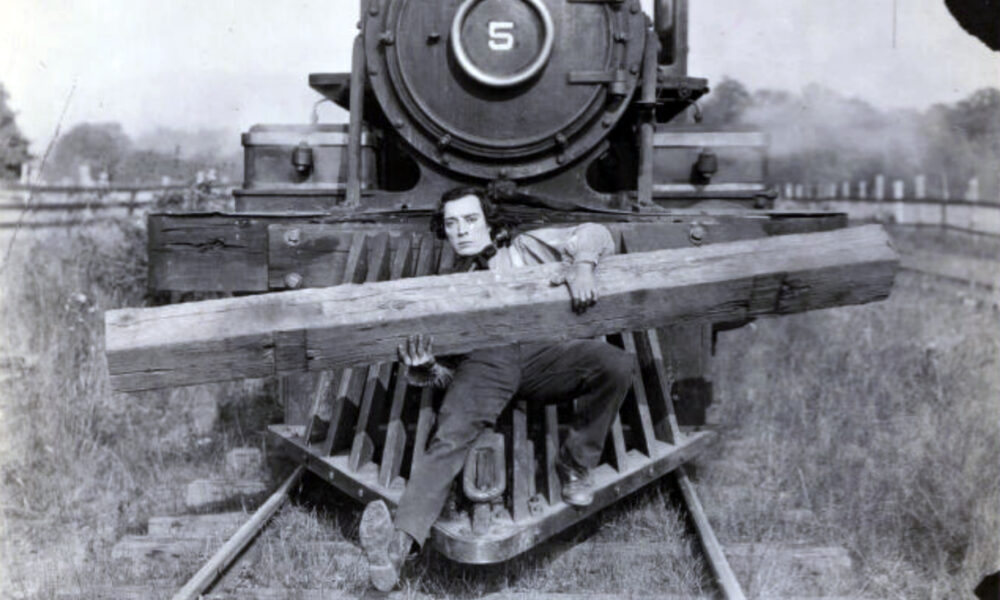

Quick answer: The General is a 1926 American silent action comedy directed by Buster Keaton and Clyde Bruckman. Keaton plays railroad engineer Johnnie Gray, who chases a stolen locomotive through Civil War-era Georgia to recover both his train, the General, and his sweetheart, Annabelle Lee. The film is famous for practical railway stunts, carefully timed visual comedy and a two-direction pursuit. The original 1926 film is in the public domain in the United States, although a later restoration’s music or other new material may have separate rights.
The General (1926) quick facts
| Detail | Answer |
|---|---|
| Film | The General (1926) |
| Genre | Silent action comedy, period adventure |
| Directors | Buster Keaton and Clyde Bruckman |
| Lead actor | Buster Keaton as Johnnie Gray |
| Female lead | Marion Mack as Annabelle Lee |
| Setting | American Civil War, principally Georgia |
| Inspiration | The 1862 Great Locomotive Chase (Andrews’ Raid) |
| Film length | Varies by edition and projection/restoration speed; check the runtime of the version you select |
| U.S. copyright status | Original 1926 film is public domain; new added music and restoration-specific elements may not be |
What happens in The General? A spoiler-light plot
Johnnie Gray is a locomotive engineer with two loves: Annabelle Lee and his engine, the General. When the Civil War begins, Johnnie tries to volunteer for Confederate military service but is rejected because his work as a railroad engineer is deemed more useful. He is not told why the army refuses him. Annabelle and her relatives think he has avoided enlistment, damaging her opinion of him.
Later, Union raiders steal the General during a railroad stop. Annabelle is trapped aboard, and Johnnie sets out alone in pursuit. His resourcefulness and luck are repeatedly tested by switches, track obstacles, engines and an increasingly complicated chase. At a turning point, he crosses enemy lines and learns about a planned offensive. Recovering Annabelle and the locomotive becomes part of the mission to warn his own side.
The ending of The General explained (spoilers ahead)
Spoiler alert: the film’s final sequence reveals how the chase resolves and what changes for Johnnie.
How Johnnie gets his train back
Having located Annabelle and overheard a Union plan, Johnnie finds an opportunity to steal back the General. This time he and Annabelle are traveling in the other direction, with Union forces chasing them. The structure is deliberate: the same railway landscape creates fresh problems when predator and prey reverse their roles.
Why the bridge collapses
Johnnie sets part of the wooden Rock River Bridge alight as he retreats. A pursuing Union locomotive attempts the crossing, and the bridge gives way beneath it. The spectacular destruction of a real locomotive is part of the film’s appeal, but within the story it also halts a critical pursuit and disrupts the attackers’ movement.
Does Johnnie become a soldier?
Yes. Johnnie returns to Confederate lines with a warning, and his actions are recognized. He captures an enemy officer and receives a lieutenant’s uniform and sword. This reverses the film’s opening misunderstanding: the man who was denied enlistment is now publicly treated as a soldier.
What is the joke in the final shot?
Johnnie sits with Annabelle and tries to kiss her, but soldiers keep passing and saluting his new rank. He repeatedly interrupts the embrace to salute back. The last comic solution is simple and visual: he keeps Annabelle close with one arm while saluting with the other. A military recognition scene becomes a romantic sight gag.
How much of The General is a true story?
Keaton’s movie takes inspiration from Andrews’ Raid, a real 1862 Union mission involving the theft of a Confederate locomotive and an attempt to disrupt rail transport. That historical incident supplies the dramatic idea of a stolen engine and a railroad pursuit. The General does not recreate the event literally: Johnnie Gray, Annabelle’s romance, their individual escapes and much of the comic business are fictionalized.
It also tells the story primarily from the viewpoint of a Confederate character. That choice is part of its historical context, not a neutral account of the Civil War. Modern viewers can admire its filmmaking while recognizing that the film does not explain slavery, the war’s causes or the experiences of the people omitted from this narrow adventure plot.
Why the train scenes still work a century later
1. Action is understandable without dialogue
Keaton establishes the physical problem before he supplies the punchline. An object on the track, a disconnected car or a shifting switch is visible in a wide composition. The viewer has time to understand what might go wrong. The resulting gag feels earned because it grows from geography and movement, not from a random cut or a verbal joke.
2. The chase doubles back and changes perspective
The first journey involves Johnnie pursuing a stolen engine; the second has him driving that engine while being pursued. That mirror structure keeps the story coherent through repeated visual locations. It also changes how an obstacle functions: a track delay that hurts the hero in one part can help him in another.
3. Practical movement creates a distinctive sense of risk
The train, railway tracks and stunt mechanics occupy the same photographed space as the performers. This allows jokes to play out in long or relatively wide shots, where the audience can see cause and effect together. The famous collapsing bridge is an actual large-scale production stunt, not evidence that everything in the movie was filmed without risk or without planning.
Three moments worth watching closely
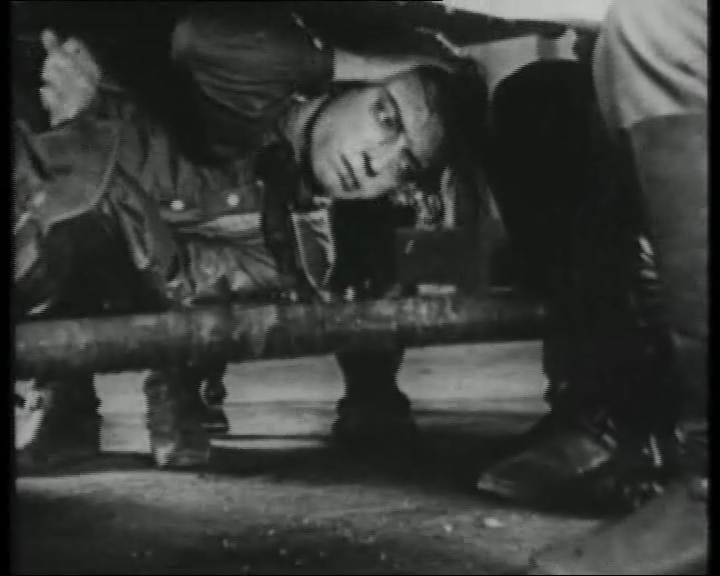
The engine pursuit: notice how Keaton changes the apparent distance between train, debris and human body, allowing the camera to do explanatory work that dialogue would otherwise do.
The cannon sequence: the cannon is comic because its position and the train’s movement make it unexpectedly dangerous to its own operator. The gag is a chain of physical consequences rather than a one-line punchline.
The final salutes: the concluding scene resolves romance and Johnnie’s desire for recognition simultaneously, using only posture and repeated timing.
What makes it different from an ordinary silent comedy?
| Feature | In The General | Why it matters |
|---|---|---|
| Scale | Railway locations, moving locomotives and crowd scenes | The comedy unfolds within a large action spectacle |
| Story structure | Chase out, then chase back | A clear narrative throughline survives without spoken dialogue |
| Character | A practical worker mistaken for a coward | His competence is the engine of both action and humor |
| Gag style | Precise physical setups and payoffs | Viewers can follow the joke visually |
| Historical frame | Fiction loosely based on a Civil War raid | It should be interpreted as cinema, not a documentary |
Was The General successful when it came out?
Although it is now widely celebrated, The General disappointed commercially at its original release. The BFI notes that the film’s unusually expensive stunts and poor initial performance contributed to restrictions on Keaton’s future creative independence. Its later reputation grew as audiences, historians and filmmakers reassessed the audacity and precision of the work.
That shift is a useful reminder that a film’s first box-office result and its long-term artistic influence are not the same thing. Rewatch the pursuit not simply as a sequence of jokes but as a carefully organized piece of visual storytelling.
Can you legally watch or reuse The General?
The underlying 1926 American film is in the U.S. public domain. That does not automatically mean every streaming upload, modern score, color treatment, subtitle translation, remaster or edited version is free of restrictions. If you plan to reuse footage in a commercial project, identify the provenance of the specific copy and check whether new copyright-protected material has been added. Copyright rules outside the United States may differ.
We explain the general distinction in our guide to public-domain movies and rights in 2026. For another film frequently discussed in connection with U.S. public-domain status, see our article on Night of the Living Dead (1968). Neither link substitutes for checking rights in a particular file or soundtrack.
Frequently asked questions
Is The General a war movie or a comedy?
Both. It uses a Civil War setting and action-adventure plot to create a silent physical comedy. The war provides the circumstances, but the central experience is Keaton’s movement, problem-solving and visual timing.
Is the General the name of the main character?
No. The General is the locomotive. The protagonist is railroad engineer Johnnie Gray, played by Buster Keaton.
Who plays Annabelle Lee?
Marion Mack plays Annabelle Lee, Johnnie’s sweetheart.
Did they really wreck a train?
The famous bridge-collapse set piece used a real locomotive in a large-scale practical production sequence. That does not make the larger storyline historically exact.
Is the movie historically accurate?
Its premise recalls a genuine Union locomotive raid in 1862, but the personal story, chases and comedic incidents are heavily fictionalized.
How long is The General?
Running time differs across releases because of projection speed, edits and restorations. Check the runtime of the edition you are using rather than treating one figure as universal.
Is it a documentary?
No. It is an intentionally fictional narrative comedy inspired by a real incident.
Where can I verify basic production information?
The British Film Institute film entry confirms the 1926 film, co-directors, historical inspiration and critical reception. Copies of the film differ; verify edition-specific credits separately.
The takeaway
The General succeeds when its viewer can see exactly what its protagonist must do, why it seems impossible, and how a tiny physical decision turns catastrophe into comedy. That clarity—not just its spectacular bridge stunt—is why the movie remains worth studying and watching.