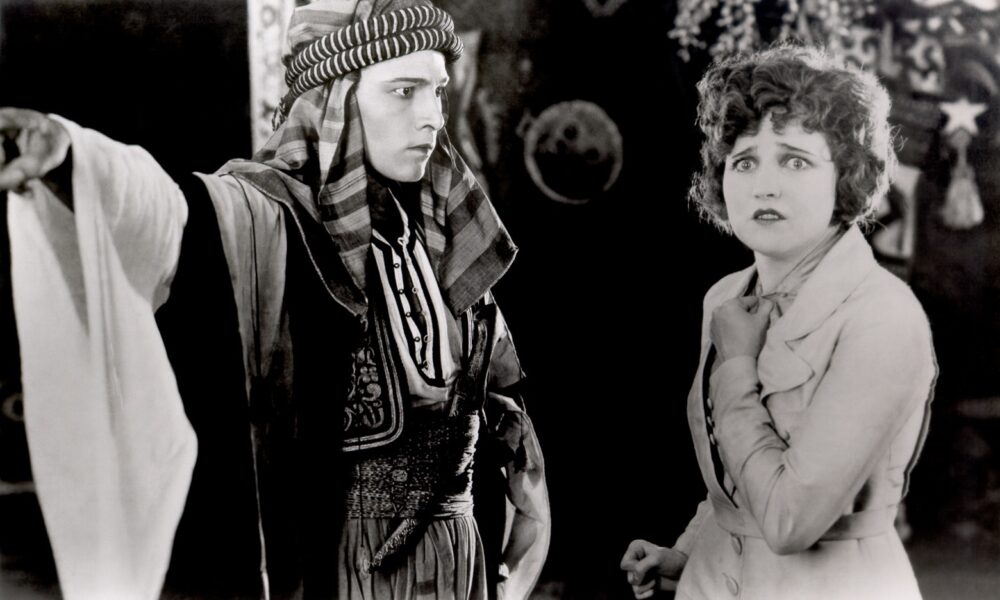

Quick answer: The Sheik (1921) is a silent romantic drama directed by George Melford, starring Rudolph Valentino as Ahmed Ben Hassan and Agnes Ayres as Lady Diana Mayo. Diana travels into the desert to assert her independence, but Ahmed takes her captive; the story develops into a rescue melodrama and romance. The film became a major part of Valentino’s screen image. The 1921 U.S. film itself is in the public domain in the United States, although particular restorations, newly recorded scores and distribution editions may have additional rights.
If you came looking for the The Sheik film rather than the 1919 novel, this guide explains who appears in the movie, what actually happens in its ending, how to distinguish different versions, and why today’s viewers often criticize the portrayal of coercion and Middle Eastern people. It includes spoilers after the first section.
The Sheik (1921) at a glance
| Question | Answer |
|---|---|
| Full film title | The Sheik |
| Original U.S. release | 1921 |
| Director | George Melford |
| Lead actors | Rudolph Valentino; Agnes Ayres |
| Supporting actor | Adolphe Menjou as Dr. Raoul de St. Hubert; Walter Long as rival bandit Omair |
| Studio | Famous Players–Lasky; distributed by Paramount |
| Adapted from | E. M. Hull’s 1919 novel The Sheik |
| Type of film | American silent romantic drama with English intertitles |
| Original run time | Often cataloged at around 80 minutes; available copies vary in length. |
| U.S. public-domain status | The 1921 original film’s copyright term has expired; later edition elements need separate checking. |
Film databases and streaming editions may show different durations because prints have been edited, projected at different playback speeds or released with newly recorded music. A 66-minute upload and an 80-minute catalog entry should not automatically be treated as identical versions. The specialist Silent Era film entry provides historical catalog details.
What happens in The Sheik? A spoiler-free overview
Lady Diana Mayo wants to travel independently rather than conform to the marriage expectations of her social circle. She encounters Sheik Ahmed Ben Hassan in North Africa, setting up an attraction that the screenplay treats as both threatening and romantic. During her desert journey, Ahmed seizes control of her movement and holds her in his camp. Other characters, including a doctor, attempt to mediate the conflict, and a rival’s violence draws the film toward its rescue climax.
For a modern audience, the premise demands caution: an abduction is not the same thing as a consensual relationship, and the film frequently packages dominance as romantic desirability. That tension is essential to understanding the work as a historical artifact, not merely a missing context that a new viewer should ignore.
Who plays whom? The main cast explained
| Actor | Role | Function in the story |
|---|---|---|
| Rudolph Valentino | Sheik Ahmed Ben Hassan | Desert leader who captures Diana and is framed as the romantic lead. |
| Agnes Ayres | Lady Diana Mayo | English traveler whose independence and safety form the narrative’s central conflict. |
| Adolphe Menjou | Dr. Raoul de St. Hubert | Ahmed’s friend who helps the characters interpret their feelings and obligations. |
| Walter Long | Omair | Antagonist whose later abduction of Diana triggers the rescue storyline. |
| Frank Butler | Sir Aubrey Mayo | Member of Diana’s English social circle. |
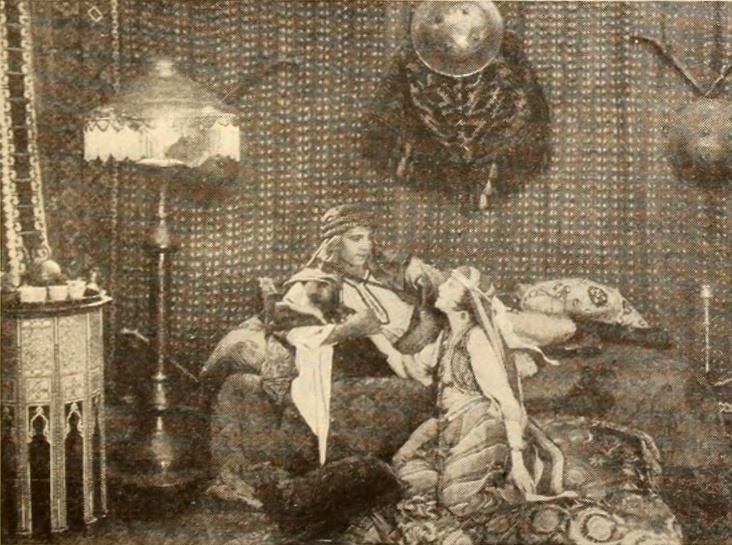
The best-known surviving publicity images focus on Valentino’s costume, expression and proximity to Ayres. Below are actual 1921 photographs from the film’s period, rather than paintings of unrelated desert characters or modern actors dressed to resemble them.
The Sheik ending explained: who is Ahmed really?
Spoilers begin here. In the final stretch, Diana is endangered by Omair. Ahmed intervenes, defeats the rival and is seriously injured. Diana’s concern becomes part of the film’s romantic resolution. The final revelation is that Ahmed was adopted into his upbringing: his biological parents were European, with an English father and Spanish mother. That information changes how the screenplay invites its contemporary audience to regard a relationship it had previously presented as crossing a racialized boundary.
Why does the ancestry reveal matter? It is not simply another twist to add surprise. The ending effectively reassures early 20th-century audiences that Ahmed is not ethnically the figure he has been costumed and framed as throughout the story. Scholars have pointed out how that device reconciles a fantasy of cultural difference with the racial expectations of the film’s original market.
Film-studies scholarship, including a 2023 analysis in AVANCA | CINEMA, examines the story through its treatment of gender, Orientalism and racial identity. The twist needs to be understood within that context rather than repeated as if ancestry made the earlier confinement acceptable.
Why was Rudolph Valentino’s performance famous?
Valentino had already appeared in films before The Sheik, but this role became strongly identified with his celebrity persona. His expressive silent-film performance, careful posing, romantic framing and costume helped establish him as a screen idol. The film’s success influenced how Hollywood marketed leading men and packaged desert-set romance as a commercial spectacle.
At the same time, the character was not a neutral or accurate portrait of an Arab leader. Hollywood’s construction of the “sheik” blended fantasies of danger, sexual control and exotic scenery. The story invited the audience to desire a character whose behavior includes nonconsensual captivity. That conflict is part of why the film remains debated rather than functioning simply as a quaint old romance.
A historical film can be both influential and troubling. Knowing this helps audiences understand why the picture is frequently mentioned in courses and writing about early Hollywood, gender roles, ethnic representation and the star system.
The Sheik film versus E. M. Hull’s 1919 novel
The movie adapts the broad framework of Edith Maude Hull’s popular romance rather than presenting every event the same way. Both center on Diana and Ahmed, and both have drawn sustained criticism for treating abduction and control as ingredients of romance. However, the film softens several of the novel’s harshest aspects and gives parts of the plot a different emphasis. Readers should not assume a scene described in a review of the novel appears identically in the surviving movie.
| Feature | 1919 novel | 1921 silent film |
|---|---|---|
| Medium | Prose romance by E. M. Hull | Visual melodrama with intertitles |
| Central plot | Diana’s captivity and complicated relationship with Ahmed | Adapted captivity, rescue and romance narrative |
| Violence and coercion | More explicit and severe in major plot elements | Some elements softened, though abduction remains central |
| Key distinction | Read as a work of early 20th-century popular romance | Read as a historical star vehicle with expressive performances |
The differences are discussed in depth in comparative scholarship on the novel and film. This is not a recommendation to overlook the story’s coercive elements; it is an explanation of why the two versions can generate different reactions.
How the film’s imagery shaped popular memory
The desert setting, robes, tents, veils and close-up faces created a highly marketable fantasy. They also reinforced misleading ideas about cultures that were reduced to an exotic backdrop for a white-oriented romance. The picture’s emphasis on danger and desire has therefore become a useful case study in what scholars call Orientalism: the representation of “the East” as imagined by outside cultural powers.
When discussing the film today, it helps to separate three questions: What does the story claim about the characters? What did its 1921 producers want viewers to feel? And what ideas about ethnicity, gender and consent do modern viewers find distorted or harmful? These are different questions, and a thoughtful film discussion can hold all three at once.
The Sheik versus The Son of the Sheik (1926)
The titles are easy to confuse. The Sheik was released in 1921 under George Melford’s direction. The Son of the Sheik arrived in 1926, again starring Valentino, and was among his final film appearances. The later film is a sequel, not simply a rerelease of the same picture.
| Film | Release | What to look for |
|---|---|---|
| The Sheik | 1921 | Original Diana-and-Ahmed story with Valentino and Agnes Ayres. |
| The Son of the Sheik | 1926 | Sequel involving the next generation and Valentino in multiple roles. |
Always verify both the title and the date before using a screenshot, film still or plot summary. A photograph labeled only “Valentino in desert costume” is not sufficient evidence that it comes from the correct installment.
Can you watch The Sheik for free, and is it public domain?
The original 1921 U.S. motion picture has fallen out of copyright in the United States under the federal duration rules for old published works. Copies of the work are preserved and available through sources such as the Internet Archive; a freely viewable copy does not, however, mean every later edition of the film is free of restrictions.
The crucial rights distinction
- The 1921 underlying film: public domain in the United States due to its early publication date.
- Original stills and publicity materials: individually check the image’s source and copyright information. The two historical images used in this article are documented U.S. public-domain items.
- A newly recorded musical score: the recording and composition may be separately protected, even when the images have expired copyrights.
- Restoration or localized versions: do not assume a distributor’s packaging, supplemental features, subtitles or new sound recordings are free to copy.
- Outside the United States: national copyright terms can differ. Confirm the law in the jurisdiction where you intend to reproduce the material.
If you want the film rather than a historical summary, search the Internet Archive for the 1921 title and confirm the uploader and actual audiovisual edition. Commercial rental or restored editions may offer better picture quality or newly recorded music at additional cost; availability and prices change, so do not rely on a fixed 2026 streaming claim. For an overview of rights checks before reusing films, see AVARIXO’s public-domain movies guide.
Is The Sheik worth watching in 2026?
That depends on why you want to watch it. For silent-cinema history, the film is important as a display of Valentino’s star image and as a window into the commercial power of early romantic melodrama. A viewer expecting a contemporary, mutually consensual romantic story may find the central premise unsettling and the stereotypes offensive. Both reactions are reasonable responses to different aspects of a work created more than a century ago.
A practical approach is to watch with historical context, notice how the camera presents Ahmed’s power over Diana, and then compare the film’s own romantic cues against Diana’s actual freedom of choice in each scene. Doing so makes the experience more informative than treating every old intertitle at face value.
As another example of an older American film whose availability and public-domain status are regularly discussed, AVARIXO has a separate guide to Night of the Living Dead (1968). It is an unrelated film with a different copyright history, not a sequel or an equivalent genre.
FAQ: The Sheik (1921)
Is The Sheik a silent movie?
Yes. The original production uses silent-era storytelling and English intertitles. Recordings of scores can accompany modern viewings, so “silent” does not mean your streamed version necessarily has no audio track.
Is Rudolph Valentino actually playing a sheik?
He plays the fictional Ahmed Ben Hassan. The movie’s portrayals of place and identity belong to Hollywood’s fictional fantasy, not to a reliable ethnographic account.
Who is the actress opposite Valentino?
Agnes Ayres plays Lady Diana Mayo, the English traveler at the center of the film’s plot.
Who directed the 1921 film?
George Melford directed The Sheik. Do not confuse his film with the separate 1926 sequel.
How long is The Sheik?
Catalogs often list approximately 80 minutes, but surviving and streaming editions vary. Check the exact transfer rather than presuming one duration applies to all copies.
Why is the ending controversial?
The ancestry reveal makes the central romance fit the racial logic expected by many early-1920s viewers. That resolution exposes the film’s stereotypes and does not erase the coercion that preceded it.
Can I republish any copy of The Sheik on YouTube?
Not automatically. The original 1921 visual work is U.S. public domain, but a specific upload may contain a copyrighted new score, edited supplements, distinctive subtitles or other protected material. Review the exact assets and jurisdiction before reuse.
Sources reviewed October 14, 2026: Silent Era film catalog, film-studies research on race and gender, and Wikimedia Commons original-era photo records. This article does not claim private archival access or original screenings of a particular restored edition.

Other Articles