
Quick answer — reviewed October 13, 2026: Kepler Cascades is an easy roadside waterfall stop in Yellowstone National Park, located on the Grand Loop Road approximately 3.5 miles (5.6 kilometers) southeast of the Old Faithful overpass. Park in the signed pullout and follow the short, level boardwalk to the viewing platform. You do not have to take a long backcountry hike. The Firehole River drops roughly 150 feet over three tiers at the cascade, according to the U.S. Geological Survey.
Kepler Cascades is worth considering if your Yellowstone itinerary includes Old Faithful and you want a waterfall view with relatively little walking. But the experience depends on seasonal road access, weather, parking conditions and the current status of the overlook. This guide separates the official facts from assumptions sometimes repeated in visitor descriptions.

Where is Kepler Cascades in Yellowstone National Park?
Kepler Cascades is on the Firehole River near Yellowstone’s Old Faithful area, along the section of the Grand Loop Road that leads toward West Thumb and Craig Pass. The National Park Service places the roadside overlook 3.5 miles southeast of the Old Faithful overpass. Visitors reach the waterfall from a parking pullout off the main road rather than from the Old Faithful geyser boardwalks.
The USGS describes the cascade as about 2.5 miles upstream of Old Faithful along the river. These two numbers describe different measurements: one is the approximate road distance from the Old Faithful overpass, and the other is the upstream position on the river. They should not be used interchangeably for driving directions.
How do you find the correct pullout?
From the Old Faithful area, follow the Grand Loop Road southeast toward West Thumb. Watch for the Kepler Cascades roadside pullout and posted signs, then park only in a permitted space. Consult Yellowstone’s official map or ask a park ranger if your navigation app shows an unexpected unpaved spur or directs you away from the main road. Do not stop in a traffic lane for photographs.
When planning a driving route, remember that road access is seasonal and a navigation app may suggest a route that is closed to standard vehicles at the time you arrive. Check the National Park Service road-status and seasonal dates page before setting off.
Kepler Cascades: essential visitor facts
| Visitor question | Best-supported answer | Source / caution |
|---|---|---|
| Where is it? | Grand Loop Road, about 3.5 miles southeast of the Old Faithful overpass | National Park Service accessibility guide |
| Which river? | Firehole River | U.S. Geological Survey |
| How high? | About 150 feet, in three tiers | USGS; height describes the series of drops |
| Long hike required? | No; a roadside pullout and short level boardwalk | NPS describes an overlook, not a long waterfall trail |
| Accessible parking? | Yes, documented by NPS | Availability can change with maintenance or snow |
| Available year-round by car? | No | The seasonal Craig Pass road closes to regular vehicles in winter |
| Best add-on stop | Old Faithful area sightseeing | Check routes and opening hours before travel |
Kepler Cascades walk: is it a hike?
The basic Kepler Cascades visit is better described as a short roadside overlook walk than a full hike. After parking, use the designated level boardwalk to reach the viewpoint. The NPS officially confirms the level boardwalk and accessible parking; it does not publish a universal walking duration for every visitor, so treat estimates from blogs as approximate.
- Reach the designated roadside parking area while the access road is open.
- Check for posted closures, snow, icy boards or temporary safety instructions.
- Follow the signed path or level boardwalk to the overlook platform.
- Stay behind any railings and observe the falls from the maintained viewpoint.
- Return to the same pullout and continue your drive only when it is safe to re-enter traffic.
Is the Kepler Cascades overlook wheelchair accessible?
According to Yellowstone’s official accessibility information, accessible parking is provided and a level boardwalk leads to a view of the cascade. That is a stronger source than assumptions drawn from photographs of the area. Actual access on your travel date may still depend on snow, repairs and the condition of the parking lot. People with specific access needs should confirm current conditions directly with the park instead of relying on a generic “easy trail” rating.
Read the Yellowstone accessibility guide for facilities around Old Faithful and other park regions. A level boardwalk at Kepler Cascades does not mean that every nearby route or adjoining trail is similarly accessible.
Is Kepler Cascades the same as the Lone Star Geyser Trail?
No. They are near each other but provide distinct experiences. Kepler Cascades is the short waterfall-overlook stop. The nearby Lone Star Geyser route is a much longer outing and involves walking through the forest to the geyser. NPS directions for Lone Star reference the roadside area near Kepler Cascades but that does not turn the overlook itself into the full Lone Star hike.
What makes Kepler Cascades special?
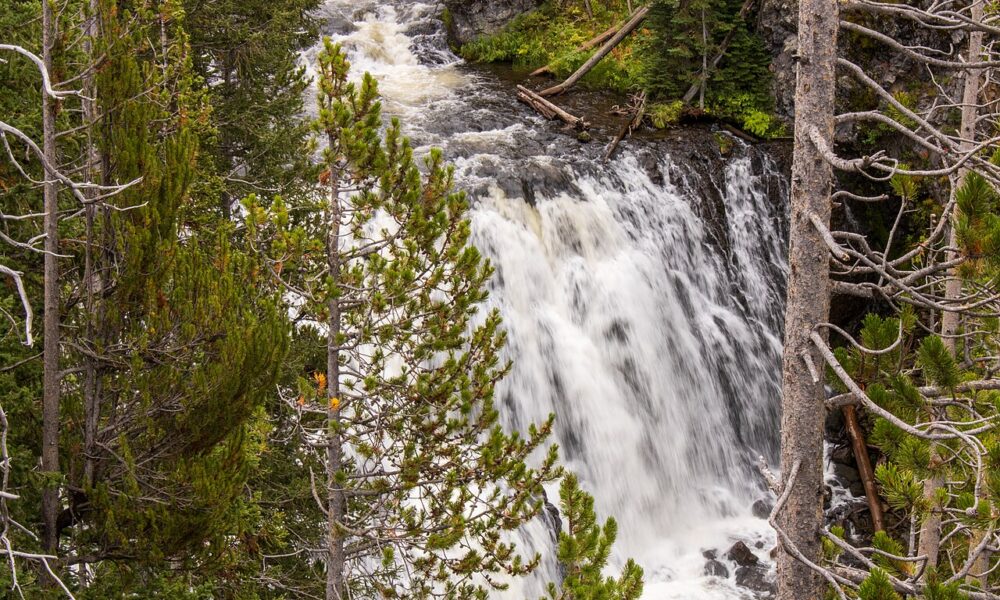
The Firehole River tumbles through a narrow, forested rocky gorge, descending in three connected tiers. The USGS identifies the combined fall as approximately 150 feet. From the viewpoint, the eye follows the whitewater down through the canyon rather than seeing one simple, straight drop. That layered appearance makes the overlook a good choice for photographing moving water and wooded Yellowstone scenery.
Why are there several tiers instead of one waterfall?
Riverbeds respond to differences in rock resistance, slope, erosion and local channel shape. Kepler Cascades follows a series of steep steps in the landscape. At a cascade, turbulent water moves down multiple rocky drops; a waterfall with one vertical lip may produce a different visual profile. The USGS description specifically emphasizes the three-tier structure, which is more precise than describing Kepler as one 150-foot free-fall.
How was Kepler Cascades named?
The waterfall is not named for astronomer Johannes Kepler. According to the U.S. Geological Survey’s Yellowstone history note, the name honors Kepler Hoyt, the 12-year-old son of Wyoming’s territorial governor who visited the park in 1881. Philetus Norris, Yellowstone’s second superintendent, gave the feature its name.
This historical detail is particularly useful when the name appears next to astronomy-related search results. Kepler Cascades is a geographic landmark in Yellowstone and has no direct relationship to NASA’s Kepler planet-hunting space telescope.
Can you visit Kepler Cascades in October 2026?
Potentially, if the Grand Loop Road section is open and safe. Yellowstone’s published 2026 regular-vehicle travel dates show that the West Thumb–Old Faithful (Craig Pass) segment is scheduled for vehicle access from May 8 to October 31, 2026. The Madison–Old Faithful segment is listed for April 17 through October 31, 2026. Those are seasonal dates, not live confirmation that every pullout remains open.
At this point in autumn, rain and snow can temporarily close roads or complicate access. Check NPS road conditions for the specific travel day. Do not rely on an older guide saying “open until October 31” as proof that a pass is open during a snowstorm. Some roads can close earlier for safety.
What happens in winter?
The seasonal road through Craig Pass closes to ordinary vehicles in the colder months. Yellowstone winter transportation operates under separate access rules, with snowmobile or snowcoach services in designated corridors when applicable. Do not treat the roadside overlook as an ordinary drive-up stop after the regular vehicle season ends. Check current winter visitor and concessionaire information before planning a trip.
What is the best time of day for photographs?
Light and shadows vary with season, weather and the position of the sun in the wooded gorge. Overcast light can reduce harsh contrasts when photographing white water, whereas bright direct sun may create strong highlights. This is general waterfall photography guidance, not a claim that Kepler Cascades is always lit perfectly at a specific hour. If the pullout is busy, return at another safe point in your itinerary instead of stopping illegally.
How long should you allow at the Kepler Cascades stop?
Because the viewpoint is near the parking area, Kepler Cascades can fit into a short sightseeing stop. The exact duration depends on traffic, available parking, mobility, weather and how much time you spend photographing the water. Avoid treating a single blog’s “five-minute stop” as guaranteed. On a crowded day the pullout and approaches may require more time.
For itinerary planning, schedule some flexibility between Old Faithful, the scenic road and West Thumb. Waiting for an Old Faithful eruption, driving through wildlife traffic or reaching a temporarily closed road can change travel time significantly.
A practical Old Faithful-area itinerary
- Start with the Old Faithful Visitor Education Center and review the current eruption prediction board.
- Walk maintained geyser-basin paths that are open on the day of your visit, leaving space for wildlife and other visitors.
- When travel on Grand Loop Road toward West Thumb is permitted, drive to the Kepler Cascades pullout.
- Enjoy the view from the level boardwalk, then return to your vehicle.
- Continue to West Thumb or return to Old Faithful according to road conditions and the time available.
The itinerary is a suggested order, not confirmation that every geothermal area, parking lot or road will be accessible simultaneously on your particular visit.
Kepler Cascades vs other Yellowstone waterfalls
| Waterfall | Visitor experience | Planning distinction |
|---|---|---|
| Kepler Cascades | Roadside pullout plus level boardwalk | Near Old Faithful, along seasonal Grand Loop Road |
| Mystic Falls | Hike from the Biscuit Basin area when open | Requires a real hiking outing and access to its trailhead |
| Upper/Lower Falls of Yellowstone River | Grand Canyon of the Yellowstone viewpoints and trails | Different park region, variable walks and overlooks |
| Rustic Falls | Roadside/scenic waterfall area near Golden Gate | Different park region and road logistics |
Kepler is particularly suitable when you want an easy overlook without committing to a longer hike. If the purpose of your day is a substantial waterfall walk, evaluate available trails elsewhere in Yellowstone. Park closures and seasonal conditions can make an otherwise popular trail unavailable. For a comparison with more demanding waterfall walks in a different U.S. national park, see our Dark Hollow Falls Trail guide in Shenandoah. For another park centered on river overlooks rather than a single short waterfall boardwalk, see our Great Falls Park, Virginia guide. Neither of those destinations is in Yellowstone.
Safety, accessibility and pet rules
Stay at the official viewpoint
Do not climb over barriers or scramble down the gorge to get a closer photograph. River currents, steep banks and slippery rock can make an apparently short shortcut dangerous. The designated viewing platform exists to provide a safer way to appreciate the cascade; there is no need to reach the water level.
Can I bring a dog to Kepler Cascades?
Yellowstone generally restricts pets to developed areas within 100 feet of roads, parking areas and campgrounds, on a leash no longer than six feet or otherwise controlled. Pets are not permitted on boardwalks or hiking trails. Therefore, do not assume you may take a dog onto the Kepler Cascades viewing boardwalk just because the waterfall is next to a road. Consult the official Yellowstone pet rules and plan accordingly. Trained service animals have different provisions.
Watch for wildlife and sudden weather changes
Large wildlife can appear on park roads and near pullouts. Keep a safe distance and never approach an animal for a better picture. Yellowstone recommends at least 100 yards from bears and wolves and 25 yards from other wildlife. In fall, prepare for cold wind, ice and sudden snow even if the morning sky is clear. Check road conditions before leaving your lodging.
Are bathrooms and food available at the waterfall?
Do not plan on restrooms, a cafe or visitor services at this small roadside overlook without checking. Old Faithful has visitor facilities, but opening hours and services vary by season. Use the developed areas for routine needs before heading onto the Grand Loop Road.
Photography tips for a natural-looking waterfall image
If you want to photograph Kepler Cascades rather than just see it, start by protecting highlights in whitewater. Water may reflect much brighter than the surrounding trees, which can cause a phone camera to overexpose the foam. Touch the brighter water to adjust exposure where your device allows it, then take additional frames at slightly different exposure levels.
- Use a wider framing to show the three-tier cascade in the forested gorge.
- Try a shorter exposure to freeze droplets and capture the scale of turbulent water.
- Try a longer exposure carefully if your camera has stable support, for a silky-water effect. Do not block the boardwalk with a tripod.
- Keep clear of railings and edges. A unique photo is not worth a dangerous position.
- Use the real subject. Do not substitute stock imagery of unrelated Yellowstone waterfalls and call it Kepler Cascades.
The photograph in this article depicts the actual Kepler Cascades and was supplied as public-domain federal-government media. It is not a generated scene, graphic or visualized hiking map.
Frequently asked questions about Kepler Cascades
Do you need to hike to Kepler Cascades?
No long hike is required for the established overlook. National Park Service visitor information describes a roadside viewing platform reached by a short, level boardwalk from accessible parking.
How high is Kepler Cascades?
The USGS reports a 150-foot descent across three tiers. Do not confuse this with a single vertical waterfall drop.
Where is Kepler Cascades compared with Old Faithful?
The roadside overlook is approximately 3.5 miles southeast of the Old Faithful overpass on the main road, according to NPS. The river distance is different from the road distance.
Is Kepler Cascades open in October 2026?
The park’s published 2026 regular-vehicle dates list the Craig Pass roadway through October 31, subject to weather and emergency closures. This does not verify current opening of the viewpoint or road; check the NPS road-status page close to your visit.
Is Kepler Cascades wheelchair accessible?
Yellowstone’s accessibility guide states that accessible parking is provided and a level boardwalk leads to the view. Contact park staff for current snow, construction or maintenance restrictions.
Can visitors swim at Kepler Cascades?
It is a roadside waterfall overlook, not a designated swimming site. Entering a steep, fast-flowing waterfall gorge is dangerous, and visitors should remain in authorized areas instead of attempting to reach the river from the overlook.
Was Kepler Cascades named after the astronomer?
No. The USGS states it was named after Kepler Hoyt, a 12-year-old who visited Yellowstone in 1881, by superintendent Philetus Norris.
Official source links and editorial verification
- NPS — Explore Old Faithful: verifies roadside pullout and viewing platform.
- NPS — Yellowstone Accessibility: confirms 3.5-mile location, accessible parking and level boardwalk.
- USGS — Kepler Cascades Yellowstone: Firehole River, 150-foot multi-tier drop and naming history.
- NPS — Yellowstone Park Roads: official 2026 regular-vehicle seasonal dates and live road-status resources.
- NPS — Pets: official boardwalk and road-proximity restrictions.
All seasonal access descriptions are based on published dates as of October 13, 2026, not a real-time confirmation that the viewpoint is open. Weather, closures and repairs may change conditions. This article does not claim that its author physically visited the site during the current season.