

Quick answer (reviewed October 13, 2026): The X-37B is a real, uncrewed, reusable orbital spaceplane built by Boeing and operated for the U.S. government. NASA helped develop the original X-37 program, but NASA does not operate today’s X-37B missions. NASA’s early research program began in 1999; responsibility transferred to DARPA in 2004. The modern Orbital Test Vehicle program involves the Department of the Air Force Rapid Capabilities Office, the U.S. Space Force and Boeing. The X-37B lands horizontally like a small space shuttle, but it is not a crewed NASA shuttle, an International Space Station transport, or a publicly documented science telescope.
That distinction answers a surprisingly common search for NASA X-37B: NASA’s historical connection is real, while the ownership, operator, mission objectives and launch site are frequently conflated. This guide separates what government and manufacturer records actually confirm from speculation.
What is the X-37B—and why do people connect it with NASA?
The Boeing X-37B is a winged, robotic spacecraft carried to orbit inside or atop a launch rocket. After an orbital mission it performs atmospheric reentry and an automated runway landing. That makes it different from a conventional satellite, which generally remains in space or burns up, and different from a crewed shuttle, because the X-37B carries no astronauts.
The NASA link is historical, not invented. A NASA history page describes a July 1999 cooperative agreement with Boeing for the X-37 experimental orbital vehicle. NASA’s own technical report, Learning Lessons from the X-37 Project, explains that the program began within NASA’s Future X work and that ownership moved to the Defense Advanced Research Projects Agency (DARPA) in mid-2004.
Because the vehicle’s roots include NASA, old NASA drawings and archival descriptions may appear in modern search results. They should not be interpreted as evidence that NASA directs current X-37B missions.
Who actually owns, builds and operates the X-37B?
| Organization | Documented connection | What it does not mean |
|---|---|---|
| NASA | Originated and participated in early X-37 research and contributed technical expertise after the transfer. | NASA is not the present-day flight operator merely because a launch uses its Kennedy Space Center facilities. |
| DARPA | Accepted the original program transfer from NASA in 2004 for subsequent experimental development. | Its historical role should not be confused with the operator of the latest orbital missions. |
| Department of the Air Force Rapid Capabilities Office | Identified by Boeing and government mission announcements as a lead government program partner. | Not the company that manufactures the aircraft. |
| U.S. Space Force | Conducts the operational space missions and publicly announces launches, experiments and runway recoveries. | Does not release every payload detail; some information remains restricted. |
| Boeing | Designs, builds, integrates and supports the reusable vehicle. | A Boeing-built craft is not a commercial passenger shuttle. |
| SpaceX and other launch providers | Supply rockets on selected missions; for example, Falcon Heavy launched Mission 7, and Falcon 9 launched Mission 8. | Providing a rocket does not make the rocket company the X-37B’s operator. |
For the current division of responsibilities, see Boeing’s X-37B program description and the Space Force’s official seventh-mission report. Roles can evolve, so compare statements against the date on each source.
The X-37B timeline: from NASA experiments to current military missions
| When | Verified milestone | Why it matters |
|---|---|---|
| 1999 | NASA and Boeing started the X-37 cooperative development effort. | This is the primary reason searches associate the spaceplane with NASA. |
| Mid-2004 | NASA transferred X-37 ownership to DARPA. | The experimental program moved into a defense research context. |
| April 22, 2010 | The first X-37B Orbital Test Vehicle launched. | Marked the beginning of the orbital mission series. |
| December 3, 2010 | Mission 1 landed at Vandenberg after more than 220 days in orbit. | Demonstrated a real uncrewed return, recovery and inspection cycle. |
| December 2023–March 7, 2025 | Mission 7 flew for more than 434 days and landed at Vandenberg. | Included a first Falcon Heavy launch and a publicly described aerobraking demonstration. |
| August 21, 2025 | Mission 8 launched on a Falcon 9 from Kennedy Space Center. | Demonstrated another reusable flight cycle, with several publicly announced technology tests. |
Important date distinction: Boeing’s headline count of seven completed missions refers to its reported total after Mission 7 returned in March 2025. Boeing separately says the eighth mission launched in August 2025. These statements are not contradictory. Do not use a completed-mission tally to infer the landing date or current orbital status of Mission 8 without a specific, dated announcement. As of this article’s October 13, 2026 review, the referenced program records establish the eighth launch; they are not evidence of a particular later landing.
What happened on the seventh X-37B flight?
The seventh mission, commonly called OTV-7, launched aboard a SpaceX Falcon Heavy in December 2023 and operated in a highly elliptical orbit. An elliptical orbit has a much greater difference between its closest and farthest points from Earth than a roughly circular low-Earth orbit.
The U.S. Space Force confirmed on March 13, 2025 that the spacecraft had landed autonomously at Vandenberg Space Force Base on March 7, 2025. It had spent more than 434 days on orbit. The service also described an aerobraking demonstration: the vehicle used atmospheric drag over repeated passes to change its orbit while conserving propellant. Mission 7 included testing related to space-domain awareness, but not every experimental detail was released.
That is a stronger answer than saying the spacecraft was merely “secret.” We can identify the rocket, landing site, flight duration, maneuver type and published goals; we cannot independently describe an undisclosed payload.
What is known about the eighth mission?
The U.S. Space Force’s August 2025 announcement and Boeing’s program updates identify August 21, 2025 as the launch date for OTV-8, from Kennedy Space Center’s Launch Complex 39A aboard a SpaceX Falcon 9.
Among its publicly stated experimental themes are laser communications and a quantum inertial sensor. Laser-communication demonstrations examine ways of moving data using optical links. Inertial sensing measures motion-related quantities and could inform future navigation capabilities when conventional satellite navigation signals are unavailable or unsuitable. Announcing these experiments does not prove that every proposed future operational use already works.
A useful place to track the official record is the Space Force newsroom, followed by Boeing’s program page. Check the publication date: older articles may accurately describe the status at the time but no longer represent the latest mission count.
What does a real X-37B look like?
Unlike circulating concept art, the photograph here shows the actual X-37B spacecraft on the ground immediately after its first orbital mission in December 2010. Its dark thermal-protection tiles, short wings, landing gear and inspection team are visible. The image is a real historical U.S. Air Force photograph—not a rendering or an artist’s concept.
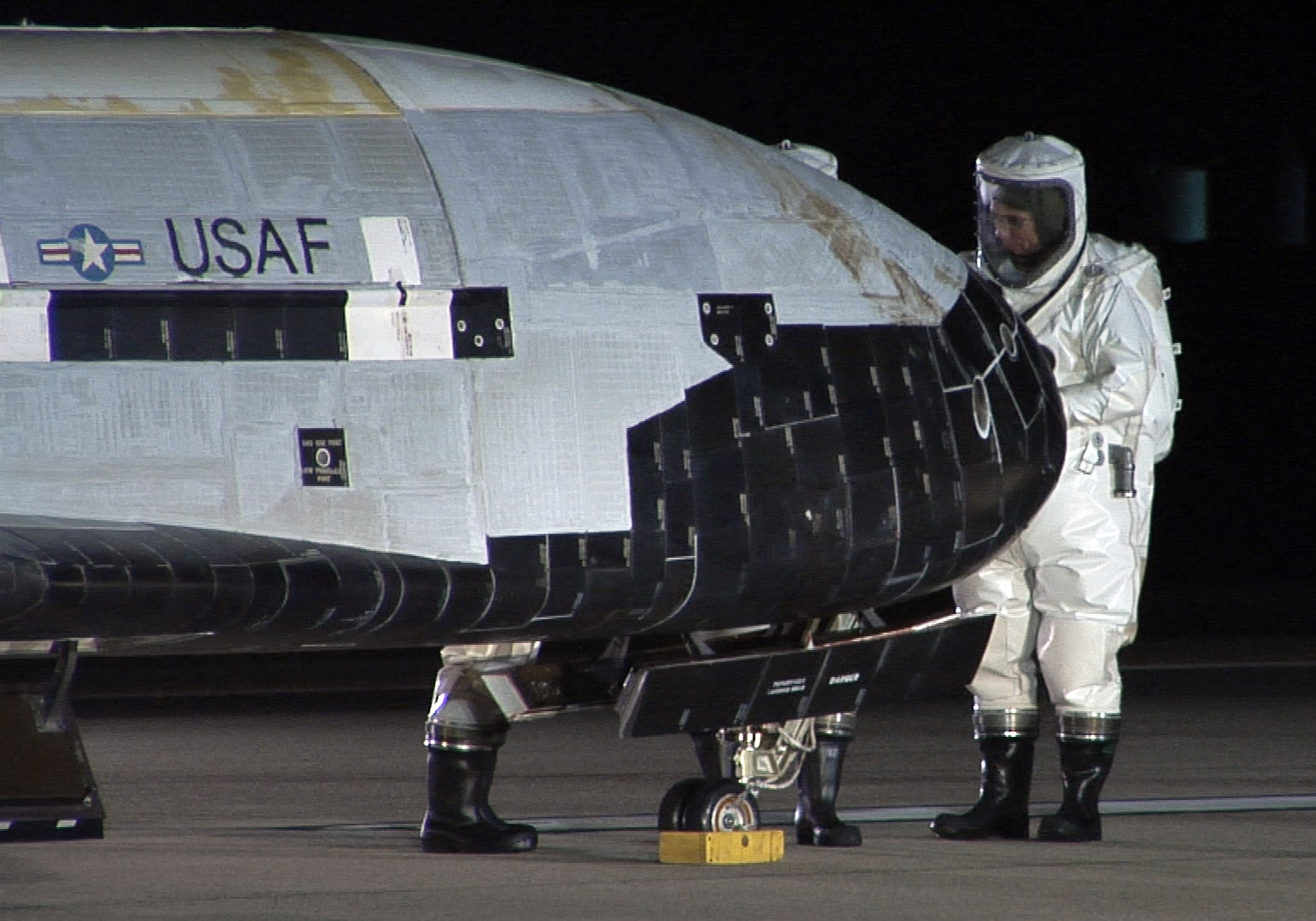
The article’s featured image is a different authentic photograph: the vehicle on the runway after the March 2025 seventh mission. Because both photographs show the specific vehicle under discussion, neither should be substituted with generic rocket art or unrelated NASA imagery.
Is the X-37B part of the International Space Station program?
No. The ISS is a crewed orbital research station run through an international partnership. The X-37B is a distinct robotic spacecraft that returns experimental hardware to Earth. Neither the X-37B’s small shuttle-like shape nor NASA’s historic development involvement makes it an ISS crew ferry. For the real public camera feed and tracking tools for the station, see our separate guide to NASA’s live ISS camera and station tracking.
What remains unknown—and which X-37B claims should you doubt?
- Not every payload is public. Official descriptions of a technology demonstration do not amount to a full payload manifest.
- Do not infer weapons from the vehicle’s appearance. A military spacecraft may be used for defense research without public proof of a particular claimed weapon or event.
- Do not equate a launch site with a mission owner. Kennedy Space Center access does not make a Space Force flight a NASA-operated mission.
- Be careful with unofficial “live location” pages. A precise orbital position requires suitable reliable tracking data; unsupported dots or maps are not proof of the current trajectory.
- Verify dates, not just mission numbers. “Eighth flight launched” and “eight flights completed” describe different milestones.
Frequently asked questions
Did NASA create the X-37B?
NASA and Boeing began the original X-37 development program in 1999. The subsequent military-operated X-37B reflects that early technical heritage, but NASA does not run present-day X-37B missions.
Does the X-37B carry astronauts?
No. It is an uncrewed, autonomous orbital test vehicle.
Can the X-37B return to Earth?
Yes. The reusable vehicle is built to survive atmospheric reentry and make a runway landing; its December 2010 and March 2025 returns are documented examples.
Who built the X-37B?
Boeing is the primary spacecraft manufacturer. SpaceX or another launch provider supplying a rocket does not change who built the orbital vehicle.
Did NASA launch the eighth X-37B mission?
The launch took place at NASA’s Kennedy Space Center in August 2025, but the mission was a U.S. Space Force/Department of the Air Force program with Boeing as spacecraft contractor and SpaceX as launch provider.
Why are some X-37B facts classified?
The vehicle supports government and defense experimentation. The authorities disclose selected technologies, launch and landing milestones, while withholding other mission details. The absence of public details should be reported as an information limit, not filled with speculation.
How this guide was checked
Facts were cross-checked against primary records: NASA’s X-37 program history, NASA’s aircraft archive, the official OTV-7 landing announcement and Boeing’s program status. This is a documentary explainer based on published records, not a claim of first-hand spacecraft testing. Last editorial fact check: October 13, 2026.

Other Articles

King Legacy Codes (October 2026): 2x EXP, Stat Resets and Gems
Driving Empire Codes (October 2026): Free Cash and Reward Cars
