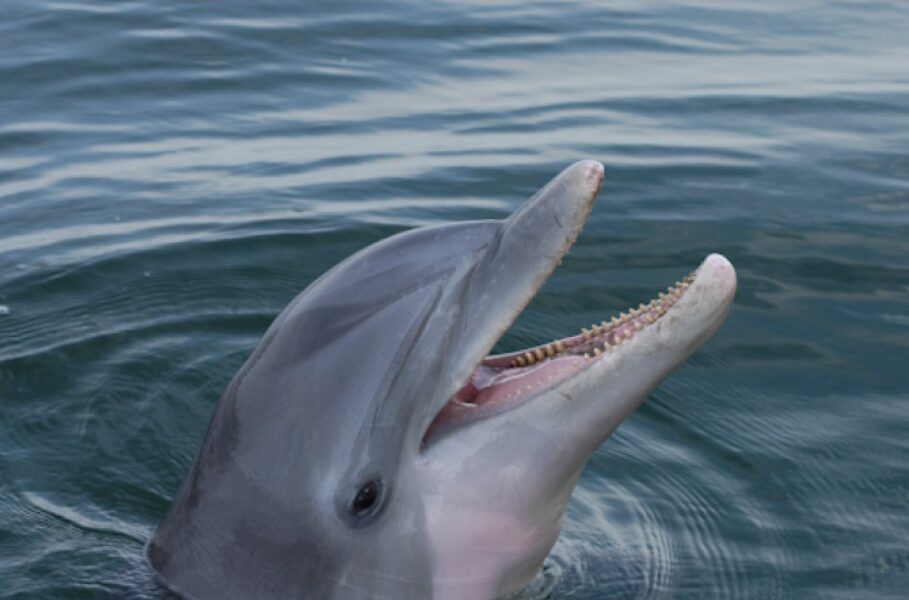
Common Bottlenose Dolphin: Real NOAA Photo, Facts, Echolocation and Dolphin vs Porpoise

Quick answer: The common bottlenose dolphin (Tursiops truncatus) is a toothed marine mammal found in temperate and tropical oceans. It has a relatively short, thick beak, a curved dorsal fin and gray skin that is often lighter underneath. It breathes air through a blowhole, finds prey partly with echolocation and has complex social groups. NOAA Fisheries lists a broad size range of 6–13 feet and 300–1,400 pounds; these are species-wide figures, not the size of every dolphin you see near a beach.
Common bottlenose dolphin facts
| Feature | Fact |
|---|---|
| Scientific name | Tursiops truncatus |
| Animal type | Toothed whale, dolphin family Delphinidae |
| Adult length | Approximately 6–13 feet across populations |
| Adult weight | Approximately 300–1,400 pounds across populations |
| Lifespan | About 40–60 years, with considerable variation |
| Food | Fish, squid and other marine animals, including some crustaceans |
| Distribution | Tropical and temperate seas worldwide |
| Protection in U.S. waters | Marine Mammal Protection Act |
Measurements, ecology and conservation information are from NOAA Fisheries’ common bottlenose dolphin profile, updated September 2026.
How can you recognize a common bottlenose dolphin?
Look for the short, stocky beak and the curved dorsal fin on a streamlined body. The upper body is generally gray, while the belly tends to be paler. Adult size and coloration vary among oceanic populations; a small coastal dolphin should not be identified from color alone. A close-up photo of the face is especially useful because it shows the beak shape separating these dolphins from porpoises.
Is every bottlenose dolphin the same species?
No. Historically, many Atlantic coastal dolphins were grouped under Tursiops truncatus, but modern genetic and morphological research has recognized Tamenend’s bottlenose dolphin (Tursiops erebennus) as a separate species in some western North Atlantic coastal habitats. NOAA discusses this distinction in its science section. A species-level photo caption should therefore be more precise than simply “a dolphin off Florida.”
What do bottlenose dolphins eat?
They consume fish, squid and some crustaceans. Hunting techniques depend on habitat and social conditions. In some locations groups herd fish against shoals, banks or seawalls, while other dolphins hunt more independently. Rather than chewing food into pieces the way many terrestrial mammals do, dolphins typically grip fish with their conical teeth and swallow prey largely whole.
How echolocation works
Dolphins produce high-frequency clicks and listen for returning echoes. The time and shape of the returning sound give information about objects or prey underwater. Echolocation is not a substitute for hearing or vision: dolphins use several senses. It also should not be confused with the clicking sonar equipment on boats, even though both involve interpreting sound reflections.
Do dolphins live in families?
Dolphin groups can change composition over time, a pattern scientists call fission–fusion social organization. Animals may gather, separate and reunite depending on feeding, protection, breeding and other conditions. Mothers maintain particularly important relationships with calves, which often swim in a position alongside and slightly behind the adult.
NOAA explains that calves may remain with their mothers for three to six years, although weaning occurs earlier. Females typically have a gestation of about 12 months. This long period of maternal care helps young animals learn foraging and social behavior.
Common bottlenose dolphin versus harbor porpoise
| Identification clue | Bottlenose dolphin | Harbor porpoise |
|---|---|---|
| Head | More obvious elongated beak | Blunter, rounded head with little protruding beak |
| Teeth | Conical | Spade-shaped |
| Size | Usually larger | Generally smaller |
| Dorsal fin | Typically strongly curved | More triangular appearance |
| Behavior near people | Some individuals are conspicuous | Often quieter and less showy at the surface |
These differences help identify animals at a distance but are not reliable in every photograph or situation. Dolphins are mammals rather than invertebrates. For a different part of ocean life, AVARIXO also explains how deep-sea jellyfish differ from marine mammals.
Why are bottlenose dolphins protected?
NOAA tracks dolphin populations by stocks, not as one single U.S. population. Some stocks in the western North Atlantic are classified as depleted. Fishing-gear entanglement, illegal feeding, vessel strikes, noise, contamination and habitat changes may affect individual stocks differently. A species that is familiar to tourists can still face serious conservation problems.
Why feeding wild dolphins is harmful
Human feeding can change natural foraging and make dolphins approach boats and hooks. NOAA notes this increases the risks of vessel collisions and fishing-gear injury. In the United States, harassing wild marine mammals is illegal, and encouraging an animal to approach a boat is not responsible wildlife watching.
How to watch dolphins without disturbing them
- Choose a designated viewing area or responsible licensed operator.
- Do not chase or circle dolphin groups with a boat.
- Never throw fish or food into the water to attract them.
- Do not try to touch, swim toward or separate mothers from calves.
- Allow animals to set the distance; change course if dolphins show avoidance behavior.
- Report an injured, stranded or entangled animal to authorized local responders.
How scientists identify individual dolphins
Researchers frequently use photographs of dorsal fins: individual cuts, notches and scars may form recognizable patterns. Such photo-identification catalogs help study relationships, movement, survival and changes in population size. NOAA describes the long-running Sarasota Dolphin Research Program as one example of how ongoing field observations can reveal marine-mammal behavior.
Frequently asked questions
Is a common bottlenose dolphin a whale?
Yes in the broad scientific sense. Dolphins are toothed cetaceans; the common bottlenose dolphin belongs to the oceanic dolphin family.
Does it breathe underwater?
No. Dolphins must surface to breathe air through a blowhole.
How long do they live?
Many live for several decades. NOAA describes a typical range around 40–60 years, but individuals vary.
Can dolphins recognize each other?
Research supports complex acoustic and social communication, including individually distinctive whistles. A whistle is not literally a spoken human name.
Are bottlenose dolphins endangered everywhere?
No single label captures every stock. NOAA identifies some U.S. stocks as depleted, while other populations have different conservation trends.
Do dolphins chew fish?
They usually grip with teeth and swallow fish rather than grinding them like people do.
Reviewed October 2026. Primary source: NOAA Fisheries, Common Bottlenose Dolphin. For details about dolphin versus porpoise facial appearance, see NOAA’s identification guide.