
Quick answer: Animation history did not begin with television or computer graphics. Artists were creating the illusion of movement with optical devices in the nineteenth century, and early filmmakers developed drawn animation around 1900. Émile Cohl’s Fantasmagorie (1908) helped establish cartoon filmmaking, Winsor McCay’s Gertie the Dinosaur (1914) showed how an animated character could express personality, and later studios made repeated production possible through techniques such as cel animation. The story continued from stop-motion and hand-painted films to synchronized sound, full-length cartoons, computer-generated 3D features and today’s mixture of techniques.
Animation history: the key dates
| Period | Example or innovation | Why it mattered |
|---|---|---|
| 1830s–1890s | Zoetrope, phenakistiscope and other optical toys | Sequential images create apparent motion. |
| 1890s | Stop-motion tricks and early film experiments | Filmmakers discover how frame-by-frame changes alter recorded action. |
| 1906 | J. Stuart Blackton’s Humorous Phases of Funny Faces | Drawn imagery is animated through film photography. |
| 1908 | Émile Cohl’s Fantasmagorie | Fluid, transforming stick-like drawn forms demonstrate cartoon possibilities. |
| 1911 | Winsor McCay’s Little Nemo | Detailed hand-drawn character motion reaches film audiences. |
| 1914 | Gertie the Dinosaur | A convincing animated character interacts with live performance. |
| 1910s–1920s | Cel animation and organized studios | Backgrounds can be reused while characters change frame to frame. |
| 1928 | Steamboat Willie | Synchronized sound becomes a celebrated commercially successful cartoon technique. |
| 1937 | Snow White and the Seven Dwarfs | A landmark American full-length cel-animated theatrical feature. |
| 1995 | Toy Story | Major milestone as the first full-length computer-animated theatrical feature. |
| 2000s–2020s | 3D, digital 2D, stop-motion and hybrid films | Different animation methods coexist rather than simply replacing one another. |
The Library of Congress’s study of American animation from 1900 to 1921 is a primary institutional reference for the early films and production techniques.
Before cartoons: how optical toys created movement
An image projected on a screen is not automatically animated. Motion appears when viewers see a timed sequence of pictures that differ slightly. Nineteenth-century devices such as the zoetrope and phenakistiscope used drawings arranged around a rotating disk or cylinder. Watching through slots or with a mirror made the drawings appear to move. Such toys established the core principle of sequential imagery long before practical motion-picture cameras existed.
Early animation history should not confuse an optical illusion toy with a recorded motion picture. Both can animate images, but only one requires photographic film.
Who made the first animated cartoon?
There is no single universally accepted title for “the first animated film” because experiments took different forms: hand-drawn sequences, cutouts, stop-motion objects and projected optical images. J. Stuart Blackton’s Humorous Phases of Funny Faces (1906) is an important early example of drawn animation on film. In France, Émile Cohl developed Fantasmagorie (1908), known for fluid, playful morphing drawings.
How Fantasmagorie worked
Cohl photographed successive drawings so that shapes transformed from moment to moment. The film’s unusual white-line-on-dark appearance gives it a distinct graphic style. Its impact was not the realism of its people but the freedom of drawing: a picture could transform into something physically impossible between frames. The British Film Institute’s history of early Parisian animation explains the importance of this innovative work.
Gertie the Dinosaur and the invention of animated personality
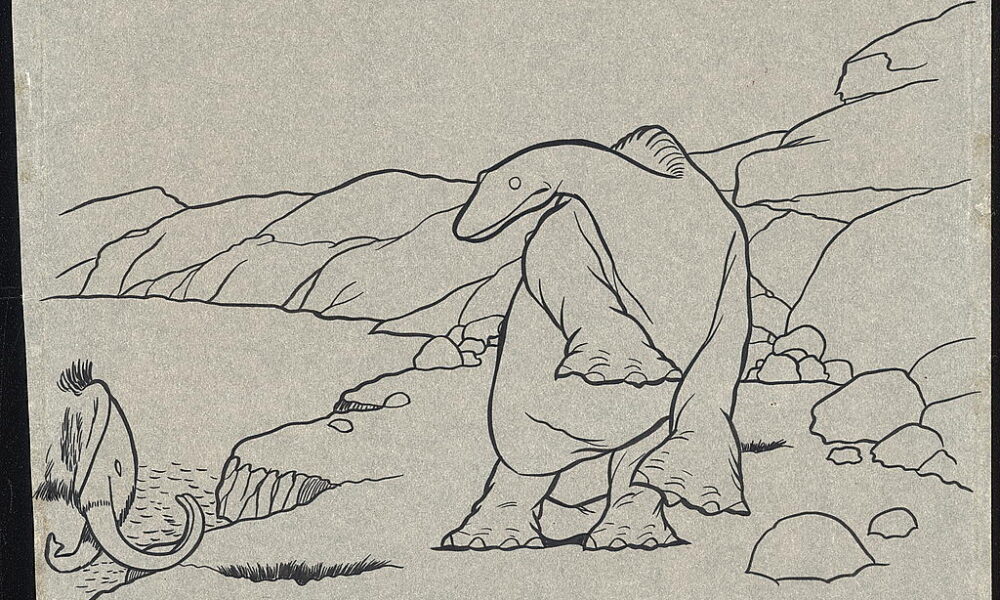
American newspaper cartoonist Winsor McCay created Gertie the Dinosaur in 1914. Gertie did not merely perform mechanical movements; she seemed to think, hesitate, react to commands and show moods. McCay incorporated this sequence into a stage act in which he appeared to interact with the animal on screen.
The Library of Congress holds a historical record of Gertie. The character’s expressive gestures helped prove that animation could sustain audience attention through performance and personality, rather than only novelty. A surviving still frame depicts Gertie standing beside a large mammal, and is direct evidence of the real historical work—not a modern invented depiction of the film.
What is cel animation?
Early hand-drawn films were labor intensive because entire pictures often had to be recreated. Cel animation addressed part of this problem by drawing moving characters on transparent cellulose sheets positioned over a separate background. Because the scenery did not need to be redrawn for each new character pose, studio production became more scalable.
Key traditional-animation steps
- Storyboard: rough drawings plan the sequence, camera angle and timing.
- Key poses: an animator establishes the most important moments of an action.
- In-between drawings: additional poses fill the gaps to create smooth motion.
- Cleanup and color: artwork is refined and made consistent.
- Photography: layered drawings are captured in sequence to create the finished footage.
- Sound: dialogue, effects and music are recorded and synchronized.
The system evolved over time and differed among studios; this simplified workflow should not be mistaken for one unchanged process since 1914.
Did Steamboat Willie invent sound animation?
No. Sound experiments preceded the cartoon. Disney’s Steamboat Willie, released in 1928, was a prominent, commercially successful example of synchronized sound that attracted enormous attention. Its significance lies in timing, sound and character business working together; calling it the first animated film with sound ever made erases earlier experiments.
Sound transformed character acting because the animator had to coordinate gestures with music, dialogue and effects. In the 1930s, cartoons became more elaborate, with extensive orchestration, color technology and new approaches to staging.
From short cartoons to feature films
Animated shorts were easier to finance and distribute than long animated stories. Walt Disney’s 1937 Snow White and the Seven Dwarfs showed that a U.S. studio could build an entire theatrical feature around character animation, music and dramatic storytelling. Other countries had produced earlier feature-length animation, so “the first feature-length cartoon in the world” is inaccurate. Snow White’s importance is its particular technical, commercial and artistic achievement in American cel animation.
How stop-motion differs from drawn animation
In drawn animation, images or digital drawings change from frame to frame. In stop-motion, real models or objects are moved slightly between photographed frames. A puppet or clay figure may move continuously on screen even though the film is made from a sequence of still images. It is a genuine animation technique, not a special effect produced by accelerating normal footage.
Computer animation: from research to Toy Story
Computers made new kinds of three-dimensional motion possible as researchers developed modeling, rendering, texture and lighting systems. Some films combined practical or drawn animation with digital elements before completely computer-generated features became viable. Pixar’s Toy Story (1995) is a major milestone as the first feature-length entirely computer-animated film released theatrically. It was not the first use of CGI in a film.
| Method | What moves between frames? | Typical strength |
|---|---|---|
| Hand-drawn 2D | Drawings on paper or a digital canvas | Expressive graphic shapes and stylized motion |
| Stop-motion | Physical models or puppets photographed repeatedly | Tangible textures and handmade environments |
| 3D computer animation | Digital rigs, cameras and models | Reusable characters, virtual sets and complex camera movement |
| Hybrid | Multiple forms combined | Artists can use different methods for specific scenes or effects |
Why animation did not become “all CGI”
Traditional 2D methods and stop-motion continue to be made because they create visual styles that do not arise automatically from 3D tools. Modern software can also draw on computers without producing three-dimensional characters. For audiences, the essential question is whether the visual technique suits the story, not whether it uses the newest software.
Animation belongs to a wider history of cinema. For a contrasting early live-action silent-film experience, AVARIXO discusses Wings (1927) and its pioneering aerial sequences, which use photographed actors and aircraft rather than hand-drawn characters.
Frequently asked questions
What is the oldest animated film?
The answer depends on definitions and which examples survive. Blackton’s 1906 film and Cohl’s 1908 Fantasmagorie are important early surviving drawn-film landmarks.
When was Gertie the Dinosaur made?
1914, by Winsor McCay.
What was the first computer-animated feature film?
Toy Story (1995) is recognized as the first feature-length entirely computer-animated theatrical film.
Does 2D animation always use paper?
No. Many modern 2D productions use digital drawing and compositing software.
Was Snow White the world’s first animated feature?
No. It was a pioneering American cel-animated feature released in 1937; earlier feature-length animation existed elsewhere.
Sources: Library of Congress animation origins, Gertie historic film record and BFI early animation scholarship. Historical review October 2026.