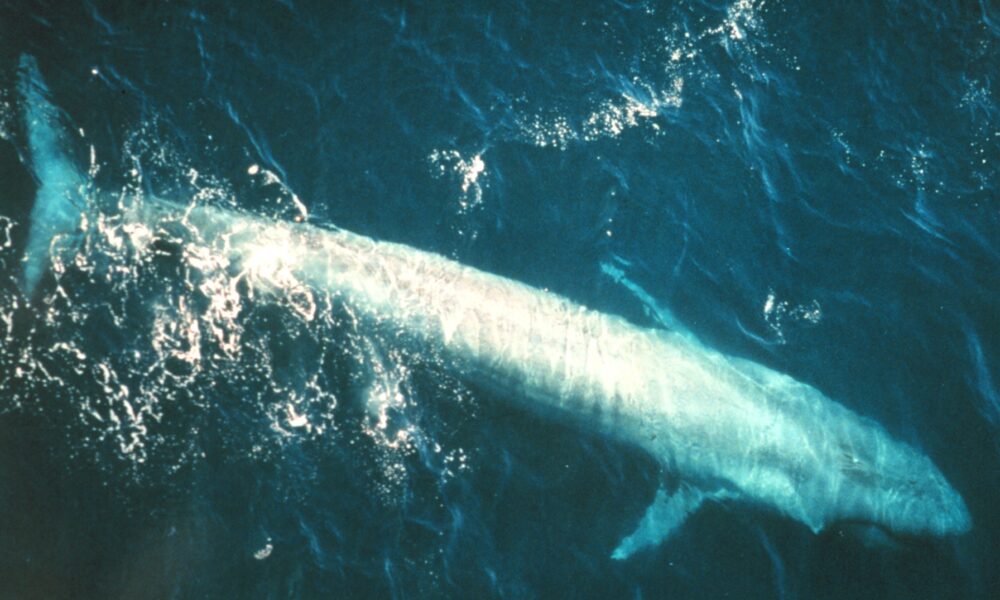

A blue whale can reach about 110 feet (33.5 meters) in length and up to 330,000 pounds (150 metric tons) in exceptional Antarctic individuals, according to NOAA Fisheries. That makes the blue whale the largest animal known to have lived on Earth. However, not every blue whale is 110 feet long: adults in the North Pacific and North Atlantic are commonly smaller, with NOAA describing animals around 90 feet long. The largest sizes are unusual and should not be mistaken for an average.
This guide explains real blue whale dimensions, how much adults and calves weigh, how a whale compares with a school bus or basketball court, and why these enormous mammals can survive on krill. The photographs are actual NOAA blue whale images, not AI mockups. Dimensions are drawn from NOAA’s current species profile and labeled so you can tell a maximum from a typical range.
Blue whale measurements at a glance
| Measurement | Real-world figure | Important context |
|---|---|---|
| Maximum reported length | Up to about 110 ft (33.5 m) | Exceptional Antarctic blue whales |
| Maximum reported weight | Up to about 330,000 lb (150 metric tonnes) | Exceptional Antarctic blue whales |
| North Atlantic and North Pacific adults | Up to about 90 ft (27.4 m) in NOAA’s overview | Regional figures, not the world maximum |
| Newborn calf length | About 23 ft (7 m) | Approximate, varies among calves |
| Newborn calf mass | About 5,000–6,000 lb (2.3–2.7 metric tonnes) | Approximate examples, not a fixed birth weight |
| Estimated lifespan | About 80–90 years | NOAA’s species profile estimate |
| Primary diet | Krill | Tiny crustaceans, eaten in very large numbers |
NOAA’s blue whale species profile supplies the maximum size and notes that Antarctic whales tend to be larger than northern populations. The newborn values are approximate figures reported in science and education resources; actual calf size depends on individual and population. Avoid using the maximum weight as the weight of every whale you see photographed.
How long is a blue whale compared with a school bus or basketball court?
A full-size U.S. school bus is often roughly 35–40 feet long. A very large blue whale measuring 100–110 feet is therefore about 2.5–3 bus lengths, depending on the bus chosen. A smaller adult measuring 70–90 feet is closer to roughly two bus lengths. These comparisons are scale illustrations, not measurements taken of one individual whale next to one standard bus.
A regulation NBA basketball court is 94 feet long. A particularly large blue whale can exceed that length, while many adult whales are shorter. If you see a viral graphic that shows a blue whale as 150 feet long, treat it skeptically unless a reliable measurement accompanies it. NOAA’s species profile gives a maximum of about 110 feet, not the exaggerated lengths sometimes spread in memes.
| Item or animal | Example length | Relative to a 100-ft blue whale |
|---|---|---|
| Typical full-size school bus | About 35–40 ft | About 2½–3 buses |
| NBA basketball court | 94 ft | A little shorter |
| Very large blue whale | 100–110 ft | Approximately its full length |
| Newborn blue whale calf | Around 23 ft | About one-quarter as long |
The comparisons use rounded lengths and are intended to help visualize scale, not imply every bus, court or whale is identical. Length and mass are also different quantities: a whale twice as long as another animal is not necessarily twice as heavy.
What does a real blue whale look like from above?
The blue whale’s body is long, tapered and often mottled blue-gray rather than a bright uniform blue. A relatively small dorsal fin sits far back toward the tail. The broad head and powerful tail region become easier to recognize from an elevated vantage point, though sunlight reflecting through moving water can distort the apparent shape.
The featured photograph shows an actual adult blue whale swimming in the eastern Pacific Ocean, supplied by the NOAA/NMFS Northeast Fisheries Science Center. Its long, slender body shape helps explain why “size” means much more than a cartoon outline: the animal is built to swim efficiently through water, not to support its mass on land. The second real NOAA image further below shows a close view of the animal surfacing.
How much does a blue whale weigh?
NOAA gives a maximum around 330,000 pounds for the largest Antarctic blue whales. For scale, 330,000 pounds is 165 U.S. short tons or about 150 metric tonnes. Many blue whales weigh substantially less. NOAA describes North Atlantic and North Pacific whales as often more than 100,000 pounds, but that is still far below the exceptional Antarctic maximum.
Different articles may quote “150 tons,” “165 tons,” or “330,000 pounds” without saying whether the unit is metric or U.S. customary. Those figures can refer to approximately the same total mass when converted correctly. Never compare 150 metric tonnes to 150 U.S. short tons as if they were interchangeable.
Can you weigh a blue whale alive?
Accurately weighing a free-swimming animal is difficult. Modern researchers can estimate body volume and condition using measurements from aerial images or other methods, but estimated mass depends on the model and physical assumptions. Historic records from whales handled during commercial whaling offer another source of information but are not the same as modern noninvasive measurements of living animals.
How big is a newborn blue whale?
A blue whale calf is already huge compared with most adult land mammals: around 23 feet (7 meters) long at birth and weighing several thousand pounds. Young calves feed on highly nutritious maternal milk and can gain mass rapidly. Because published calf weight estimates vary across sources, it is more accurate to describe birth size as an approximate range than to claim that every calf weighs exactly one number.
Blue whales are mammals, so females give birth to live calves and nurse them. Adult females are generally larger than adult males, according to NOAA. The ability to grow to enormous size is linked to an aquatic environment that supports the animal’s body and provides large, concentrated seasonal food sources.
How can the largest animal live on tiny krill?
Krill are small shrimp-like crustaceans, but they can gather in enormous swarms. Blue whales feed by lunging into dense patches of these animals, engulfing water and prey, then forcing much of the water out through baleen plates. Their flexible throat grooves allow the mouth and throat area to expand dramatically during feeding.
NOAA reports that large blue whales can consume up to about six tons of krill in a day under favorable feeding conditions. That is a maximum-style estimate, not a daily requirement that every whale reaches everywhere in the world. The whale needs enough energy to maintain its massive body and build reserves for migration or seasons when prey is less available.
Baleen is not a set of ordinary teeth; it is a filtration system that allows the whale to separate food from seawater. Despite the whale’s intimidating mouth size, krill—not large fish or swimmers—make up the overwhelming majority of the diet. Blue whales sometimes consume other small prey opportunistically, but krill are their primary food.
How big is a blue whale’s heart?
NOAA’s feature The Big-Hearted Blue Whale says the heart of a large blue whale can weigh approximately 400 pounds, on the order of a large upright piano. This striking comparison is widely quoted, but it is a rough description of the organ’s size—not a claim that every individual has a 400-pound heart. A whale’s heart, like the rest of its body, varies with age and individual size.
The whale’s circulatory system supplies oxygen to a very large body while supporting diving and active swimming. Marine mammals are adapted for repeated breath-holding and pressure changes during dives, but they still breathe air through their blowholes at the water’s surface.
Why can a blue whale appear black rather than blue?
From a boat, the whale’s upper surface often looks dark gray, slate or nearly black. Underwater light and surface reflections can produce a more blue impression. The whale’s coloration is not a neon-blue patch and does not provide a reliable way to estimate its age or weight.
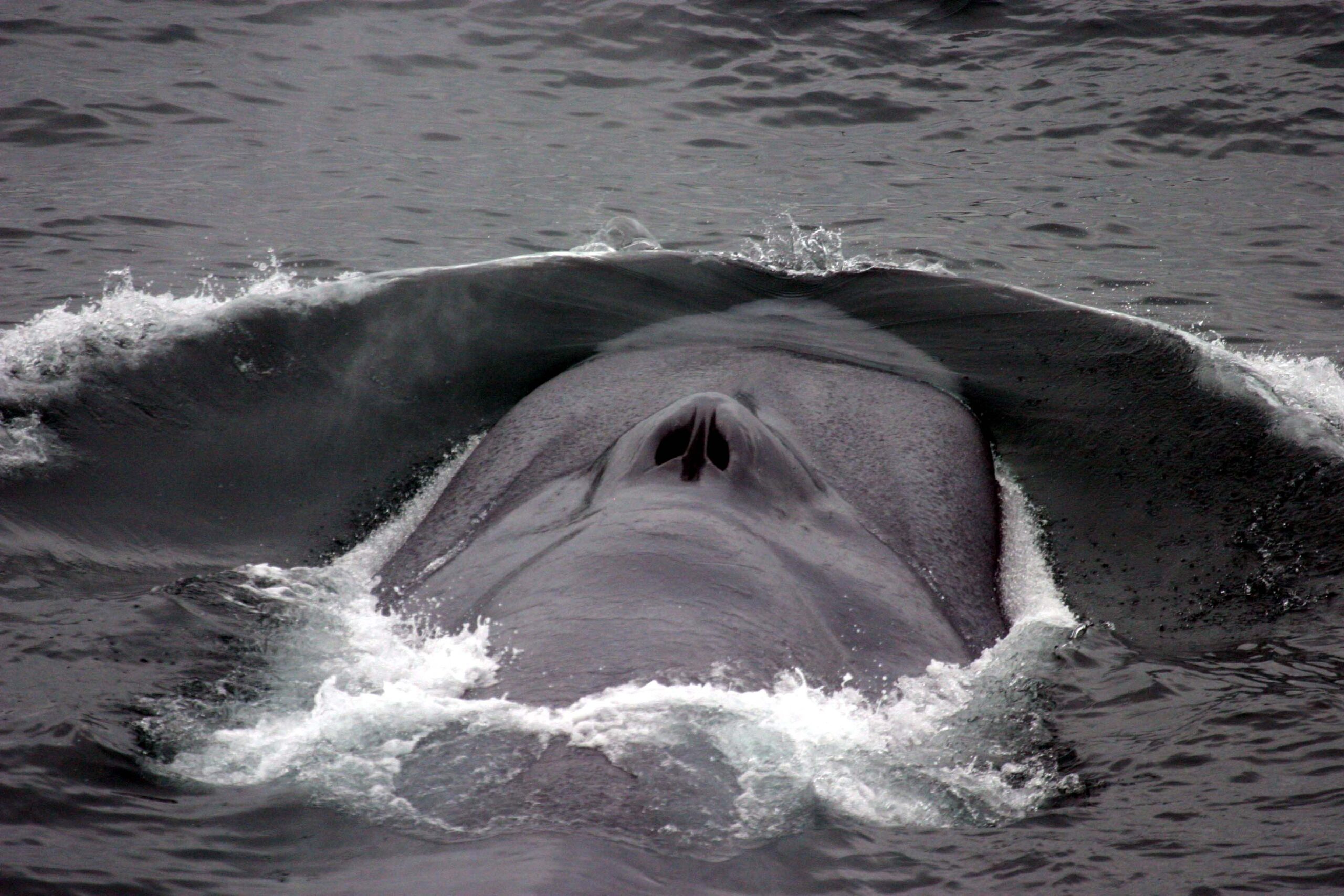
This second NOAA photograph shows a real blue whale at the surface with the paired blowhole opening visible above the waterline. It is a close-up, not a complete-body scale photograph, so it is excellent for identifying anatomy but unsuitable for measuring overall length from pixels alone.
Is the blue whale longer than the biggest dinosaurs?
Blue whales are widely recognized as the largest animals known to have lived, including when compared with the most massive dinosaurs. However, comparisons involving extinct animals are inherently less certain because dinosaur body mass is reconstructed from incomplete fossils and physical models. It is better to say largest known animal by mass than to invent a record for an unmeasured individual dinosaur or whale.
Some giant sauropod dinosaurs were extremely long, and estimates for their total body lengths vary. But extreme body length does not automatically translate to a heavier animal. The most dependable blue whale comparisons use measured or carefully estimated mass in correctly named units.
Are blue whales bigger than humpback or fin whales?
Blue whales are the largest living whales. Fin whales are often described as the second-largest whale species; humpback whales, while large, are generally shorter and much lighter than very large blue whales. Exact ranges overlap because species have variation by sex, geography and age, so a universal ranking based on one spectacular photograph can be misleading.
To identify whales, observers consider body shape, surfacing behavior, dorsal-fin position, coloration, blow and tail traits. Size alone is hard to judge from a boat. Blue whales have a long streamlined body and a small dorsal fin set well back. Humpbacks are especially recognized by long pectoral fins and distinctive diving behavior.
Where do the largest blue whales live?
NOAA explains that Antarctic blue whales tend to be larger than blue whales in the North Atlantic and North Pacific. The species occurs in oceans around the world, excluding the Arctic, and many populations migrate between seasonal feeding and breeding areas. It is inaccurate to say every whale seen off California is one of the 110-foot Antarctic giants.
Some coastlines offer whale-watching opportunities, but viewing distance, regional species distribution and the season matter. Our Cape Perpetua Overlook guide is an example of a Pacific Coast whale-watching location; sightings there are often gray whales, and that article is not a promise of blue whale sightings. Learn to distinguish species before labeling every large whale a blue whale.
Why are blue whales endangered despite their size?
Being enormous has not protected blue whales from human pressures. Industrial whaling caused major population declines, and modern risks include ship strikes, entanglement in fishing gear, ocean noise and changing marine conditions. NOAA lists the blue whale as endangered under the U.S. Endangered Species Act and protected under the Marine Mammal Protection Act.
Whale sightings, scientific surveys and conservation measures help researchers assess recovery, but population estimates differ across regions and are revised. For information on smaller ocean animals that also play roles in food webs, our deep-sea jellyfish guide covers another part of ocean life; jellyfish are not blue whales’ typical food source.
Frequently asked questions about blue whale size
How big can a blue whale get in feet?
NOAA gives a maximum of about 110 feet for exceptional Antarctic blue whales. Many adults are shorter.
How much does the largest blue whale weigh?
NOAA’s species overview reports up to about 330,000 pounds, equivalent to roughly 150 metric tonnes.
Is a blue whale as long as a basketball court?
A regulation NBA basketball court is 94 feet. A 100–110-foot blue whale can be longer, but many adult blue whales are shorter than that.
How long is an adult blue whale on average?
Size varies substantially by subspecies and region. NOAA notes northern animals can grow to about 90 feet, while large Antarctic individuals can approach 110 feet. An exact worldwide mean requires a defined dataset, not an unsourced single number.
Is the blue whale bigger than a megalodon?
A very large adult blue whale can exceed commonly reconstructed lengths and masses of megalodon, but megalodon estimates remain uncertain because scientists reconstruct it from fossil evidence rather than a complete living animal.
Are blue whales larger than humans at birth?
Yes. A newborn blue whale is several meters long and weighs several thousand pounds—larger than an adult human in length and vastly heavier.
What is the difference between a tonne and a ton?
A metric tonne is 1,000 kilograms, approximately 2,205 pounds. A U.S. short ton is 2,000 pounds. That’s why 150 metric tonnes and 165 U.S. tons are approximately equivalent.
Primary sources and original photo records
Dimensions and conservation context: NOAA Fisheries — Blue Whale. Heart comparison: NOAA — The Big-Hearted Blue Whale. Real, unaltered NOAA public-domain photographs: adult eastern-Pacific blue whale, NOAA/NMFS (featured image) and surfacing whale and blowhole, NOAA (second image). Both photo files are U.S. government public-domain works, hosted locally in the AVARIXO Media Library; images are not externally hotlinked.
Bottom line: the largest blue whales approach 110 feet and 330,000 pounds, but those are exceptional figures. For an accurate comparison, say which population and age you’re discussing, name the units, and distinguish a measured size from an illustrative “as long as three buses” analogy.