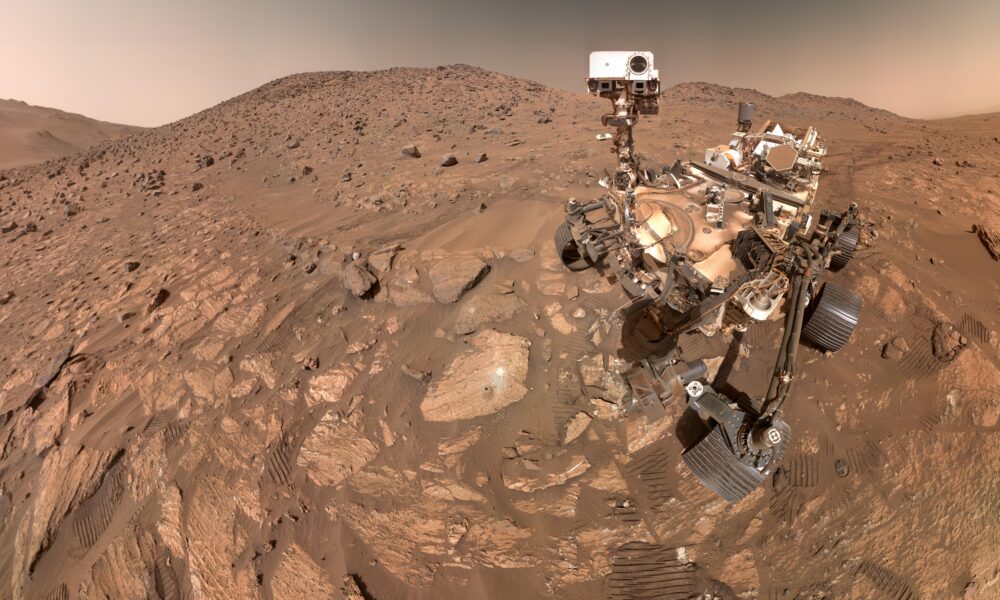

NASA’s Perseverance is a six-wheeled robotic rover exploring Mars’ Jezero Crater to study ancient environments and search for possible signs of past microbial life. It landed on February 18, 2021, and on October 11, 2026 it passed a new milestone: 28.10 miles (45.22 kilometers) driven, eclipsing the previous off-world driving record of 28.06 miles (45.16 kilometers) held by NASA’s Opportunity rover. The mileage is a dated measurement from NASA’s October 12 mission report, not a continually updated odometer.
Perseverance also collects carefully selected Martian rock samples, documents geological clues to a once-wetter planet, and uses instruments to study rocks, minerals, dust and weather. Below are two real NASA rover photographs taken on Mars, an explanation of the mission and its 2026 driving achievement, and a clear distinction between potential biosignatures and confirmed discovery of life.
Perseverance rover: the essential mission facts
| Question | Verified answer |
|---|---|
| What is Perseverance? | NASA’s Mars 2020 robotic science rover |
| Landing site | Jezero Crater on Mars |
| Landing date | February 18, 2021 |
| Primary scientific goal | Investigate ancient habitability and seek potential traces of past microbial life |
| Samples | Collect and cache selected Martian rock and soil for possible future laboratory analysis |
| Distance as of Oct. 11, 2026 | 28.10 miles / 45.22 km |
| Previous off-world record | Opportunity: 28.06 miles / 45.16 km |
| Selfie camera | WATSON camera on the robotic arm |
NASA maintains the official mission page and interactive route map. For the exact driving record, refer to NASA’s dated October 12, 2026 announcement.
Why did NASA send Perseverance to Jezero Crater?
Jezero is a geologically compelling site because evidence indicates it once hosted a lake and a river delta. Sediments deposited in ancient water environments can preserve information about the conditions under which they formed. By examining different rock layers and sampling selected locations, the team investigates whether the ancient environment could have supported microscopic life. Habitability is not evidence that organisms definitely lived there; it means the conditions may have been compatible with life.
NASA’s science objectives are broader than one life-detection experiment: the rover analyzes geology, past climate, possible biological signatures, samples and technologies relevant to future human missions. The landing site was chosen in part because rocks shaped by an ancient river and lake make valuable scientific targets.
The October 2026 driving record, explained
On October 11, 2026, Perseverance’s odometer reached 28.10 miles (45.22 km), slightly surpassing Opportunity’s final 28.06 miles (45.16 km). NASA announced the achievement on October 12. That makes Perseverance the off-world surface vehicle with the greatest total distance driven as of that stated date.
The two rovers achieved their totals in different eras. Opportunity operated on Mars from 2004 to 2018 and accumulated its distance over almost fifteen years. Perseverance reached the new mark in around five and a half years. Its navigation capabilities help explain the difference: NASA says Perseverance used AutoNav for more than 90% of its driving distance, whereas Opportunity and Spirit’s early version of the technology accounted for a much smaller share.
Why AutoNav matters: controllers cannot steer a Mars rover continuously like a remote-control car. Commands and telemetry take time to move between Earth and Mars, and the rover must avoid rocks, slopes and hazards using its cameras and onboard computing. More capable autonomous navigation lets Perseverance choose safe routes while covering more ground within the time available.
| Record detail | Perseverance | Opportunity |
|---|---|---|
| Distance at comparison | 28.10 miles (45.22 km) | 28.06 miles (45.16 km) |
| Milestone timing | October 11, 2026 | Final lifetime total before mission ended in 2018 |
| Rough operating time to total | About 5½ years | Almost 15 years |
| Why important | New cumulative distance record | Previous Mars rover distance benchmark |
That comparison is not the same as measuring a rover’s instantaneous speed. It is a cumulative mission distance over years of driving, science stops and route planning. If Perseverance keeps moving after October 11, its total will grow beyond the value quoted here. See NASA’s real rover-track photo from the record-day drive for the landscape rather than treating a speculative animation as direct photography.
Why can Perseverance take a selfie on Mars?
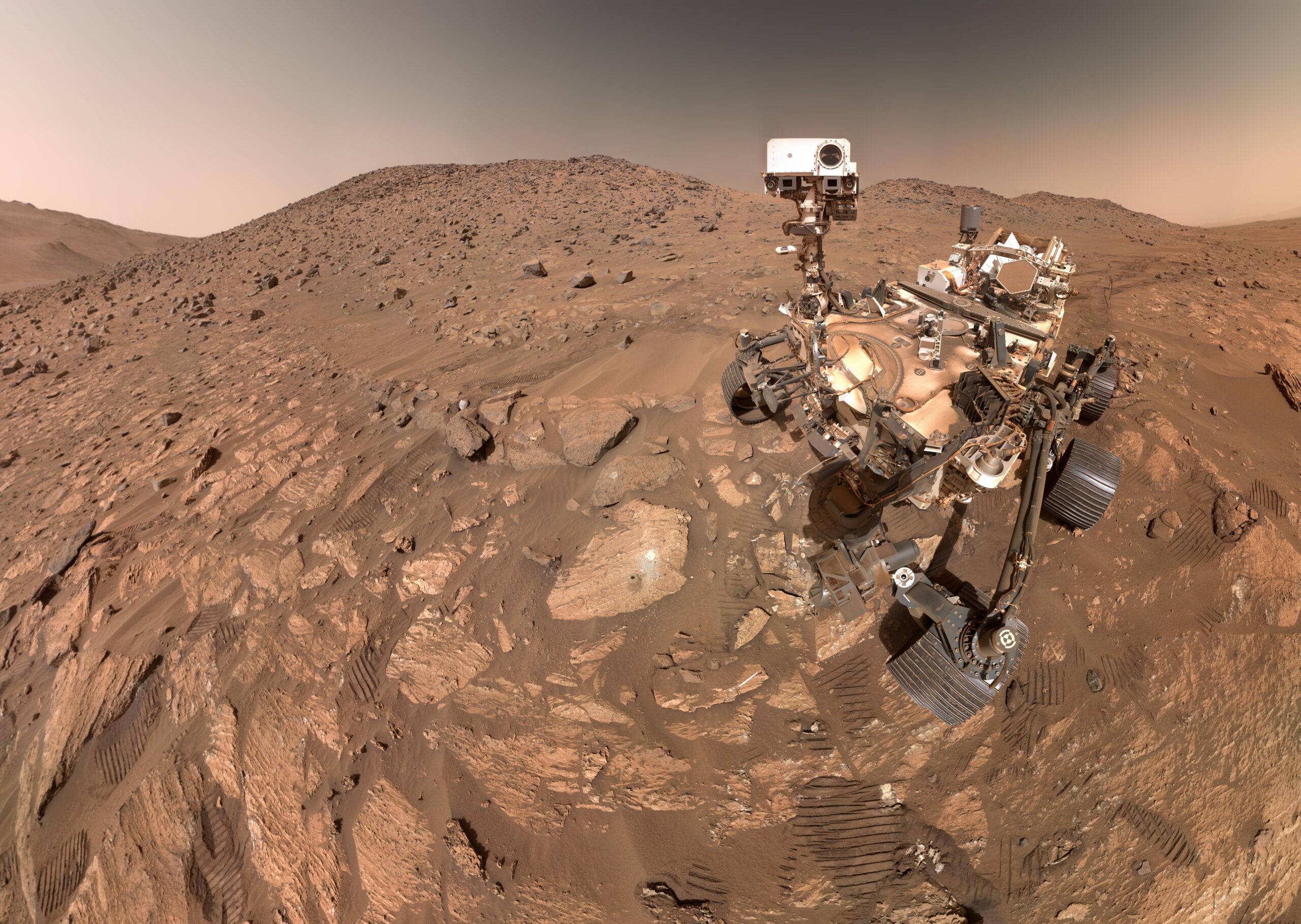
The photo above is a real spacecraft image assembled from many overlapping photographs. NASA explains that the rover uses its WATSON camera at the end of a robotic arm to capture the different views. The team then stitches those frames together so the rover and surrounding rocks appear in one wide image. It is not a single smartphone-like shot and it is not a picture taken by a person standing on Mars.
The 2024 photo near Cheyava Falls was assembled from 62 images. Some people mistake this kind of composite for AI fabrication because the robotic arm is not visible in the final selfie. NASA’s selfie-production explanation shows how the arm moves between frames so it can be omitted from the final combined picture without inventing the surrounding scene.
What did Perseverance find at Cheyava Falls?
One important scientific target was a rock nicknamed Cheyava Falls, examined in 2024. The rock exhibited features and mineral patterns that researchers considered relevant to whether Mars once hosted microscopic life. A core sample from the site is associated with the name Sapphire Canyon.
In a September 10, 2025 NASA statement, the agency described potential biosignatures associated with the sample, including minerals and patterns studied using instruments such as PIXL and SHERLOC. A potential biosignature is not proof of Martian life. NASA emphasized that nonbiological explanations must also be considered, and further study is required before drawing a strong conclusion about ancient organisms.
That distinction protects the reader from misleading headlines. A rover can establish the presence of minerals, organic molecules or features compatible with certain biological processes, but it cannot automatically determine that biology is the only possible explanation. Read NASA’s official 2025 research update for the scientific context.
How does Perseverance collect samples?
The rover uses a drill and robotic arm to inspect rocks and collect sealed core samples in specially designed tubes. The team chooses targets based on scientific value, including geological diversity and clues about ancient water. This is different from scooping random dirt into an open container; the samples are documented in context and stored for possible later study.
NASA’s rock sample inventory catalogs the collected material. Not all tubes contain the same kind of material; mission plans also account for quality-control and witness tubes. A future return of selected samples to Earth would permit laboratory techniques that cannot all fit aboard a rover, but the timing and architecture of any sample-return effort should be checked against the latest confirmed NASA plans rather than presented as a guaranteed launch date.
What was special about the Rochette drilling site?
In September 2021, Perseverance drilled into a rock nicknamed Rochette to obtain early Martian core samples. NASA photographed the rover at that target after drilling. The marks visible in the second real image below are connected with its actual sampling campaign, which makes the photograph a useful record of science operations—not merely a promotional picture of the vehicle.
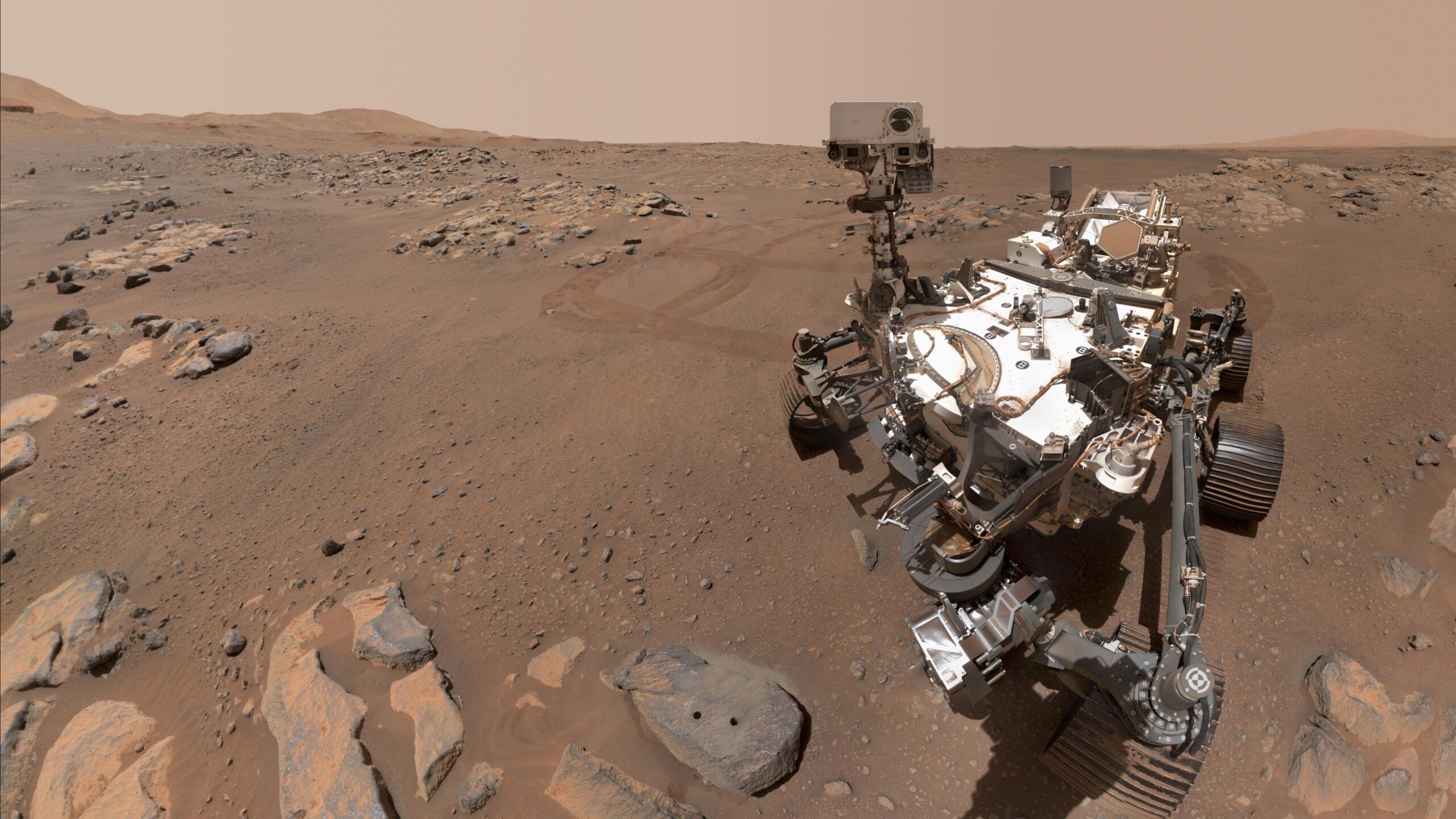
The Rochette selfie comes from official NASA Photojournal image PIA24836, taken on September 10, 2021. It was assembled from multiple images recorded by the arm-mounted camera and reflects a different date and location from the 2024 Cheyava Falls image. These two images are deliberately distinct: they show the same rover during two different scientific campaigns, with separate image IDs and source records.
What instruments does the rover carry?
| Instrument | What it helps scientists study |
|---|---|
| Mastcam-Z | Color, zoom and stereo images for geology and surface context |
| SuperCam | Remote investigation of rock chemistry and physical characteristics |
| PIXL | Fine-scale elemental chemistry and mineral context |
| SHERLOC and WATSON | Minerals, organic-material clues and detailed close-up views |
| MEDA | Mars weather conditions such as temperature, wind and dust |
| RIMFAX | Radar observations of structures below the surface |
These tools complement one another. An image can show a rock’s appearance but not automatically identify every mineral inside it; spectroscopy can add chemical context. The instruments are documented on NASA’s Perseverance science-instruments page.
What happened to the Ingenuity Mars helicopter?
Ingenuity traveled to Mars with Perseverance as a technology demonstration to test powered flight in the planet’s thin atmosphere. It far exceeded its original short demonstration plan, completing 72 flights before its mission ended after rotor damage during its final flight in January 2024. Perseverance has continued its rover mission separately from Ingenuity’s completed flight campaign.
Perseverance and Ingenuity were real companion spacecraft, but Ingenuity is not an active aircraft still flying around the rover in October 2026. NASA’s 2024 final-helicopter update records the mission’s end. Keeping the timeline straight is especially important when an old selfie shows the two vehicles together.
How is Perseverance different from Curiosity or Opportunity?
NASA’s Mars rovers were not interchangeable. Opportunity was a smaller, solar-powered geologist that drove for many years and established the previous distance record. Curiosity is a larger, nuclear-powered science rover investigating ancient environments in Gale Crater. Perseverance builds on the rover engineering family while emphasizing astrobiology, detailed rock studies and sample caching for possible future return.
For a comparison of Mars exploration technology in a broader planetary-science context, our Pioneer 10 spacecraft guide shows how very different missions used spaceflight instrumentation, although Pioneer was a flyby spacecraft rather than a Mars surface rover.
Perseverance rover FAQ
Is Perseverance still working on Mars in October 2026?
NASA’s October 12, 2026 mission update confirms active operations and a record drive on October 11. The status can change after publication, so consult the current NASA mission blog for subsequent updates.
How far has Perseverance driven?
At the October 11, 2026 milestone, NASA reported 28.10 miles (45.22 km) traveled. That is a dated total, not a claim about today’s live odometer.
Did the rover discover life on Mars?
No confirmed discovery of ancient Martian life follows from the cited findings. Some samples have potential biosignatures, which require further analysis and evaluation of nonbiological alternatives.
When did Perseverance land?
February 18, 2021, at Jezero Crater, using an advanced entry, descent and landing system.
Can the rover return its samples to Earth by itself?
No. Perseverance caches samples on Mars; transporting selected material back to laboratories on Earth would require separate future mission hardware and an approved return plan.
Are NASA rover selfies actual photographs?
Yes. The photos are composites stitched from many real spacecraft-camera frames. NASA explains how WATSON moves around the rover to capture the necessary views.
Was Ingenuity the same machine as Perseverance?
No. Ingenuity was a separate small helicopter that arrived with the rover. Its flight mission ended in 2024 after 72 flights.
NASA photo credits and primary references
The two authentic rover photographs are courtesy NASA/JPL-Caltech/MSSS: PIA26344, Cheyava Falls selfie (July 2024), and PIA24836, Rochette selfie (September 2021). They are included under NASA’s editorial media usage guidelines; no NASA endorsement of this site is suggested. Current milestone numbers come from the October 2026 NASA mission announcement, and the biosignature explanation is grounded in NASA’s 2025 release.
Bottom line: Perseverance is a real, active scientific vehicle that studies the history of water and potentially habitable environments on Mars. Its October 2026 driving achievement, authentic Mars photos and carefully qualified sample findings offer a clearer view of the mission than claims that it has conclusively found life or that old images show a live feed.