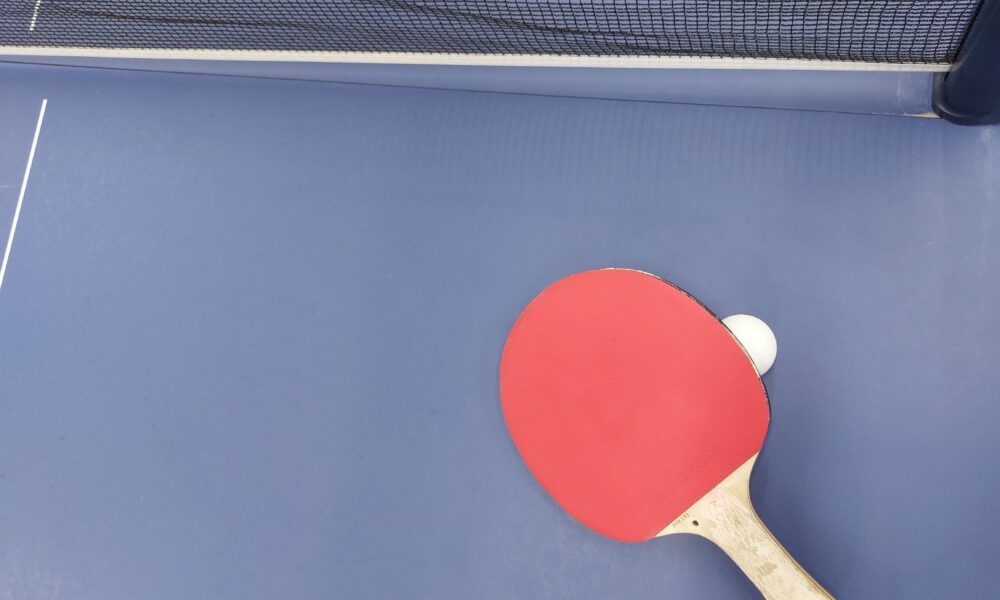

A legal table tennis serve starts with the ball resting on the open palm of a stationary free hand, followed by a near-vertical toss of at least 16 cm (about 6.3 inches) without imparting spin. The server strikes the falling ball so it bounces first on their own side and then on the receiver’s side of the table.
Unlike lawn tennis, where a valid serve goes directly into the receiver’s service box, table tennis requires a bounce on both halves. The toss and visibility rules also matter: a serve cannot be disguised by hiding the ball with the body, arm or clothing.

The five basics of a legal table tennis serve
1. Show the ball on an open palm
Start with the ball resting freely on the open palm of your stationary free hand. Do not pinch it between the fingers or launch it from a moving, curled hand.
2. Toss at least 16 cm
Project the ball near vertically upward without adding spin at release. It must rise at least 16 cm after leaving the palm and then fall without touching anything before it is struck. The 16 cm requirement refers to the rise after release, not the height of the paddle.
3. Keep the ball visible
From the beginning of service until contact, the ball must remain above table-surface level and behind the server’s end line. The server may not hide it from the receiver. After projecting the ball, move the free arm and hand out of the space between the ball and net.
4. Strike the falling ball
Do not strike the ball while it is still ascending from the toss. The server must hit it as it falls. The racket can create spin at contact, but the free hand must not impart spin during the toss itself.
5. Bounce on both sides
For a standard singles serve, the ball must touch the server’s half first and then the receiver’s half. In doubles, it must bounce in the right half of each player’s court in the specified order. Singles does not require the serve to travel diagonally.
The 2026–27 Laws of Table Tennis, section 2.6, set out these requirements. Use the current rules when refereeing a formal match rather than relying on informal house rules.
What makes a table tennis serve illegal?
| Example | Why it is a problem |
|---|---|
| Ball tossed only a few centimeters | Fails the minimum 16 cm toss. |
| Ball hidden behind the body or free arm | Receiver cannot see the serve properly. |
| Ball struck on the upward toss | The ball must be struck while descending. |
| Ball hits the net then misses the receiver’s side | The serve does not land legally. |
| Doubles serve lands in the wrong half | Doubles placement requirements are not met. |
What happens if the serve clips the net?
A service let can occur if the ball touches the net assembly but the serve would otherwise have been good. The point is replayed. If it hits the net and fails to reach the receiver’s side correctly, it is not a valid let just because the net was touched.
When does service change in table tennis?
Under standard scoring, each player serves for two points before service passes to the opponent. At 10–10, players alternate the serve after every point. In doubles, both the order of serving and the receiving pair’s positions matter. Recreational games sometimes ignore these requirements; formal play does not.
Singles vs. doubles: the main difference
In singles, the server may normally direct the ball to either side of the opponent’s table so long as the required bounces occur. In doubles, the serve must pass from the server’s right half to the receiver’s right half. That diagonal placement restriction is a frequent source of confusion.
Practice without learning bad habits
- Hold your free palm flat and still.
- Practice vertical tosses over the minimum height before striking.
- Allow the ball to descend into a consistent contact zone.
- Keep the ball clear of the body and remove the free arm from the sightline.
- Confirm that the ball touches your half and then your opponent’s half.
- Only then add spin or placement variation.
If you also play lawn tennis, the rule differences are substantial: our tennis scoring guide covers a separate sport with different service-box and scoring procedures. Do not apply its two-serve rule to table tennis.
Frequently asked questions
How high must you toss the ball in table tennis?
At least 16 cm after it leaves the open palm, tossed near vertically and without spin from the free hand.
Can you serve with spin?
Yes, spin applied by the racket at contact is allowed, provided the toss itself follows the rules.
Does every table tennis serve have to be diagonal?
No. Diagonal right-half placement is required in doubles; singles serves are not restricted that way.
Can the opponent return a serve before it bounces?
No. For a legal table tennis serve, the ball must reach and bounce on the receiving side as required.
Bottom line: A visible, vertical toss of at least 16 cm and the proper bounce sequence are the foundations of a legal table tennis serve.

Other Articles

How Long Is an NFL Game? Four Quarters, Halftime and TV Time
When Was Basketball Invented? The True Story of Naismith’s 1891 Game
