Tennis scoring works in three layers: points win a game, games win a set, and sets win a match. In a standard game, the announced points progress from love (zero) to 15, 30 and 40. A player usually needs at least four points and a two-point margin to win the game. When both players reach 40, it is called deuce, and one player must win two points in a row from that position.
This guide follows the standard rules and explains common variations, including no-ad scoring and match tiebreaks. The precise format depends on the competition, so always check the event’s rules before assuming that every match uses the same deciding-set procedure. The 2026 Rules of Tennis are available from the sport’s governing rules organization.
Tennis scoring cheat sheet
| Situation | What it means | What happens next |
|---|---|---|
| Love | Zero points in a game | First point for a player is called 15 |
| 15 | One point won | Next point is 30 |
| 30 | Two points won | Next point is 40 |
| 40 | Three points won | A fourth point may win the game if the margin is sufficient |
| Deuce | Both players have at least three points and are tied | Win two consecutive points to take the game |
| Advantage | One point won after deuce | Win the next point for game; lose it and return to deuce |
| Tiebreak | Special points-counted game used in certain sets | Usually first to seven points, by two, unless another format applies |
Players call the server’s score first in a standard game. Thus, 30-15 means the server has won two points and the returner one. A television scoreboard sometimes visually lists names in a fixed order rather than mirroring the way points are spoken, so read its column headings carefully.
Why is tennis scored 15, 30, 40?
There is no single, universally proven explanation for the historical origin of tennis’s numbering. Popular theories involve clock-face divisions and older court-game traditions, but presenting any one theory as an established fact would be misleading. The useful modern rule is simple: 15, 30 and 40 are names for successive points, not the number of points required.
For a beginner, think of the sequence as zero, one, two, three and then game, with a special procedure at a three-point tie. Once you know that translation, the apparently unusual score becomes manageable.
How do you win a tennis game?
Imagine Player A serves. They win the first point and lead 15-love. Player B wins the next two points, putting A behind 15-30. A then wins two points: 30-all followed by 40-30. If A wins the next rally, A wins the game because they have four points and a two-point advantage over B’s two points.
What if B wins instead at 40-30? The game becomes deuce. From there, a player earns advantage by winning one point. Winning the following point completes the game; losing it resets the score to deuce. A game with repeated deuces can therefore continue well beyond six or eight points.
Deuce and advantage: a point-by-point example
| Rally winner | Announced score | Why |
|---|---|---|
| Players have won three points each | Deuce | Neither leads by two |
| Server | Advantage server (Ad-In) | Server wins first point after deuce |
| Receiver | Deuce | The advantage was cancelled |
| Receiver | Advantage receiver (Ad-Out) | Receiver now has the advantage |
| Receiver | Game receiver | Receiver wins two consecutive points after deuce |
The USTA scoring guide explains these terms and the rule that two consecutive points are needed after deuce. In a no-ad game, however, the rules differ: a deciding point is played at deuce. Do not assume a local doubles league uses traditional advantage scoring unless the competition confirms it.
How tennis sets work
A set is a collection of games. In a common tiebreak-set format, the first player to win six games with a margin of two wins the set, such as 6-3 or 6-4. If the players reach 5-5, a 7-5 score can finish it. When they reach 6-6, a standard set tiebreak often decides it; the resulting set score is recorded as 7-6.
There are also advantage sets, where players continue until one leads by two games, and formats that replace the final set with a match tiebreak. This is why a local junior tournament and a professional Grand Slam match may both use familiar game scoring but finish at different times.
How does a tennis tiebreak work?
A standard tiebreak counts points with ordinary numbers: 0, 1, 2, 3 and onward. Typically, the first player to reach seven points with a two-point margin wins. Thus, 7-5 is final, but 7-6 is not: play continues until the lead is two, such as 8-6 or 10-8. Players normally change ends after every six points in the standard tiebreak format.
Service order also differs from an ordinary game. The player due to serve starts the first point; the other player serves the next two; after that, the players alternate two-point service turns. This produces a fair sequence without starting a whole new service game for each point.
What is a 10-point match tiebreak?
Some events use a deciding match tiebreak instead of playing another complete set, often to ten points with a two-point margin. In Grand Slam singles, a 10-point tiebreak is used at 6-6 in the final set under the unified format introduced in 2022. In recreational doubles events, a match tiebreak may replace an entire third set. Always verify the event’s service and end-change rules, which can differ under particular approved formats.
How to read a tennis scoreboard
A match scoreboard usually shows each player’s sets won, completed set scores, current games and points in the game. For example, a line reading 6-4, 3-2 with 30-15 in the current game conveys different layers: one set has ended 6-4, the next stands 3-2 in games, and the server leads 30-15 in the active game. Knowing which player is currently serving is essential to interpreting the points.

Scoreboard photograph by Jeuwre, Wikimedia Commons, CC BY-SA 4.0, unchanged.
A manual scoreboard is useful for reading completed game totals, while broadcast overlays may display live point-by-point updates. Some scoreboards use dots, stars or distinct highlighting to indicate the serving player; legends vary by broadcaster.
Tennis court sides and service boxes
The court’s deuce side is the right service side when you face the net, and the ad side is the left. Serving begins from the deuce side at the start of each game and alternates sides every point. The served ball must land in the diagonally opposite service box. The service lines and baseline are therefore not decorative markings: they define where a legal serve may land and where players serve from.
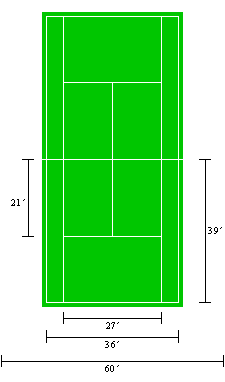
Tennis-court diagram, Wikimedia Commons, public domain.
Singles vs. doubles scoring
Both singles and doubles can use the same standard point sequence. What changes is the number of players and how serving and receiving rotate. In doubles, teammates alternate their service games according to the service order chosen for that set, and the receiving order must also be maintained during a set. Doubles competitions frequently use no-ad games or a deciding match tiebreak, but this is an event rule rather than an inherent property of all doubles tennis.
Best-of-three vs. best-of-five tennis matches
In a best-of-three match, winning two sets secures the match. In a best-of-five, winning three does. Many professional singles and doubles matches use best-of-three formats, while some major men’s singles matches use best-of-five. Do not confuse a 10-point tiebreak with a ten-game set: tiebreak points count differently from ordinary games.
Common scoring mistakes to avoid
- Calling 40-40 ‘game point’. It is deuce. One player needs two consecutive points unless the event uses no-ad scoring.
- Assuming a 6-5 set is over. The leading player generally needs the next game to win 7-5, or a tiebreak may follow at 6-6.
- Reading a tiebreak like a normal game. Tiebreaks use plain numbers rather than 15, 30 and 40.
- Forgetting server-first announcements. Spoken standard-game scores place the server’s points first.
- Assuming every event plays the same final set. Some competitions use a 10-point match tiebreak or another authorized format.
Tennis scoring FAQ
What does love mean in tennis?
Love means zero points, as in 15-love when the server has won the first point and the receiver has none.
What does 40-all mean?
Both players have reached 40 in the same game. In standard scoring, the score is called deuce, and one player must win two consecutive points.
Can a tiebreak end 7-6?
No, not a standard first-to-seven, win-by-two tiebreak. A 7-6 tiebreak point score is only a one-point margin. But a completed set can show 7-6 games because its tiebreak has been won.
Why do players change ends?
End changes help balance differing conditions such as light and wind. In standard games, players change ends after odd-numbered games, with separate end-change rules for tiebreaks.
Is a super tiebreak always played to ten?
The name commonly refers to a first-to-ten, win-by-two tiebreak, but check the tournament’s published match format before beginning.
What is a bagel in tennis?
In informal tennis language, winning a set 6-0 is often called giving an opponent a bagel. It is slang, not a different scoring rule.
For other beginner-friendly rules and explainers, explore the AVARIXO Sports section. This article explains standard scorekeeping; it is not a substitute for an individual tournament’s regulations.

Other Articles

Soccer Formations Explained: 4-3-3, 4-4-2, 4-2-3-1 and 3-5-2
Soccer Positions Explained: Roles, Numbers 1–11 and Field Diagram