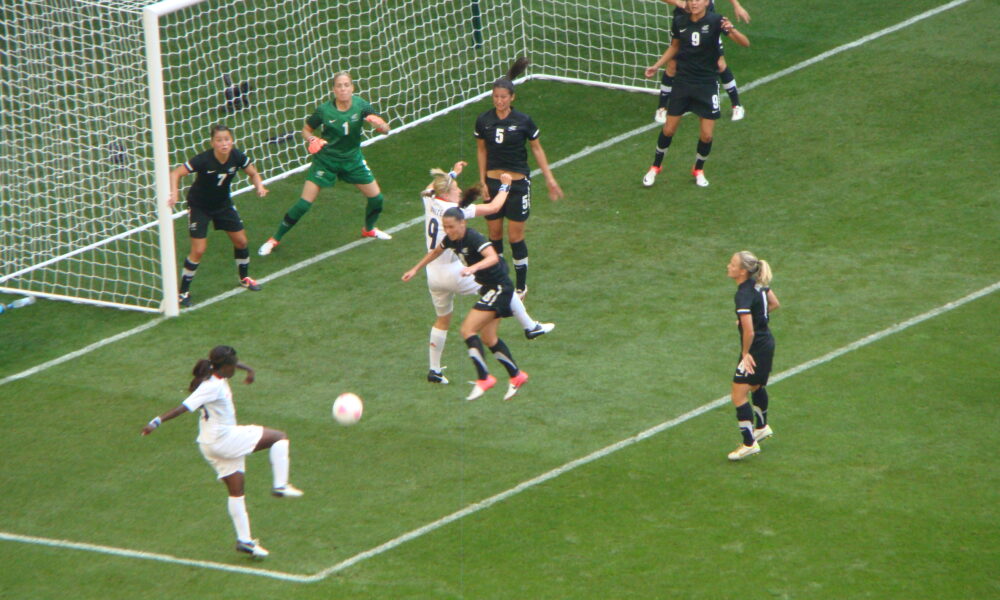

Soccer shooting is the skill of striking the ball toward goal with the right balance of accuracy, power and timing. A reliable shot starts before your kicking foot reaches the ball: look up to read the goalkeeper, take a controlled approach, plant your support foot near the ball, strike with a firm ankle, and follow through toward your target. Good finishing is not just about hitting hard; it is about choosing a shot the goalkeeper is less likely to save.
This practical guide separates shooting technique from shot selection, shows common mistakes and provides drills for improving both feet. The coaching principles are consistent with the US Youth Soccer Skills School Manual, which emphasizes preparation, body posture, ball contact and follow-through. Reviewed October 11, 2026.
How to shoot a soccer ball: six steps
- Scan before receiving. Note the goalkeeper’s position, nearby defenders and the open part of the goal.
- Set your final touch. Push the ball far enough in front to swing naturally, but not so far that a defender or goalkeeper can reach it first.
- Approach under control. Use the angle and number of steps that let you stay balanced; do not treat maximum running speed as mandatory.
- Plant beside the ball. Your non-kicking foot points generally toward the target and provides balance. Its distance from the ball varies with the player’s size and the type of shot.
- Lock the ankle and choose the contact surface. For a driven shot, strike through the ball with the instep or laces. For more precise placement, the inside of the foot may be appropriate.
- Follow through toward the target. Keep your body controlled through impact. Where you strike the ball and how you lean affect whether it stays low or rises.
A player can perform all six steps well and still miss if the decision is wrong. Shooting directly at a set goalkeeper may be easier to save than a lower shot toward open space. Technique gives you choices; decision-making helps select the right one.
The five main types of soccer shots
| Shot | Best use | Technical focus |
|---|---|---|
| Inside-foot placement | Clear opening inside the box, controlled finish | Open the hip, present the inside of the foot and guide the ball toward the target |
| Laces or instep drive | Fast driven attempt when there is a clear shooting lane | Firm ankle, stable plant foot and contact through the ball |
| Low shot across goal | Goalkeeper is guarding the near side or recovering | Accuracy and a low trajectory matter more than maximum power |
| First-time finish | Pass or cross arrives in a position to shoot before defenders recover | Early decision and clean contact with a moving ball |
| Chip or lifted finish | Keeper commits far forward, leaving space above | Controlled lift and careful weight of contact; not the default under pressure |
Choose the shooting surface according to the available time, angle and desired ball flight. A hard instep shot is not automatically superior to an inside-foot finish. Conversely, an elaborate chip may be a poor choice when the goalkeeper is still on the line.
Placement vs. power: which soccer shot is better?
Placement usually becomes the priority when you can see a clear, unguarded area of the goal. Power can help when you must release quickly through a narrow window or drive from greater distance. Both fail without control.
Try the following decision rule: before shooting, identify the goalkeeper’s set position and the defender’s path. If the ball is already on the correct foot with time to aim, choose a target first. If pressure is arriving fast, simplify the movement, minimize extra touches and strike cleanly. If the shot is blocked, taking one more touch, passing or creating a new angle may be a better decision than forcing an effort into a defender.
Why shots fly over the crossbar
A frequent cause is striking too low on the ball while leaning excessively backward. The ball’s contact point, the support foot position and the torso all influence trajectory. To keep a standard driven attempt lower, arrive with the body balanced, stay over the ball at contact and aim through its central area rather than scooping underneath it.
Why shots have little power
A loose ankle, timid backswing, poor plant-foot balance or contacting the ball with an unstable foot can reduce ball speed. Fix the mechanics at moderate speed first; an uncontrolled full-force swing often hides the real problem. As contact improves, increase approach speed without sacrificing accuracy.
Five soccer shooting drills that teach real finishing
Drill 1: Two-target finishing
Setup: Place two safe target markers or cones inside the goal, away from the posts and goalkeeper. From a comfortable distance, take alternating right- and left-foot attempts using an inside-foot finish. Keep a tally of clean target hits, not just shots that enter the net.
Coaching cue: Look at the target before the last approach step, then keep the ankle firm through contact. Start with the ball stationary before adding a slow dribble. When a target becomes easy, reduce its width.
Drill 2: Receive, turn and shoot
Setup: A teammate passes from the side. Open the body to receive across the front foot, take the first touch into a shooting lane and finish with the second touch. Alternate the side from which the service arrives.
Coaching cue: A useful first touch should improve the next action. If it rolls under your feet or too far away, reset the drill rather than practicing a rushed bad strike.
Drill 3: First-time finish from a cutback
Setup: A wide teammate reaches the side of the penalty area and plays a controlled low cutback to a trailing runner. The runner scans, arrives on balance and shoots with the first touch.
Coaching cue: Time the run to meet the ball instead of waiting stationary. This is an extension of our cutback passes and finishing drills guide.
Drill 4: Finishing under a closing defender
Setup: A shooter receives in front of a goal while a defender begins several steps away. The defender applies initially passive pressure before progressing to realistic closing speed. The shooter may take one controlling touch or shoot first time.
Coaching cue: Learn to recognize the moment when an extra touch closes the lane. Do not add full contact until the players have suitable skill, space and supervision.
Drill 5: One-minute weak-foot challenge
Setup: Use controlled passes into a short-range shooting area. For one minute, take comfortable shots only with the non-dominant foot, emphasizing stable support-foot placement and measured contact. Rest, then repeat with a different angle.
Coaching cue: Record clean shots on target rather than the total number of balls struck. A slower, more deliberate repetition may be more useful than rapid, inaccurate shooting.
A 20-minute soccer shooting practice plan
| Time | Activity | What to measure |
|---|---|---|
| 0–4 minutes | Mobility, short passes and easy controlled strikes | Balanced preparation |
| 4–8 minutes | Two-target inside-foot placement with each foot | Target hits by foot |
| 8–12 minutes | Instep strikes from an appropriate distance | Clean contact and low/controlled flight |
| 12–16 minutes | Receive-and-shoot or first-time cutbacks | Useful first touch and quick decision |
| 16–20 minutes | Defender closing on a shooter; finish with a short cool-down | Correct shot choice under pressure |
Adjust distances, number of repetitions and intensity to the player’s age, physical readiness and skill. Rather than claiming a fixed conversion-rate target for everyone, track your own accuracy across comparable sessions, such as successful attempts toward a marked area out of ten controlled shots.
How to choose when to shoot instead of passing
The moment to shoot often appears when the defender cannot block the ball, the striker has a balanced stance and the goalkeeper is still adjusting. But if a teammate has a significantly clearer angle, the better football decision may be a pass. Third-man runs and blindside movement can create these opportunities before the final pass.
Scanning matters most on moving attacks: after a through ball, the goal may be visible for only a short moment. If a striker repeatedly shoots directly into a nearby defender, the fix may be earlier perception or a better first touch, not a stronger kick.
Common soccer shooting mistakes and fixes
| Problem | Likely cause | Practical fix |
|---|---|---|
| Ball repeatedly goes high | Leaning back or contacting low on the ball | Practice balanced central contact from a short distance |
| Shots drift far left or right | Support foot or hips not aligned with intended direction | Slow down, check plant foot and aim at a smaller target |
| Shot lacks speed | Soft ankle or interrupted follow-through | Rehearse a firm instep strike at moderate intensity |
| Defender blocks every attempt | Extra touch or shot chosen after lane closes | Scan earlier, change angle or release sooner |
| Only dominant foot is usable | One-sided training volume | Alternate both feet in placement drills |
Soccer shooting FAQ
What part of the foot do you use to shoot a soccer ball?
The inside of the foot is commonly used for precise placement, and the instep or laces for a firmer driven shot. Both require controlled body posture and a stable support foot.
Should you look at the ball or the goal when shooting?
Scan the goal and goalkeeper before committing, then keep your head stable and watch the ball through contact. Looking only at the ball throughout the attack can hide a better target or passing option.
How can beginners improve soccer shooting accuracy?
Begin with short-range inside-foot targets, balanced approaches and clean contact. Add moving service, faster decisions and defensive pressure once technique is repeatable.
What is the difference between shooting and finishing?
Shooting is the act of striking an attempt toward goal. Finishing combines that technique with positioning, timing, decision-making and converting a specific scoring opportunity.
Does kicking harder always mean a better shot?
No. Ball placement, timing, visibility and the goalkeeper’s position can matter more than raw speed. A hard shot directly at the goalkeeper may be easier to save than a controlled shot into space.
Why does my soccer shot curve?
Contacting the ball to one side of its center, with the foot moving across the ball, can impart spin that curves the flight. Learn consistent straight contact before deliberately practicing bending shots.
Sources and photo
Technical principles checked against the US Youth Soccer Skills School Manual, especially its preparation–contact–follow-through framework, and the practical training material from Online Soccer Academy. Source review: October 11, 2026. These drills are editorial training examples, not claims that AVARIXO personally tested them.
Featured photo: Jon Candy, “Player taking a shot,” Wikimedia Commons, CC BY-SA 2.0. Unmodified by AVARIXO.

Other Articles

NBA Divisions Explained: All 30 Teams in 6 Divisions (2026–27)
Tennis Court Oath Explained: June 20, 1789, Causes and Significance
