
A blindside run in soccer is an off-ball movement made out of a defender’s field of vision. Instead of sprinting straight toward the ball, the attacker first positions themselves near the defender’s shoulder, then accelerates into a useful passing lane when the defender is watching the ball. The run can lead to a through ball, cut-back or simple pass into space. It can also draw a marker away even if the runner never receives the ball.
Unlike a trick move with the ball, blindside running is about reading three things at once: the defender’s body shape, the passer’s next touch and the space the team wants to attack. The same principle works for wide forwards, central midfielders and strikers.
What makes a run “blindside”?
Imagine a right-back defending a winger near the touchline. The defender has turned toward the ball carrier. An attacking midfielder stands just behind the right-back’s shoulder, outside that defender’s immediate view. When the winger draws the defender toward the ball, the midfielder accelerates through the channel between the right-back and center-back. That movement is a blindside run.
The movement is effective because a defender cannot easily track both the ball and an attacker approaching from behind. A pass delivered at the right moment can reach the runner before the back line adjusts. FIFA’s Training Centre analysis of inner-channel runs highlights timing, pass weight and the runner’s position outside a defender’s sightline as key factors.
How to make a blindside run in five steps
1. Start where the defender cannot watch both you and the ball
Do not stand directly in front of your marker. Move to the outside shoulder or just behind the defender, while staying close enough to attack the next gap. Check over your shoulder so you know the space and whether another defender is covering it.
2. Wait for the ball carrier to engage a defender
The most useful cue is often the passer taking a positive touch toward a defender. That action pulls attention toward the ball, opens the passing angle and can create a seam between defenders. Running early gives the defender time to follow you.
3. Change your pace, not just your direction
Start with a slow walk or short checking movement. Accelerate sharply as the passer looks up. A curved run can help you avoid drifting offside and position your body to receive facing the goal. For more on the rule, see AVARIXO’s offside guide.
4. Make the run match the pass
For a grounded through ball, attack the gap with an angle that allows you to receive in stride. For a lifted pass, prepare to control a bouncing or dropping ball. The passer should play into the runner’s path rather than forcing them to stop. AVARIXO’s through-ball tutorial explains the passing side of this combination.
5. Keep running if it creates space for someone else
A defender who follows you may leave room for a teammate to receive between the lines. A good blindside run is not a wasted run just because the pass goes elsewhere. Coaches should reward movements that help the attack, not only runs that produce a shot.
Blindside run vs. overlapping run vs. third-man run
A blindside run describes the relationship between a runner and a defender’s line of sight. An overlap describes a teammate moving around the outside of a ball carrier. A third-man run describes the receiving movement in a passing combination involving three players. A single run can be both blindside and part of a third-man combination.
Blindside runs also differ from simply standing in a half-space: the half-space is a zone on the field; the run is a timed movement that exploits a defender’s attention.
Two simple blindside-running drills
Drill A: Winger, runner and defender (3v2)
Mark an 18-by-22-yard area leading toward a mini-goal. Put a ball carrier near one touchline, a midfielder inside, and two defenders in a staggered line. The winger must attack the outside defender before passing. The midfielder starts just behind that defender’s shoulder and times a run into the seam. Score one point for receiving beyond the first defender, two for a controlled finish. Rotate positions every four attempts.
Drill B: Weak-side finish (5v4)
Play toward a normal goal with five attackers against four defenders across approximately half a field. Award an extra point when a player who began outside a marker’s line of sight receives behind the line. Encourage the ball carrier to use a short pass, cut-back or diagonal rather than automatically lofting the ball. Reset if the run begins from an offside position.
Common mistakes and quick corrections
- Running before the passer can play: wait for a forward-facing touch or eye contact.
- Running in a straight line beyond the last defender: use an arcing approach and stay legal when the ball is played.
- Watching only the ball: scan the marker and the covering center-back before accelerating.
- Ending the run after the passing lane closes: curve into a second receiving position or drag the marker away.
- Always running toward goal: sometimes a lateral blindside movement creates a better cut-back angle.
FAQ
Are blindside runs allowed in soccer?
Yes. Moving behind a defender is legal. Offside, obstruction and contact rules still apply; the run itself is not an offence.
Who should make blindside runs?
Strikers and wingers commonly make them, but central midfielders, attacking full-backs and even deep runners can use the same cues.
Why do blindside runs fail?
The runner often starts too early, the passer lacks time to deliver, or another defender covers the space. Review the timing of the passer’s forward touch before blaming the pass.
Sources and image credit
Rule and coaching checks: FIFA Training Centre — inner-channel runs; FIFA Training Centre — movement behind the defence; IFAB Law 11 — offside. Checked October 11, 2026.
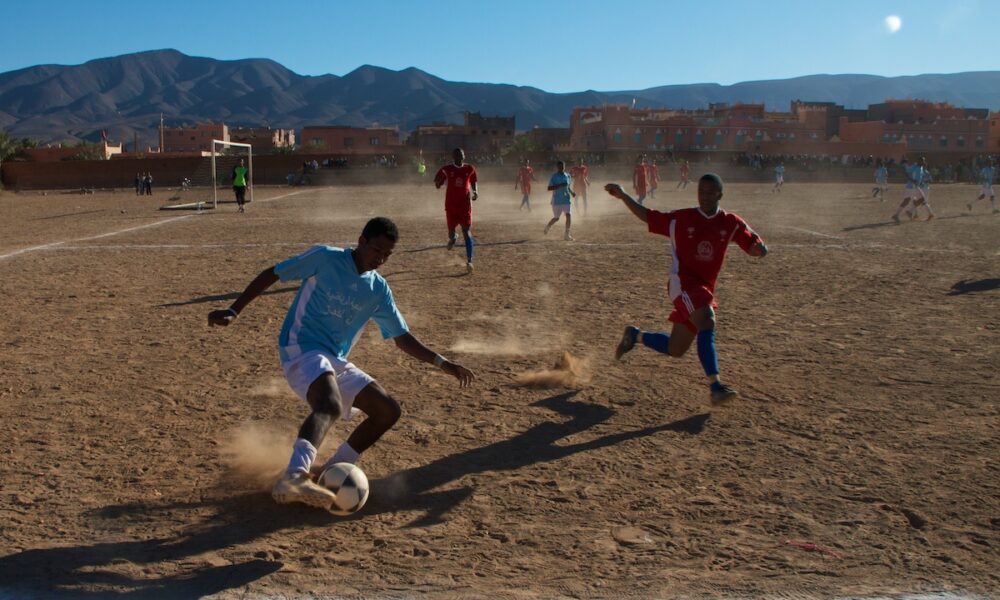
Featured image: Daoudfimaroc, Wikimedia Commons, CC BY-SA 3.0. The image depicts soccer match action and does not claim to show a specific blindside run.