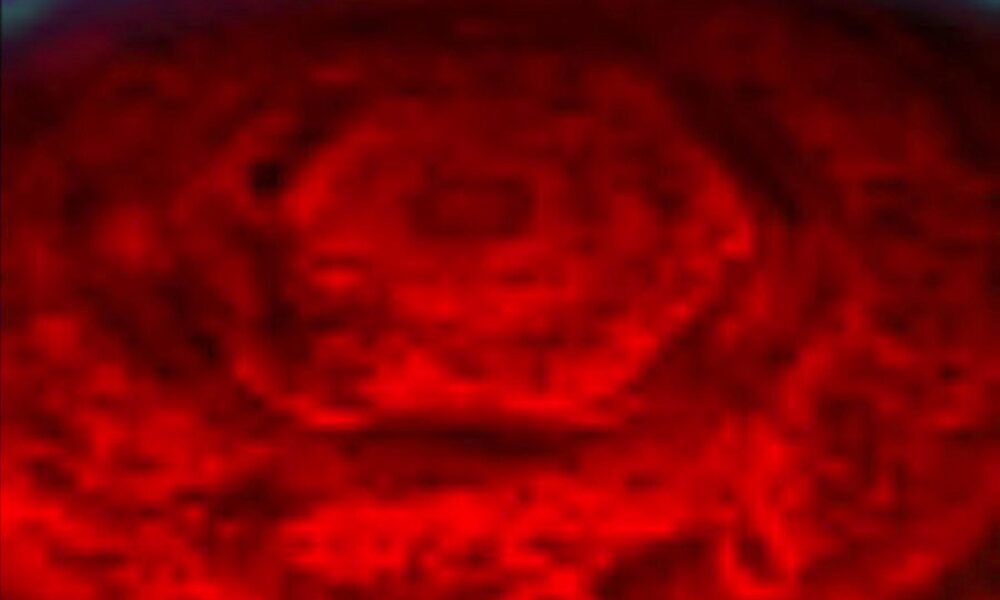

Saturn’s hexagon is a vast, six-sided jet stream encircling the planet’s north pole. It is a real atmospheric feature, not a solid structure or an artificial object. NASA’s Voyager spacecraft observed it in the early 1980s, and Cassini later captured detailed infrared and visible-light views. The hexagon spans roughly 25,000 kilometers (15,000 miles), large enough to fit nearly four Earths across its width. Its persistence for decades is one of the most intriguing puzzles in planetary meteorology.
The photographs in this article come from two separate Cassini observations, both archived by NASA. The first shows the six-sided structure in thermal infrared; the second shows clouds and part of the northern jet stream as the spacecraft approached the planet in 2016. They are genuine spacecraft images, not generative illustrations.
Saturn’s hexagon: quick facts
| Question | Answer |
|---|---|
| What is it? | A six-sided atmospheric jet stream around Saturn’s north pole |
| Approximate diameter | 25,000 km (15,000 miles) |
| Where is it? | North polar region of Saturn |
| First observed | Voyager images in the early 1980s |
| Later studied by | NASA’s Cassini orbiter, including infrared and visible cameras |
| Is it a solid object? | No, it is a pattern in moving gas and clouds |
| Is it the same as the central hurricane? | No. A separate polar cyclone sits within the larger hexagonal flow |
What does Saturn’s hexagon actually look like?
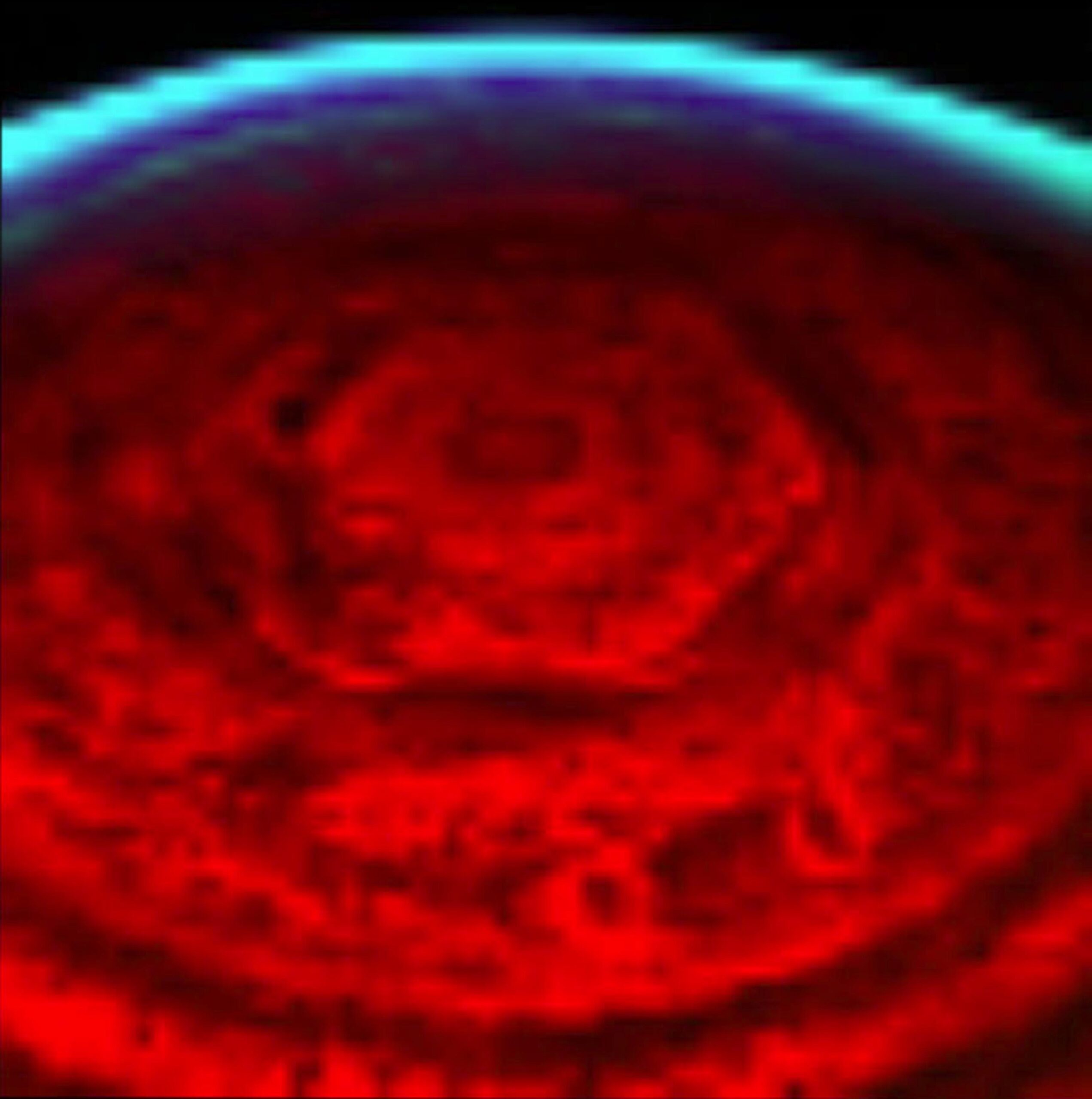
Seen from above the north pole, the boundary of a powerful atmospheric current forms six relatively straight sides and six corners. Individual clouds move along the current, but the overall polygonal pattern remains recognizable. The shape does not mean Saturn has six flat walls or a geometric opening in its surface. Saturn is a gas giant without a solid surface like Earth’s.
The image below is the actual Cassini PIA09186 nighttime thermal-infrared view. Cassini’s Visual and Infrared Mapping Spectrometer could detect the feature while the north pole was in seasonal darkness, before sunlight returned to make the region easier to photograph in visible wavelengths.
Why does Saturn have a hexagon instead of a circle?
Researchers generally interpret the hexagon as a large-scale atmospheric wave associated with a high-speed eastward jet stream. Rotating fluid systems can develop stable wave patterns, including polygon-like boundaries, under certain combinations of wind speed, shear, depth and latitude. Laboratory experiments and numerical models have reproduced polygonal flows, but the full explanation for Saturn’s exact shape and extraordinary longevity remains an active research topic.
It would be misleading to say that scientists have proved one simple cause or that a mysterious machine controls the winds. NASA describes the feature as a long-lived atmospheric phenomenon and notes that the infrared observations suggested it extended well below the cloud tops. The hexagon’s existence is directly observed; the precise mechanisms sustaining it are studied through models and measurements.
How fast are the winds?
Cassini infrared observations show clouds within the hexagonal region moving at speeds exceeding 530 kilometers per hour (about 330 mph) in some measurements. These are winds in Saturn’s atmosphere, not the rotation rate of the entire planet. Different cloud layers and locations can have different speeds. NASA’s Cassini infrared movie documentation explains the observed motion and the large polar cyclone.
Is Saturn’s hexagon a hurricane?
Not exactly. The hexagon is the boundary of a broad jet stream surrounding the pole. Within it lies a large central polar cyclone, sometimes compared with a hurricane because of its eye-like appearance and swirling clouds. The hexagonal jet and the cyclone are related features of the same dynamic atmosphere but should not be described as one identical storm.
The north pole also contains smaller storms and vortices. Cassini’s later images showed a busy, evolving cloud field even as the large six-sided boundary persisted. This contrast—stable overall geometry with continuously moving internal weather—is one reason the hexagon is scientifically interesting.
Why did Cassini photographs look different in 2006 and 2016?
Saturn’s seasons are long because its orbit around the Sun takes about 29 Earth years. Cassini arrived when Saturn’s north pole was experiencing darkness, so its infrared instrument was crucial for the early observations. As northern spring and summer brought sunlight, Cassini’s conventional imaging cameras could record more detail in reflected light.
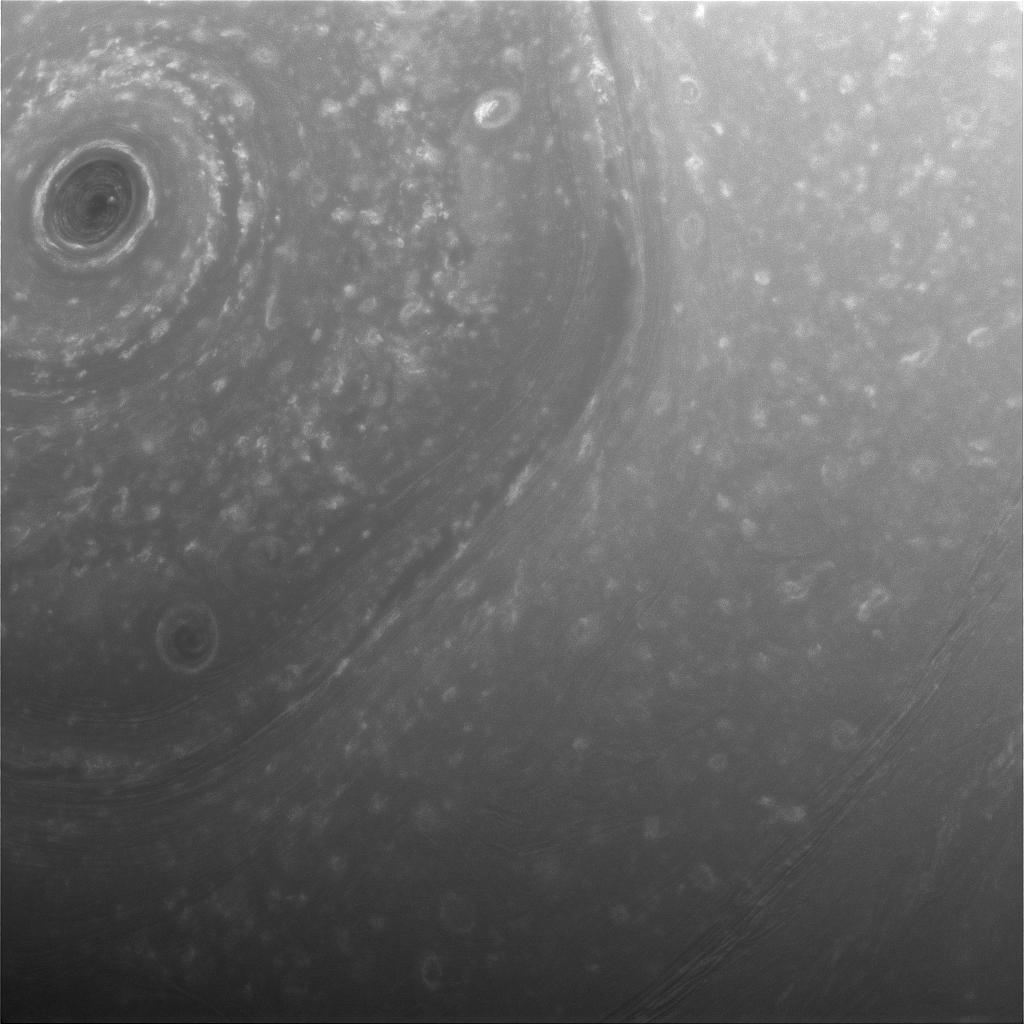
The second photograph is a distinct 2016 Cassini image, PIA21052, taken about half a day before the spacecraft’s first close pass near the outer edges of Saturn’s main rings in its final mission phase. NASA reports that it shows part of the jet stream, with a central circular storm farther toward the pole. The colors and contrast vary with instrument filters, processing and viewing geometry.
Can the hexagon be seen from Earth?
Saturn itself is easy to identify in a telescope when well placed in the sky, and its rings are a favorite observing target. The north polar hexagon, however, is far too small and low-contrast for ordinary backyard telescopes. Its clear outline comes from close spacecraft imaging and specialized instruments, not from a typical amateur view.
For a broader look at Saturn’s exploration, see our Cassini mission guide. NASA’s 2007 report explains how the discovery was confirmed and why the infrared observations were important.
Common questions
Is Saturn’s hexagon real?
Yes. Voyager and Cassini independently observed the six-sided atmospheric pattern, and NASA publishes the original image records.
How big is Saturn’s hexagon?
Approximately 25,000 kilometers across, or 15,000 miles, according to NASA’s Cassini report.
Is it a hole in Saturn?
No. It is a jet stream and cloud pattern, not an opening in a solid planet.
Does Saturn have a hexagon at both poles?
The well-known persistent hexagon surrounds the north pole. Saturn’s south pole has different circulation features, including a large cyclone, rather than a matching observed hexagon.
Why does it stay hexagonal?
Atmospheric-wave dynamics are the leading physical explanation, but scientists continue to investigate the details of its persistence.
Did Cassini land on Saturn?
No. Cassini orbited Saturn and studied its atmosphere, rings and moons before entering Saturn’s atmosphere at the end of its mission in September 2017.
Primary NASA image and science sources
Photo 1: PIA09186, Saturn’s Strange Hexagon (NASA/JPL/University of Arizona). Photo 2: PIA21052, Over Saturn’s Turbulent North (NASA/JPL-Caltech/Space Science Institute). Additional context: Cassini Images Bizarre Hexagon on Saturn and Infrared Movie of Saturn’s North Polar Region. Both original images are hosted in the AVARIXO Media Library with source credits; NASA endorsement is not implied.