
Historical explainer, reviewed October 2026; references are NASA’s archived mission records, not a claim about live spacecraft operations.
The mission in 30 seconds
Cassini-Huygens was an international mission to Saturn, launched on October 15, 1997. The Cassini orbiter entered orbit around Saturn on June 30, 2004 in California time (July 1 UTC), spending more than 13 years studying the planet, its rings, magnetic environment and moons. The European Space Agency’s Huygens probe descended through the atmosphere of Saturn’s largest moon, Titan, and landed on January 14, 2005. Cassini’s work ended on September 15, 2017, when the orbiter deliberately entered Saturn’s atmosphere.
The mission was not one robot with one instrument. It combined an orbiter, a separate atmospheric probe, multiple planetary flybys and a long scientific campaign. Its findings transformed Titan and Enceladus from intriguing moons into central targets for understanding potentially habitable environments beyond Earth.
Cassini mission facts
| Question | Verified answer |
|---|---|
| Launch | October 15, 1997, Cape Canaveral, Florida |
| Saturn orbit arrival | June 30, 2004 PDT / July 1, 2004 UTC |
| Major partners | NASA, ESA and the Italian Space Agency (ASI) |
| Orbiter | Cassini, managed by NASA’s Jet Propulsion Laboratory |
| Titan lander | ESA’s Huygens probe, January 14, 2005 |
| Primary targets | Saturn, rings, magnetic environment and moons |
| Grand Finale | 22 passes between Saturn and its rings in 2017 |
| Final day | September 15, 2017 |
The project built on earlier spacecraft encounters, but Cassini was the first spacecraft to orbit Saturn and repeatedly return to particular moons for detailed studies. That sustained perspective distinguishes a long orbital mission from a fast flyby.
Why scientists sent Cassini to Saturn
Saturn is not just a planet with photogenic rings. Its atmosphere, magnetic environment, rotating cloud patterns and many moons form a complex system. Scientists wanted to understand how the rings evolve, what conditions exist on different moons and how a giant planet influences everything around it. The spacecraft used cameras, spectrometers, radar and instruments for measuring particles and fields, allowing researchers to compare visible landscapes with information not apparent in ordinary photographs.
Some questions required repeating observations across seasons. A single image could show a storm or a ring feature, but only months or years of data could reveal whether that feature changed, moved or disappeared. That is why mission extensions were scientifically valuable rather than merely keeping an old spacecraft running.
The seven-year trip: Venus, Earth, Jupiter and Saturn
Cassini could not simply fly straight to Saturn using an affordable amount of rocket propellant. Mission planners used gravity-assist flybys to change its heliocentric path and velocity. The trajectory passed Venus twice, then Earth and Jupiter before reaching Saturn. A gravity assist exchanges a small amount of orbital momentum with a planet; it is not an unpowered engine that creates energy out of nowhere.
When Cassini arrived, it used its propulsion system to slow enough for Saturn’s gravity to capture it into orbit. That orbit could then be adjusted repeatedly to visit different regions of the system. NASA’s mission timeline records Saturn orbit insertion in 2004, following the 1997 launch.
Huygens at Titan: a landing in the outer Solar System
Huygens traveled attached to Cassini until late 2004, then separated and coasted toward Titan. On January 14, 2005 it entered Titan’s thick atmosphere, deployed parachutes and sent data during a descent that lasted about two and a half hours. The probe landed on terrain shaped by processes that researchers compared with erosion and sediment movement on Earth.
Huygens was not a rover. It had no wheels or plan for driving across the moon. It was a short-lived atmospheric and surface experiment, returning images and measurements through Cassini’s relay. Its achievement mattered because Titan’s haze had previously hidden the surface from ordinary visible-light views. Scientists could finally connect orbital observations with readings taken from within the atmosphere and on the ground.
Titan has lakes and seas of liquid hydrocarbons such as methane and ethane rather than familiar liquid-water oceans on its surface. Its weather and landscape provide striking parallels to Earth’s cycles, while its chemistry is fundamentally different. Neither Huygens nor Cassini discovered life on Titan.
Enceladus: why tiny icy moon changed the mission
Enceladus is much smaller than Titan, yet observations of its south-polar region revealed plumes of water-rich material emerging from fractures in the ice. Cassini directly sampled material associated with these jets and helped build the case for a global ocean beneath the ice. Evidence for hydrothermal activity at the ocean floor made Enceladus important to astrobiologists interested in environments where chemistry, water and an energy source can coexist.
This evidence supports the idea that Enceladus contains conditions worth investigating. It does not prove that microbes exist or that the moon is inhabited. Distinguishing a potentially habitable environment from detected life is essential when interpreting headlines about Cassini’s discoveries.
What Cassini learned about Saturn’s rings
The rings consist of countless particles of varying sizes, dominated by icy material. Cassini documented waves, gaps, spokes and interactions between ring particles and nearby moons. Rather than behaving like a solid disk, the rings constantly respond to gravity and collisions. Small embedded moons can disturb nearby particles, producing distinctive patterns visible in detailed images.
During the final part of the mission, Cassini’s path brought it through the region between the cloud tops and the innermost ring. Those close encounters provided an unusual perspective on the ring system and allowed the spacecraft to sample particles and study the planet’s gravity and magnetic field more directly. Scientists continue to analyze this data when studying the rings’ mass, evolution and age.
The Grand Finale: 22 daring orbits
In 2017 Cassini completed the Grand Finale, a set of 22 trajectories threading between Saturn and its rings. These close passages were possible only after the main moon-exploration goals had been accomplished and the spacecraft approached the end of its useful life.
On September 15, 2017, the orbiter entered Saturn’s atmosphere and transmitted data until it could no longer keep its antenna pointed toward Earth. Mission controllers selected this ending in part to avoid the possibility of an uncontrolled collision with potentially habitable moons such as Enceladus. The spacecraft did not land intact: intense heating and atmospheric forces destroyed it.
Astronomers distinguish the spacecraft’s event time from the later time its radio signal arrived at Earth. The last signal needed roughly 83 minutes to cross the distance from Saturn, so reports of ‘when contact ended’ can describe different clocks unless the time reference is stated.
Cassini versus Voyager: two different strategies
| Mission | Approach at Saturn | Main advantage |
|---|---|---|
| Voyager 1 | High-speed flyby in 1980 | Survey of the planet and Titan during a short encounter |
| Voyager 2 | Flyby in 1981 | Additional Saturn data before continuing to Uranus and Neptune |
| Cassini-Huygens | Long-duration orbiter plus Titan lander | Repeatable close observations, seasonal change and in-situ Titan measurements |
Earlier probes provided the first detailed reconnaissance. Cassini could return to locations, change orbital geometry and track evolving conditions, which explains why its Saturn science was so extensive.
What the spacecraft image shows
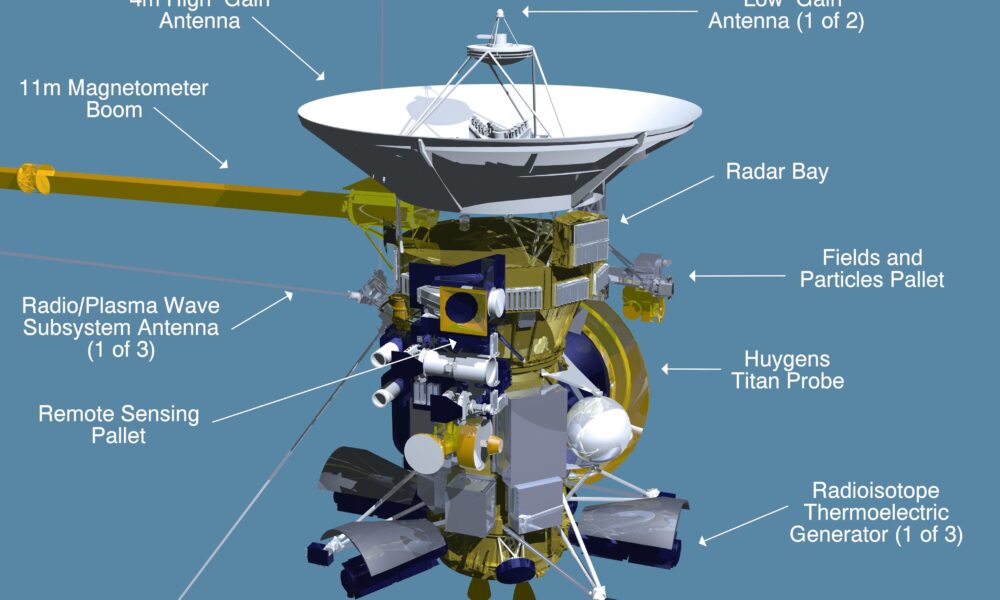
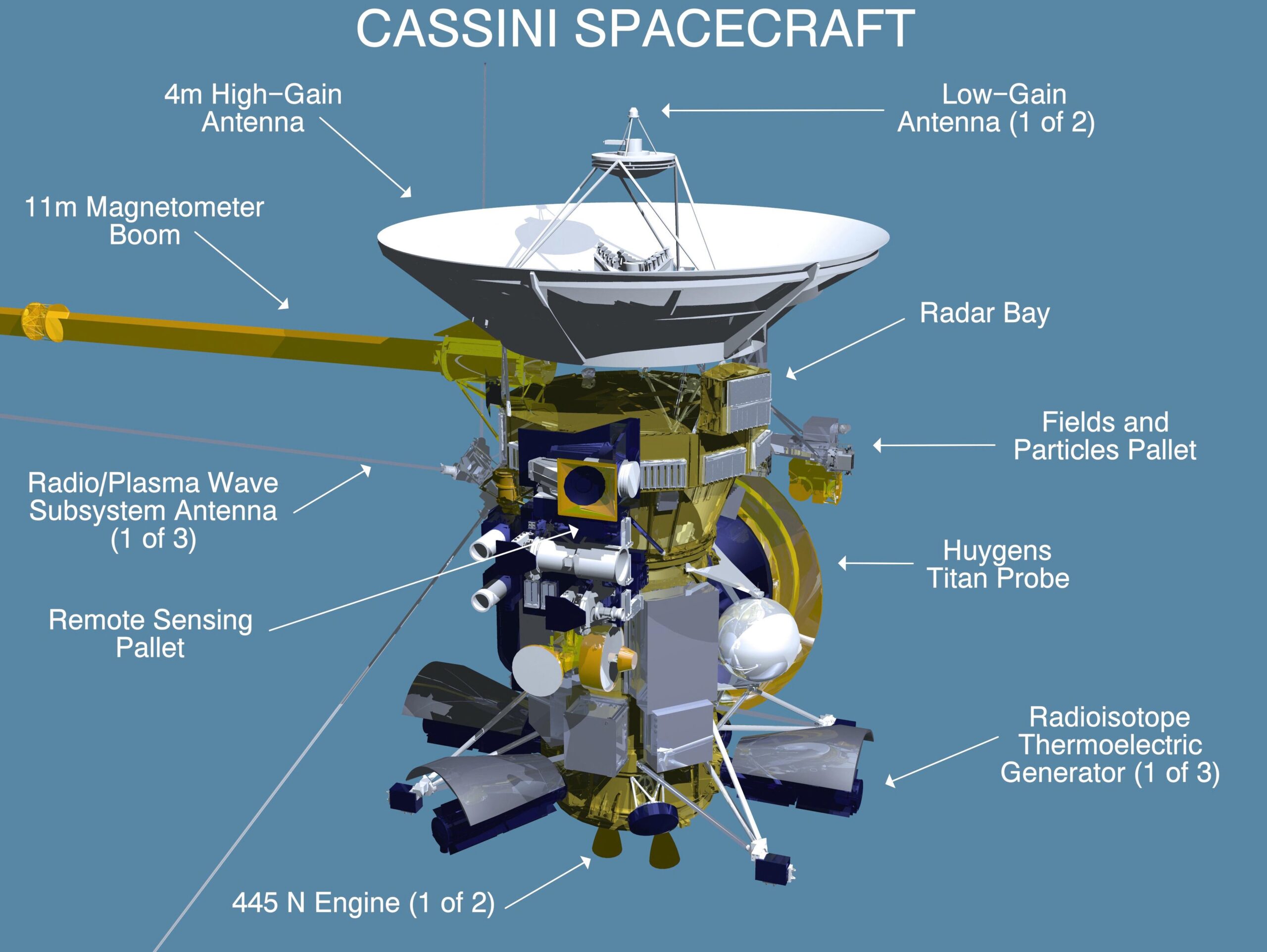
The featured image is a NASA-sourced spacecraft illustration uploaded to AVARIXO, not a photograph taken from Saturn’s orbit. Its shape is useful for identifying the orbiter and instruments but should not be confused with a camera image of Saturn or a real on-orbit photograph. Cassini’s wide-ranging payload was designed to study clouds, ice particles, magnetic fields, radar reflections and much more.
Frequently asked questions
Did Cassini land on Saturn?
No. Cassini’s final plunge into Saturn’s atmosphere ended with the spacecraft burning up. The separate Huygens probe landed on Titan, one of Saturn’s moons.
Why was Cassini destroyed on purpose?
Mission managers chose a controlled descent to prevent a future uncontrolled crash into worlds that may have environments suitable for life, while collecting additional science during the finale.
Did Cassini find life on Enceladus?
No. It found evidence for an ocean and potentially interesting chemistry, not organisms.
How long was Cassini at Saturn?
From Saturn orbit insertion in mid-2004 to September 2017, a little more than thirteen years.
Why was Titan important?
Titan has a dense atmosphere and a methane-based surface liquid cycle. Huygens provided the first direct descent and landing data from the moon.
Can Cassini still send pictures?
No. The spacecraft ended its mission in September 2017. NASA’s publicly accessible archive contains mission photographs and scientific observations that researchers still study.
Official sources and further reading
For dates, science and mission history, see NASA’s Cassini Grand Finale overview, the Huygens mission record and NASA’s detailed Cassini timeline. NASA’s Voyager 1 mission record gives context on earlier outer-planet exploration.
Related AVARIXO reading: Gemini spacecraft history with authentic NASA images explains another major chapter of human spaceflight, distinct from the robotic Cassini program.