
Poison arrow frogs, also called poison dart frogs, are small, often brightly colored tropical amphibians whose skin can contain powerful defensive chemicals. Most live in Central and South American forests. Their remarkable colors are often a warning to predators, and in many species the skin toxins are linked to the ants, mites and other small arthropods they eat in the wild. The name can be misleading: only a few species are documented as sources of toxins for traditional hunting blow darts, and many captive-bred frogs are not toxic in the same way as wild individuals.
This guide uses two real photographs of dyeing poison frogs (Dendrobates tinctorius) rather than AI illustrations or generic frogs. It explains the difference between poison and venom, why some zoo frogs lose their toxicity, what their vivid colors mean, how parents raise tadpoles and why conservation status depends on the particular species.
Poison arrow frog facts at a glance
| Question | Answer |
|---|---|
| Other names | Poison dart frog, poison frog |
| Scientific family | Dendrobatidae |
| Where they live | Mostly tropical Central and South America |
| Typical size | Many are about 0.75–1.5 inches (20–40 mm), with considerable species variation |
| Active during | Usually daytime (diurnal) |
| Main food | Small insects and other arthropods, including ants and mites |
| Defense | Skin alkaloids in some species, sometimes advertised by warning colors |
| Most famously toxic example | Golden poison frog, Phyllobates terribilis |
| Major threats | Habitat loss, wildlife trade and amphibian disease, varying by species |
The Smithsonian National Zoo poison frog profile explains that these frogs are not all equally poisonous and that only three species are documented in connection with hunting dart poison. The San Diego Zoo Wildlife Alliance describes their ecology, breeding and diet.
What do real poison arrow frogs look like?
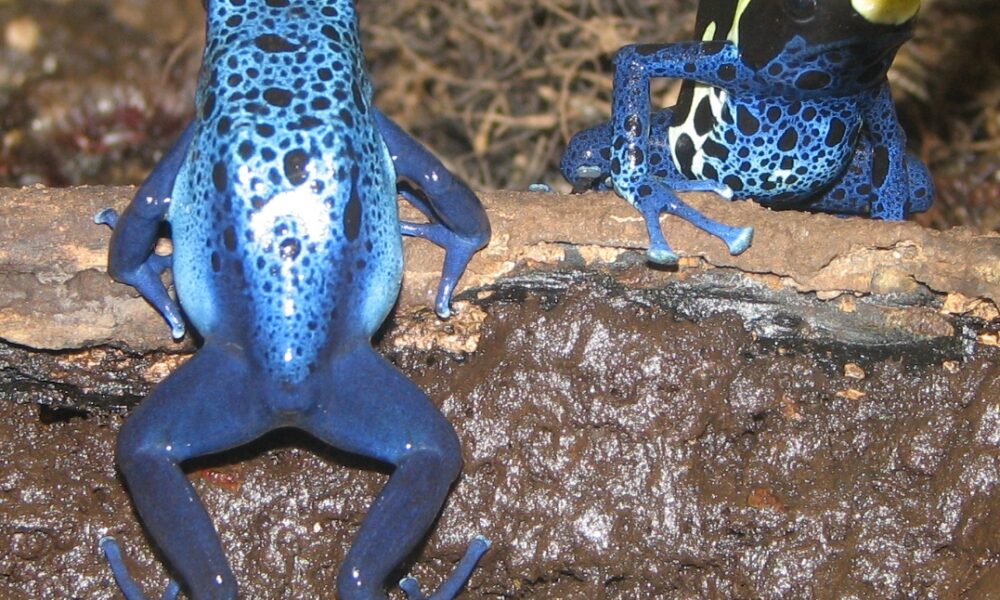
Poison frogs vary enormously. Some are electric blue with dark spots, others yellow and black, green and black, orange, or bright red. Not every member of the family has the same pattern, and some less conspicuous species can be difficult to recognize without careful identification. The images in this article show Dendrobates tinctorius forms photographed in a zoo, not the golden poison frog or an unrelated tree frog.
The featured image shows actual blue and patterned dyeing poison frogs photographed by Ltshears at Louisville Zoo in January 2007. The photographer released the photograph into the public domain. Colorful skin alone cannot tell you exactly how toxic an individual is, and it cannot prove that a captive animal has the same alkaloid content as a wild frog.
Are poison dart frogs poisonous or venomous?
They are primarily poisonous, not venomous. Poison generally harms an animal when it is eaten, absorbed or otherwise enters the body. Venom is actively delivered by a specialized structure such as a fang or stinger. Poison frogs do not inject toxin through fangs when they bite. Some species store defensive alkaloids in skin glands, discouraging predators that try to eat them.
That distinction does not make handling wild poison frogs safe. Avoid touching wild amphibians, and never touch your eyes or mouth after handling a frog or its habitat. Their skin is delicate, and oils or contaminants on human hands can harm the animal. The risks depend on the species, the amount and route of exposure, and the individual’s diet.
Why are poison arrow frogs so colorful?
Many species use aposematic coloration: bold colors or patterns associated with chemical defenses. Predators may learn to avoid an unpleasant or dangerous animal after an encounter. Brightness is therefore often a warning signal rather than camouflage. Some frogs also resemble toxic species even when their own defenses differ, making appearance an imperfect guide to danger.
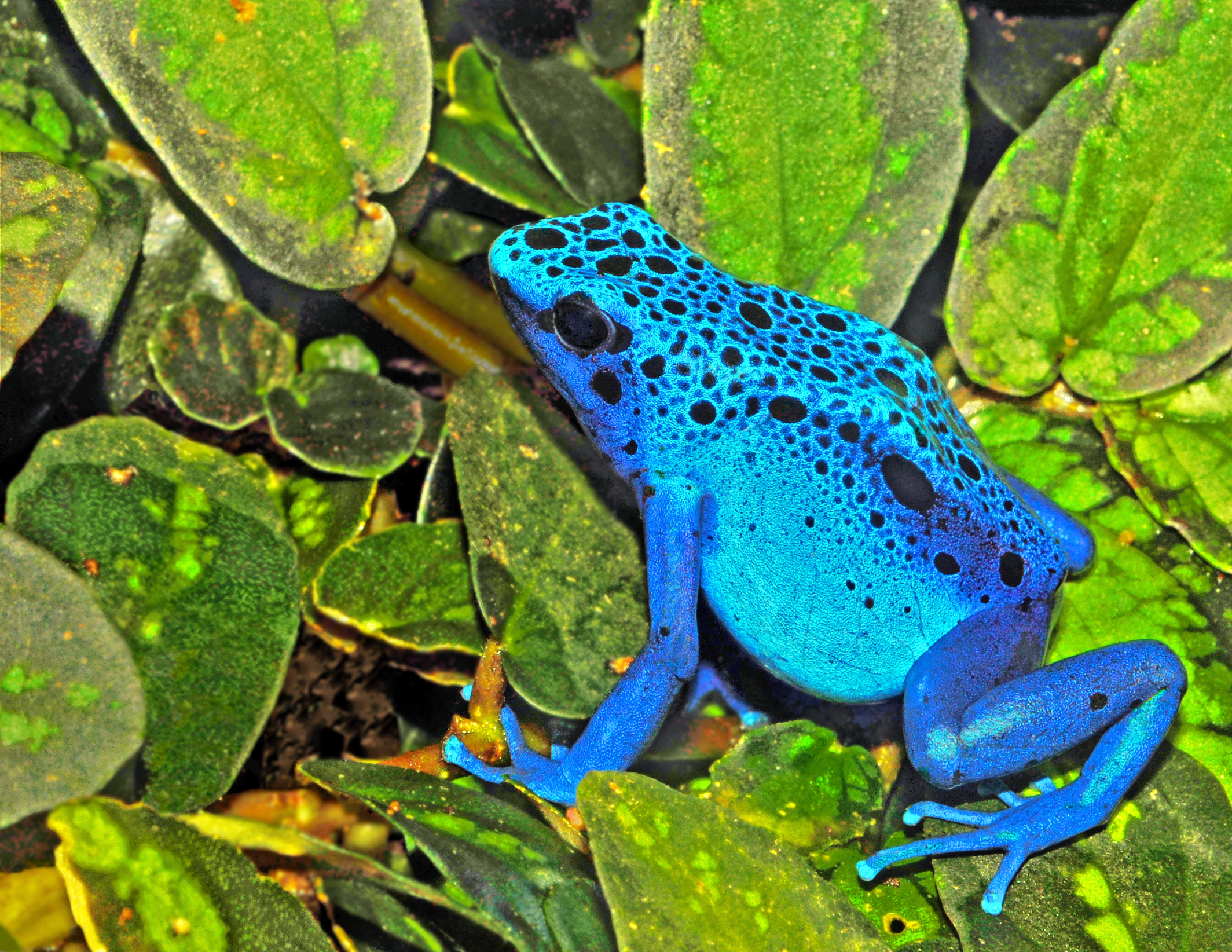
The famous blue poison frog is often treated as a separate species in older sources, but it is commonly classified as Dendrobates tinctorius “azureus,” a form of the dyeing poison frog. Exact taxonomic treatment can change as new research emerges. The photograph below is an authentic blue form captured by photographer Michael Gäbler in 2009, licensed under Creative Commons Attribution 3.0.
Where does the poison come from?
For many poison frog species, defensive alkaloids are associated with the tiny arthropods they consume in their natural habitat. Ants and mites are among the important dietary sources being investigated. The frogs can accumulate and sequester certain compounds rather than making every chemical entirely from scratch. Their ability to store these substances varies by species and compound.
This is why many poison frogs bred and raised in human care on a controlled diet of non-toxic insects lack the potent wild-type skin secretions. The Smithsonian says the frogs in its care are not poisonous because of their diet. It would be incorrect, however, to claim that all frogs in captivity are guaranteed harmless or that anyone should handle them freely.
Which poison arrow frog is the most dangerous?
The golden poison frog (Phyllobates terribilis) is the best-known exceptionally toxic member of the family. It can carry batrachotoxin, a potent neurotoxin. Its danger is not shared equally by every blue, green or red frog labeled a poison dart frog. Scientists distinguish between different species, their alkaloid profiles and their actual exposure risks.
Smithsonian notes that the documented traditional use of frog skin toxins on hunting darts involved only a small number of Phyllobates species. The common phrase “poison arrow frog” is broader than the documented historical practice and should not be taken to mean every species was used to poison arrows.
What do poison frogs eat?
They consume tiny invertebrates, including ants, termites, mites, beetles and other insects. Their small bodies and sticky tongues are adapted to picking up little prey from forest leaf litter, roots and vegetation. Diet can vary with body size, habitat and species. Young tadpoles eat very different foods from adult frogs, sometimes including algae, organic debris or insect larvae.
Some species are especially selective about feeding their offspring. In certain species, a female returns to the water pocket where she placed a tadpole and supplies unfertilized eggs as food. This is parental investment, not the same as a typical frog leaving hundreds of eggs in a pond without further care.
How do poison dart frogs raise their tadpoles?
Many poison frogs lay relatively small clutches of eggs in moist protected places, such as leaf litter. One or both parents guard the eggs and prevent them from drying out. After hatching, the adult may transport tadpoles on its back to a small pool, a stream or a water-filled plant structure such as a bromeliad. Their development and care vary greatly across the family.
The Smithsonian describes clutch sizes ranging from one to about 40 eggs depending on the species, while San Diego Zoo emphasizes the remarkable diversity of transport and feeding behaviors. These figures should not be used as if they describe one universal reproductive schedule for every poison frog.
Can poison arrow frogs be kept as pets?
Captive-bred poison frogs are kept by experienced amphibian keepers, but they require species-appropriate humidity, temperature, secure habitats, a reliable supply of tiny live food and careful hygiene. Never collect a wild animal, and do not assume a brightly colored wild frog is safe to handle. Wildlife trade rules differ by country and species, and captive-bred provenance matters for conservation.
These are sensitive animals, not decorative objects. Research their long-term needs before considering amphibian ownership, and never release a captive frog into local ecosystems. It can introduce disease or become an invasive organism.
Are poison dart frogs endangered?
There is no single conservation status for all poison frogs. Some species remain relatively widespread; others have very restricted habitats or declining populations. Rainforest clearing, illegal collection and infectious disease such as chytridiomycosis can create serious pressures. A current conservation claim should always name the exact species and region rather than labeling the entire family endangered.
Habitat protection and responsible, documented captive breeding can reduce pressure on wild populations. For broader examples of how wildlife habitat matters, our horseshoe crab ecology guide explains the relationship between a coastal species and migrating birds; the ecosystems are different, but both illustrate why protecting habitat is more useful than collecting wild animals.
Poison arrow frog FAQ
Are blue poison dart frogs the most poisonous?
No. The golden poison frog is the most famous example of extreme toxicity; a blue frog’s vivid color does not make it the most dangerous species.
Why are captive poison frogs less toxic?
Many rely on specific dietary alkaloids acquired in the wild, which are absent from typical captive insect diets.
Are poison frogs aggressive?
They can defend territories against other frogs, but they do not hunt or attack people with injected venom.
Do all poison dart frogs live in trees?
No. Many spend substantial time in moist forest leaf litter, while others climb plants and trees.
How big are poison dart frogs?
Many measure around 20–40 mm long, but the range depends on the species and can extend outside those values.
Can I tell a poisonous frog by its color?
No. Warning colors are a useful ecological clue but are not a reliable safety or species-identification test.
Sources and photo licenses
Scientific facts were checked against Smithsonian National Zoo’s poison frogs profile and San Diego Zoo Wildlife Alliance’s poison frog overview. The real photographs were uploaded to AVARIXO’s own Media Library: Ltshears’ public-domain photo of actual frogs and Michael Gäbler’s blue poison frog photo, licensed CC BY 3.0. Neither is an illustration, AI-generated scene or hotlinked image. No endorsement by the photographers or institutions is implied.