Quick answer: Pioneer 10 was the NASA probe launched on March 2, 1972 that became the first spacecraft to cross the main asteroid belt and fly past Jupiter. It returned the first close-up views of the giant planet and made measurements that helped engineers plan later outer-planet missions. Its last detectable radio signal arrived on January 23, 2003. The spacecraft is no longer communicating, so no one has a live camera feed or current telemetry from it.
Pioneer 10 facts at a glance
| Question | Verified answer |
|---|---|
| Agency | NASA; managed by Ames Research Center |
| Launch | March 2, 1972, from Cape Canaveral on an Atlas-Centaur rocket |
| Primary target | Jupiter flyby, not landing or orbit insertion |
| Spacecraft launch mass | About 258 kg (569 lb) |
| Closest Jupiter approach | December 4, 1973 UTC, about 130,000 km (81,000 mi) above cloud tops |
| Routine mission operations ended | March 31, 1997 |
| Last usable telemetry | April 27, 2002 |
| Last detected signal | January 23, 2003 |
The often-quoted December 3 date for the Jupiter flyby reflects differences in historical reporting and time zones. NASA’s detailed mission timeline places closest approach at 02:26 UTC on December 4, 1973. That precision matters more than turning two calendar-day references into an invented second encounter.
What did Pioneer 10 actually accomplish?
1. It demonstrated an asteroid-belt crossing
Before the mission, the physical environment between Mars and Jupiter was not as well characterized as it is today. Pioneer 10 entered the asteroid belt in July 1972 and emerged in February 1973. Its instruments measured dust and particles as it crossed. The success did not prove that every future trajectory would be risk-free, but it materially reduced uncertainty for subsequent missions traveling beyond Mars.
2. It measured Jupiter’s powerful environment
Jupiter is more than clouds and colorful bands. During the flyby, Pioneer 10 sampled its magnetic field, plasma, charged particles and radiation environment. Those measurements informed the design of later missions, particularly their protection against intense radiation around the planet. A particularly useful lesson was that a beautiful close-up image is only one product of a spacecraft encounter: invisible radiation and magnetic-field data can matter just as much for the next mission.
3. It returned genuine images of Jupiter and moons
The featured image on this article is a genuine historical Jupiter observation sequence returned during the Pioneer 10 mission, not a modern photograph and not an artist’s impression of the spacecraft. Because the imaging instrument was an early photopolarimeter and the encounter took place in 1973, do not expect today’s high-resolution digital-camera results. Some historical releases assemble multiple observations into a sequence to show the changing view of Jupiter before and after the spacecraft passed it.
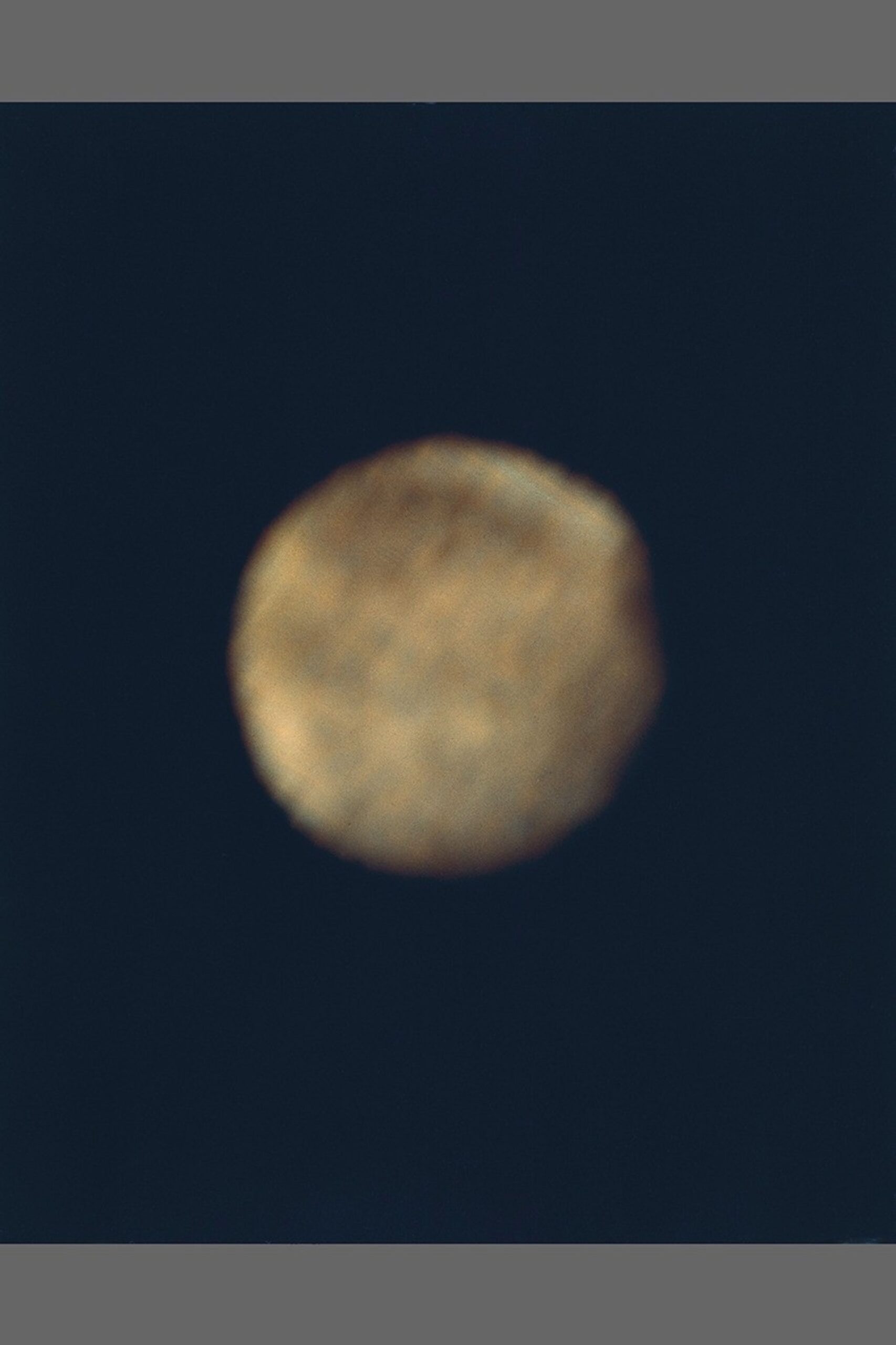
This separate, low-resolution historical image shows Ganymede as observed on the flyby. The low detail is part of the real 1973 record. NASA also reports that some desired imaging, including an image of Io, was disrupted by Jupiter’s radiation environment. Treat vividly detailed paintings of Pioneer 10 near Jupiter as illustrations, not onboard photographs.
Why does Pioneer 10 have a large dish but no solar panels?
The prominent parabolic dish was its high-gain radio antenna, used to communicate with Earth over extraordinary distances. Electrical power came from radioisotope thermoelectric generators (RTGs), which use heat produced by radioactive decay and convert part of it into electricity. Unlike a reactor, this power source does not sustain a chain reaction. At Jupiter’s distance from the Sun, relying on 1970s solar-panel technology would have imposed serious practical limits.
The probe was spin-stabilized, so the antenna and spacecraft geometry formed part of its communication strategy. As the electrical output from the RTGs declined, the radio link ultimately became too weak to maintain.
What happened after the Jupiter flyby?
Pioneer 10 continued outward after the flyby instead of settling into orbit around Jupiter. It crossed Saturn’s orbital distance in 1976 and Neptune’s orbital distance in June 1983. Passing an orbit is not the same as leaving the Sun’s gravitational influence at that moment, and descriptions such as “escaped the solar system in 1983” simplify a much more gradual journey.
Its planned mission was approximately 21 months, yet useful measurements and communications continued for decades. NASA ended routine operations in 1997, received the last usable telemetry in April 2002 and detected the last extremely weak signal in January 2003. A final contact attempt in 2006 did not restore communications. As a result, contemporary online “live Pioneer 10 images” should be treated skeptically unless they are explicitly labeled historical archives.
Pioneer 10 timeline
| Date | What happened | Why it matters |
|---|---|---|
| March 2, 1972 | Launch | First NASA outer-planet mission begins |
| July 1972–February 1973 | Crossed the asteroid belt | Directly measured an uncertain region |
| December 1973 | Jupiter flyby | First close-up data and imagery of Jupiter |
| June 13, 1983 | Crossed Neptune’s orbit | Extended journey beyond the major planets |
| March 31, 1997 | Routine contact ended | Not the same as the last radio signal |
| January 23, 2003 | Last faint signal | Last confirmed contact |
Is Pioneer 10 still in space in 2026?
Yes. The probe did not burn up at Jupiter or return to Earth. It continues following its outward solar-system trajectory, but it is silent. Any statement about its exact present-day distance should identify an ephemeris and calculation date rather than pretend a current measurement arrived from the spacecraft. It is generally headed in the direction of the star Aldebaran, a direction in the sky rather than a near-term destination or guaranteed physical encounter.
To compare this pioneering flyby with another class of space machine, see AVARIXO’s Roman Space Telescope mission guide, which explains a telescope built for a very different type of observation. For historical space images, our Hubble Deep Field explainer shows why image provenance and observing method matter.
Frequently asked questions
Was Pioneer 10 the first spacecraft to reach Jupiter?
Yes. It conducted the first Jupiter flyby in December 1973. It was not the first to orbit Jupiter; flyby and orbit insertion are different mission types.
Can Pioneer 10 take photos today?
No working communication channel exists to transmit new pictures, and its original imaging system was built for its early mission. The images you can view today are archival data.
Did Pioneer 10 pass through the asteroid belt safely?
It completed the passage successfully and measured its environment. That did not eliminate every risk for every spacecraft or every route.
How is Pioneer 10 different from Pioneer 11?
Pioneer 10 went to Jupiter and continued outward. Pioneer 11 later flew by Jupiter and went on to make the first spacecraft encounter with Saturn. Their flight histories are related but not interchangeable.
Why do sources disagree about the Jupiter flyby date?
Some write December 3 based on local date or rounded historical descriptions; NASA’s detailed mission history uses the UTC timestamp in the early hours of December 4.
Official reference: NASA Pioneer 10 mission timeline. Last reviewed: October 15, 2026.