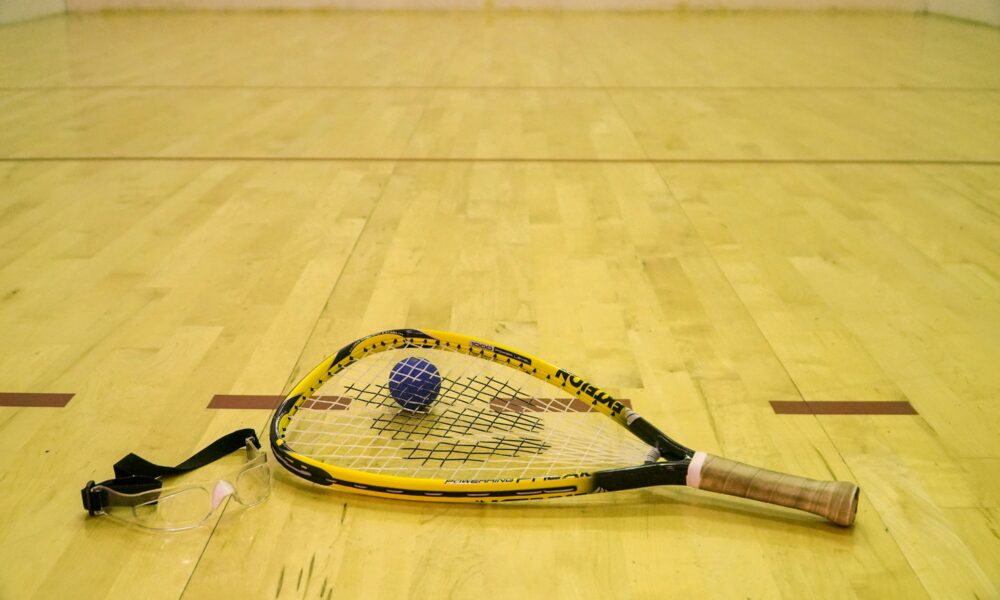

Racquetball rules in brief: In standard U.S. four-wall racquetball, one player faces another (singles), or two partners play against two (doubles) on an enclosed court. After a legal serve, players alternate hitting a small rubber ball toward the front wall before it touches the floor. The ball may bounce only once on the floor before each return. Under the regular USA Racquetball scoring system, only the serving player or team scores. Games are usually to 15 points, with an 11-point tiebreaker if the first two games are split. The official rulebook, not a casual house rule, governs tournament calls.

Important format difference: International Racquetball Federation (IRF) tournaments can use a different rally-scoring system. Do not assume that every racquetball match uses the same win condition; check which organization’s rules your tournament follows.
Racquetball rules at a glance
| Question | Standard USA Racquetball answer |
|---|---|
| Players | Two in singles; four in doubles |
| Court | Four enclosed walls, about 20 ft wide × 40 ft long × 20 ft high |
| Equipment | Short racquet, hollow rubber ball, approved protective eyewear |
| Serve | Stand in service zone; bounce ball, strike it to front wall, rebound past short line |
| Floor bounces | No more than one before each return |
| Scoring | Side-out scoring: serving side scores only |
| Games | Best of three; 15, 15, then 11 if needed |
| Winning margin | No two-point margin required in standard U.S. games |
| Safety | Protective eyewear is mandatory in sanctioned play |
1. The court and equipment you need
A regulation four-wall court is roughly 20 feet wide, 40 feet long and 20 feet high. The front, side and rear walls can all be part of play, as can the ceiling, subject to the sport’s specific contact rules and any marked out-of-play openings. Racquetball is therefore not played like tennis: there is no net dividing two halves, and a shot can legally rebound off several walls on its way to the front wall.
A short racquet (no more than 22 inches under USA Racquetball equipment specifications), a racquetball and purpose-built protective eyewear are essential. Do not substitute ordinary eyeglasses for sport goggles. Indoor court shoes with clean, non-marking soles help protect the floor and offer grip; bring water and leave enough space for other players to swing safely.
2. How to serve in racquetball
Begin inside the service zone, between the service line and short line. Drop the ball, let it bounce once, and strike it. The serve must reach the front wall first; the rebound must pass the short line and can then reach the receiving area within the allowed limits. Players must observe serve-position and readiness rules before beginning the rally.
Common types of serve faults
| Fault | What happened | Beginner correction |
|---|---|---|
| Short serve | Ball rebounds from front wall and first lands before or on short line | Hit higher or with greater pace |
| Long serve | Ball reaches back wall before touching floor | Reduce power or change angle |
| Three-wall serve | After front wall, ball hits both side walls before the floor | Aim away from extreme side angles |
| Ceiling serve | Service return contacts ceiling in a disallowed manner | Use a controlled waist-height strike |
| Foot fault | Server violates required service-zone positioning | Reset stance behind the proper line |
Under standard USA Racquetball play, one ordinary fault gives a second serve. A second consecutive fault causes a side-out, transferring the serve. But some more serious “out serves” lose the serve immediately, even on the first attempt. For example, failing to send the ball to the front wall directly on the serve is not simply a routine short serve.
3. How to return the ball and win a rally
Once the receiver legally returns the serve, the players alternate shots. A valid return must strike the front wall before the ball next hits the floor. It may hit side walls, the back wall or the ceiling beforehand if the overall path is legal. Players can return the ball straight out of the air or after one floor bounce.
The receiving player loses the rally if they allow a second floor bounce, miss the ball entirely, hit the floor before the front wall, carry or throw the ball with the racquet, or commit another rule-defined fault. A shot that reaches the front wall and then dies before the opponent can return it is often called a kill shot.
What about the ceiling?
Unlike many racket sports, the ceiling is usually in play during a racquetball rally. A defensive ceiling shot can hit the ceiling and then the front wall without bouncing on the floor first. Service rules are stricter: a ceiling contact during a serve may be a service fault. Do not apply a rally allowance to service automatically.
4. Racquetball scoring: A rally-by-rally example
Here is the essential distinction: winning a rally while serving gives the serving side one point. Winning a rally while receiving ordinarily gives the receiver the next serve, but not a point. This is called side-out scoring.
| Play | Server | Winner of rally | Score after rally | Next server |
|---|---|---|---|---|
| 1 | Alex | Alex | Alex 1 – Bea 0 | Alex |
| 2 | Alex | Bea | Alex 1 – Bea 0 | Bea |
| 3 | Bea | Bea | Alex 1 – Bea 1 | Bea |
| 4 | Bea | Alex | Alex 1 – Bea 1 | Alex |
When Alex lost Play 2 and Bea lost Play 4, neither receiver earned a point. Those rallies changed the serving side. This is the beginner mistake to fix first: racquetball can include several exciting rallies without a score change.
5. How to win the game and match
For normal USA Racquetball matches, the winner is the first player or team to win two games. Each of the first two games goes to 15 points. If the sides win one game each, the deciding third game goes to 11 points. A side can win 15–14 or 11–10; unlike a number of other sports, the standard U.S. format does not require a two-point advantage.
Keep in mind that professional and international tournament organizers sometimes choose a different scoring system or match format, including rally scoring. Read the match sheet first rather than silently applying American amateur rules to an IRF event.
6. What is a hinder in racquetball?
Racquetball players share the same enclosed court. This creates a special rule category called a hinder. When one player or team blocks an opponent’s reasonable access to the ball or prevents a fair swing, the rally may be stopped. The details matter:
- Replay hinder: a recognized accidental interference or unavoidable situation results in playing the rally again.
- Penalty hinder: an opponent causes prohibited interference, depriving a fair chance to make a shot; the rules award the rally to the non-offending side.
- No hinder: merely standing in the court is not an automatic stoppage; the ball’s path and whether the player could have returned it matter.
Safety comes first: never swing a racquet toward someone’s face or body to force a referee to acknowledge a hinder. Stop, call the interference and consult the official rulebook if the call is contested.
7. How doubles racquetball differs from singles
In doubles, two teammates play as one side. Both receiving players must be alert, and players should call “mine” or “yours” to prevent collisions. Under USA Racquetball doubles procedures, both partners ordinarily have an opportunity to serve during their team’s service possession. When the first server loses the rally, this is often called a handout; after the second server loses service, the opponents receive the serve (a side-out). Special first-turn and event-specific serving exceptions should be checked in the current doubles rules.
The scoring principle remains the same: the serving side earns points on won rallies in U.S. side-out play. Doubles adds tactical communication, positioning and extra hinder risks because four athletes share the small court.
8. Racquetball vs squash, tennis and pickleball
| Sport | Playing area | Typical scoring distinction | Key tactical difference |
|---|---|---|---|
| Racquetball (U.S.) | Enclosed four-wall court | Only server scores | Ceiling and many walls are in play |
| Squash | Enclosed court with boundary and tin | Modern international singles uses rally scoring | Different front-wall target and out lines |
| Tennis | Open court divided by a net | Games, sets and tie-breaks | Shots travel across the net |
| Pickleball | Net court and non-volley zone | Several sanctioned scoring formats | Kitchen and two-bounce rules |
For pickleball’s very different serving and non-volley-zone rules, see our existing pickleball rules guide. Racquetball’s first wall target and court movement demand their own footwork and safety habits.
9. A safe 15-minute beginner practice
- Minutes 0–3: warm up, fit proper eyewear, walk the service line and short line.
- Minutes 3–6: practice controlled legal serves into the front wall, allowing the proper receiving bounce.
- Minutes 6–10: rally gently with a partner, aiming to hit the front wall before any floor bounce.
- Minutes 10–13: rehearse forehand and backhand returns in open space with no close opponent.
- Minutes 13–15: play a brief side-out scoring drill and record when the serve changes.
If you feel crowded, stop before taking the shot. Warming up with shorter swings and maintaining eye protection reduce avoidable injuries. Tournament competitors should follow venue rules and player safety protocols.
Frequently asked questions
Do you have to let a racquetball bounce?
No. A player may volley the ball before a floor bounce, or strike it after its first bounce. A second floor bounce ends the chance to return it.
Can the ball hit the ceiling?
Yes, in many normal rallies, provided the eventual legal shot reaches the front wall before bouncing on the floor. Serves are subject to a separate ceiling restriction.
Do you have to win by two points?
No. In standard USA Racquetball games, the first to 15 (or 11 in the tiebreaker) wins. Different competitions can adopt different match formats.
Can you score if the other player serves?
Not in traditional USA Racquetball side-out scoring. Winning as the receiver gains the serve, not a point. IRF rally-scoring events use a different approach.
Is safety eyewear required?
Yes, approved protective eyewear is required for sanctioned play, and it is strongly recommended for every recreational player.
Where can I read the official racquetball rules?
Check USA Racquetball’s official rulebook page for four-wall U.S. play. If competing internationally, consult the event’s governing federation and ruleset rather than assuming the U.S. version applies.


