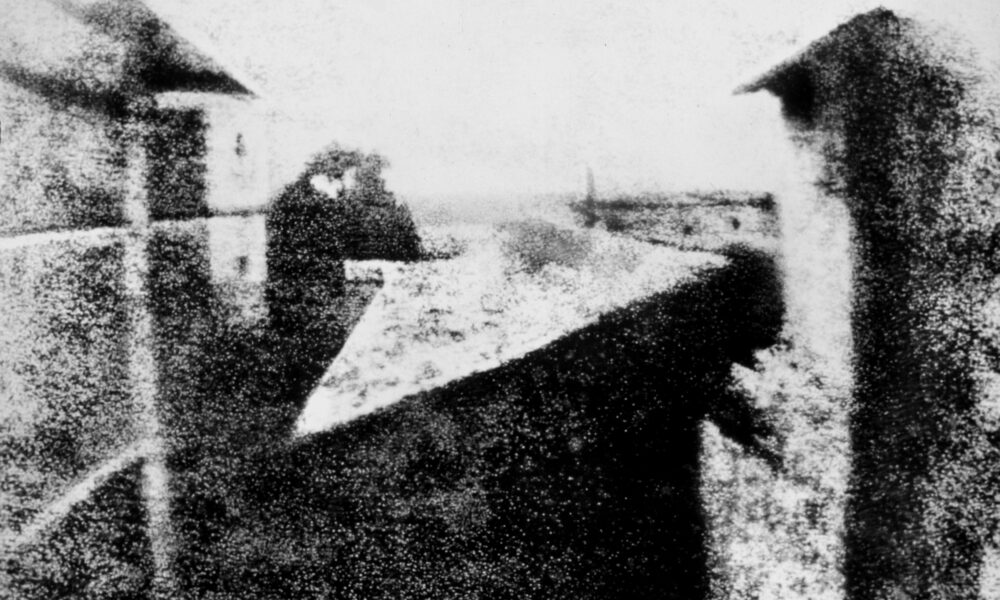

Quick answer: Photography began long before digital cameras. The earliest surviving photograph made with a camera is View from the Window at Le Gras, produced by Joseph Nicéphore Niépce in France around 1827. His experiment used a light-sensitive coating on a pewter plate and required an exceptionally long exposure. Photography became publicly available as a practical image-making process in 1839, with Louis Daguerre’s daguerreotype and important parallel work by William Henry Fox Talbot. The story is therefore a series of breakthroughs, not one person inventing the modern camera in a single year.
Who invented photography?
Joseph Nicéphore Niépce made the earliest camera photograph known to survive. That achievement is separate from inventing every technology used by photographers today. Camera obscuras projected scenes long before Niépce. Later, Louis-Jacques-Mandé Daguerre developed a new method for making detailed direct-positive images, while Talbot developed negative-to-positive methods capable of generating multiple prints.
The Harry Ransom Center at the University of Texas, which holds the original Niépce plate, dates it to 1827. Some older histories say 1826 or 1827; the safest precise description is around 1827 rather than claiming there is no uncertainty.
The earliest surviving camera photograph: what does it show?
Niépce positioned a camera obscura at a second-story window at the family estate in Saint-Loup-de-Varennes, France. The resulting View from the Window at Le Gras shows portions of courtyard buildings, rooflines and the view beyond. It can appear almost abstract to a modern viewer because the contrast is faint and uneven. Its significance is that light, not a drawing hand, left a persistent image on the plate.
Niépce called his technique heliography, meaning roughly “sun writing.” He coated polished pewter with a light-sensitive form of bitumen, exposed it for many hours and used solvents to separate differently exposed regions. The Harry Ransom Center explains that the plate was exposed over an extended period, not instantaneously. The exact duration is debated; “several hours” is more responsible than repeating an exact hour count as certainty.
Why is the original image difficult to see?
The plate is not a paper print. It relies on changes in the reflecting surface of a metal plate and must be viewed under controlled lighting. Many reproduced versions increase contrast so viewers can recognize buildings. A digitally enhanced version can help explain the scene but should not be mistaken for the plate’s original visual appearance.
Photography history timeline
| Year or period | Milestone | What changed |
|---|---|---|
| Ancient to early modern | Camera obscura | Optical projection demonstrates that light can form an image without preserving it. |
| 1810s–1820s | Niépce experiments | Chemical methods begin to retain camera-produced scenes. |
| About 1827 | View from the Window at Le Gras | Earliest surviving camera photograph on a permanent surface. |
| 1829 | Niépce–Daguerre partnership | Two inventors collaborate on improving photographic processes. |
| 1839 | Daguerreotype announced | Detailed one-of-a-kind photographs become publicly known. |
| 1841 | Talbot patents calotype | A paper-negative process supports making multiple positives. |
| Mid-1800s onward | Glass plates and later roll film | Processes become more practical, repeatable and transportable. |
| 20th century | Color processes and electronic sensors | Photography expands from chemical film toward digital capture. |
The Library of Congress daguerreotype timeline documents the 1839 and 1841 developments.
Daguerreotype versus calotype: why two inventions mattered
Daguerreotypes and calotypes both record light, but their handling and reproduction differ.
| Property | Daguerreotype | Calotype |
|---|---|---|
| Associated inventor | Louis Daguerre | William Henry Fox Talbot |
| Public milestone | 1839 announcement | 1841 patent |
| Image support | Silver-plated copper plate | Light-sensitive paper negative |
| Copies | Each original is a unique direct-positive image | Negative can make multiple positive prints |
| Typical character | High detail and mirror-like surface | Soft, fibrous paper texture compared with plate photography |
The Metropolitan Museum’s history of the daguerreian era provides further examples of why silver-plated images dominated early portrait photography. Talbot’s paper-negative principle had an especially long-lasting influence on reproducible photography.
What did camera obscura contribute?
A camera obscura is a darkened enclosure with a small opening or lens that projects an inverted view of the outside world. It provided the optical component of photography, but it did not automatically make a lasting record. The missing piece was chemistry: a material that would react predictably to light and then be stabilized so the picture did not disappear.
From chemical fixation to reproduction
Early pioneers needed not only a sensitive surface but also a way to stop continued exposure from destroying the image. Fixing chemistry and positive-negative workflows solved different parts of that challenge. John Herschel made important contributions to photographic fixing and terminology; the Library of Congress historical overview discusses this development.
How photography changed in the 1800s
Photography began as a difficult experiment performed by specialists with customized equipment. Studios then provided portraits to growing numbers of people. Glass negatives, improved emulsions, and eventually roll films made cameras more mobile and exposures more manageable. This progression is why describing 1839 as “the invention of the camera” is misleading: the optical device and permanent image-making process have different histories.
From film to digital photography
Film cameras hold a light-sensitive material behind the lens and record an image through a chemical change. Digital cameras instead use sensors that convert light into electronic signals and store image data. Both use core ideas inherited from early camera design: controlled exposure, focus, framing and light-sensitive recording. The storage mechanism differs enormously. For a modern explanation of electronic storage, see how flash memory, SD cards and SSDs work.
How to recognize an authentic early photograph
- Identify the process: a daguerreotype plate is not the same as a paper calotype print.
- Read an institution’s object record: look for title, maker, approximate date, materials and holding collection.
- Separate the historic original from a later reproduction: a scan or contrast-enhanced image may not show the object’s original surface appearance.
- Confirm the rights: a public-domain nineteenth-century photograph may have a later photographic reproduction with separate licensing terms in some jurisdictions.
- Be skeptical of exact “first ever” claims: inventions often have parallel experiments and partially surviving records.
Frequently asked questions
What is the oldest surviving camera photograph?
Joseph Nicéphore Niépce’s View from the Window at Le Gras, usually dated around 1827 and preserved at the Harry Ransom Center.
Was photography invented in 1826 or 1839?
Both dates refer to different milestones. The Niépce camera image dates from the 1820s; 1839 marks the public announcements of processes that made photography much more widely known.
Who invented the daguerreotype?
Louis-Jacques-Mandé Daguerre, building on his research and earlier collaboration with Niépce.
Could daguerreotypes be copied?
The original daguerreotype is a unique direct-positive image, though copies could be made by photographing the original. The negative-positive process associated with Talbot supported routine printing of more copies.
Why does the first photograph look blurry?
The original has very low contrast, a reflective plate surface and extremely primitive capture conditions. Reproductions may enhance contrast to make the scene easier to recognize.
For another milestone in visual media, explore the history of animation from early cartoons to CGI.
Reviewed October 2026. Primary institutional references: Harry Ransom Center original Niépce plate and Library of Congress process timeline.