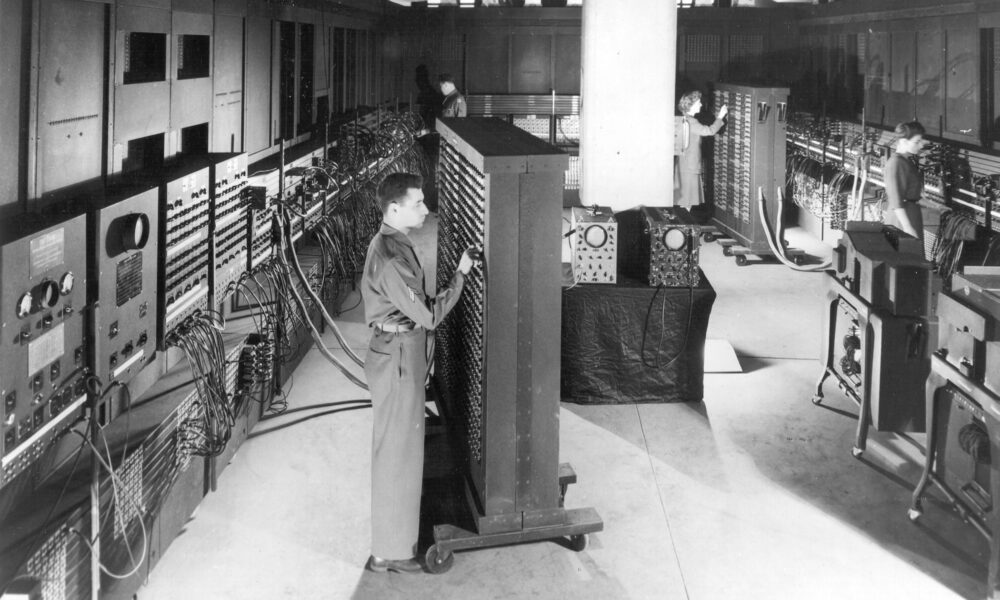
ENIAC Explained: What the First Electronic Computer Did, How It Worked and Who Programmed It

Quick answer: ENIAC stands for Electronic Numerical Integrator and Computer. Unveiled to the public in February 1946 at the University of Pennsylvania, it was a pioneering large-scale, general-purpose electronic digital computer. It used thousands of vacuum tubes instead of the mechanical relays found in earlier machines, and its programming depended on switches and physical connections rather than the easy-to-edit software files we use today. It was created by John W. Mauchly and J. Presper Eckert for the U.S. Army’s Ballistic Research Laboratory.
What was ENIAC used for?
The original military need was faster artillery firing-table calculations. A firing table estimates how a projectile will travel under different conditions so that a gun crew can select useful settings. These calculations required many mathematical operations, making them a strong use case for electronic computation. By the time ENIAC was completed, World War II had ended, and the machine was also applied to other scientific and military problems.
A useful distinction is that ENIAC was not invented to browse the web, store photos or run consumer apps. It showed that vacuum-tube electronics could execute large numbers of numerical operations rapidly and that a machine could be adapted to more than one complex problem.
ENIAC facts at a glance
| Question | Answer |
|---|---|
| Full name | Electronic Numerical Integrator and Computer |
| Main designers | J. Presper Eckert and John W. Mauchly |
| Place built | Moore School of Electrical Engineering, University of Pennsylvania |
| Public unveiling | February 1946 |
| Original sponsor | U.S. Army Ballistic Research Laboratory |
| Technology | Electronic vacuum tubes, switches, cables and decimal accumulators |
| Scale | Roughly 30 tons and approximately 18,000 vacuum tubes in common historical descriptions |
| Programming | Initially configured using plugs, cables and switches |
The original hardware and historical accounts are documented by the University of Pennsylvania and the U.S. Army Research Laboratory’s historical computer archive.
How did ENIAC actually work?
ENIAC was a decimal computer: its accumulators represented numbers with electronic circuitry. Thousands of vacuum tubes acted as rapidly switching components. The system connected arithmetic units and control units so they could perform sequences of additions, multiplications and related calculations without a human repeatedly turning mechanical cranks.
Vacuum tubes versus mechanical switches
Mechanical relay computers used moving contacts. Vacuum tubes allowed much quicker switching because no large mechanical part had to physically move for each operation. The trade-offs were heat, power consumption, physical size and maintenance complexity. Calling ENIAC “electronic” therefore refers to its actual switching technology, not merely to the presence of electric power.
Why programming was physically demanding
In its early form, programmers set switches and attached cables to route data and operations. Reconfiguring a problem could take far longer than running the actual calculation. This is different from the stored-program approach, in which instructions are kept in memory and changed as data rather than by moving cables. Later modifications to ENIAC changed some of its programming methods, but its original architecture should not be mistaken for a modern personal computer.
Who programmed ENIAC?
The history of ENIAC is not only a story about its hardware. The early programming team included Kathleen McNulty, Frances Bilas, Jean Jennings, Betty Snyder, Marlyn Wescoff and Ruth Lichterman, whose work involved translating mathematical problems into the machine’s switch and cable configurations. They developed methods for debugging and checking computations when there was no conventional high-level programming language or graphical interface.
Early publicity tended to emphasize the machine and its male designers while giving less attention to the women who programmed it. Later historical research corrected much of that imbalance. The University of Pennsylvania’s account of the ENIAC programmers is a useful primary institutional starting point.
Was ENIAC the first computer?
The simple answer “ENIAC was the first computer” needs qualification. Computing machines existed before 1946, and historians distinguish between analog and digital, mechanical and electronic, special-purpose and general-purpose, programmable and stored-program computers.
| Claim | More precise explanation |
|---|---|
| First computer ever | Too broad; earlier mechanical, analog and electromechanical machines existed. |
| First large-scale general-purpose electronic digital computer | A widely used historical description of ENIAC. |
| First modern stored-program computer | Not how ENIAC originally operated; stored-program history involves later designs and experiments. |
| First personal computer | No. ENIAC filled a room and was not designed for individual ownership. |
The distinction matters because different milestones answer different questions. A machine can be electronic without storing instructions internally, or programmable without being a practical consumer product.
What happened to ENIAC after 1946?
ENIAC moved to the Army’s Aberdeen Proving Ground in Maryland in 1947, where it continued to serve computational research. The machine ceased regular operations in the 1950s. Preserved panels and artifacts have since been displayed in museums and at the University of Pennsylvania, allowing visitors to see that early electronic computing depended on extensive physical engineering.
What ENIAC changed for today’s computers
ENIAC demonstrated the potential of large-scale electronic numerical computation, but it was not a miniature version of a laptop. The subsequent evolution to transistors, integrated circuits, semiconductor memory and stored-program software transformed what machines could do. For a modern hardware comparison, read our guide to flash memory, NAND and SSD storage, technologies radically different from ENIAC’s tube-and-cable hardware.
Frequently asked questions
What does each letter in ENIAC mean?
Electronic Numerical Integrator and Computer.
When was ENIAC revealed?
It was publicly unveiled in February 1946. Work began earlier during World War II, so unveiling and construction dates should not be confused.
Did ENIAC use binary?
Its main arithmetic system used decimal accumulators. That is one reason ENIAC’s design differs from the binary architecture associated with most modern computers.
How many vacuum tubes did it have?
Historical descriptions generally cite approximately 18,000 vacuum tubes. Figures differ slightly depending on whether sources refer to the original design or particular operating configurations.
Can you still see an ENIAC?
Surviving portions are held by institutions including the University of Pennsylvania. Check their current exhibit information before visiting.
Related technology history: how the internet developed from ARPANET to the Web.
Editorial review: October 2026. Historical references: Penn Today, Penn’s ENIAC programmers and Army Research Laboratory archive.

Other Articles