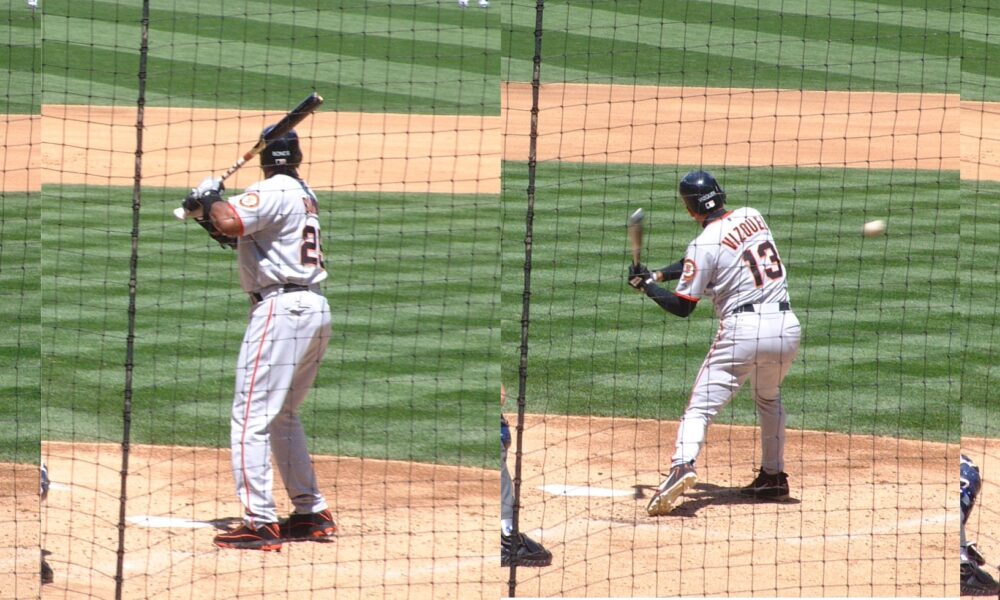

OPS in baseball stands for on-base plus slugging. It adds a hitter’s on-base percentage (OBP) to their slugging percentage (SLG), producing one quick number that reflects two useful skills: getting on base and hitting for extra bases. For example, a player with a .350 OBP and a .480 SLG has an .830 OPS. OPS is not the probability of reaching base and should not be read as a percentage of successful plate appearances.
How to calculate OPS
The formula is straightforward:
OPS = On-Base Percentage (OBP) + Slugging Percentage (SLG)
Both components are commonly written as three-decimal figures. Suppose a fictional hitter has the following season line:
- OBP: .365
- SLG: .510
- OPS: .365 + .510 = .875
There is no need to multiply by 100 to read the usual baseball stat line. You may hear announcers call that an “eight-seventy-five OPS.” The calculation follows MLB’s official OPS glossary.
What OBP and SLG measure differently
On-base percentage: how often a hitter reaches safely
OBP considers hits, walks and hit-by-pitches in relation to a defined set of plate appearances. Unlike batting average, it credits a walk as a successful way of getting on base. OBP is not simply hits divided by plate appearances, because its denominator excludes certain events under the scoring formula.
Slugging percentage: how many bases come from hits
SLG measures total bases per at-bat. A single contributes one total base, a double two, a triple three and a home run four. Walks do not count as total bases and are not at-bats for this calculation. A hitter who produces frequent doubles and home runs can have a much higher SLG than someone with a similar batting average made up mostly of singles. See the MLB definition of SLG.
Because OPS combines OBP and SLG, it captures more about an offensive profile than batting average alone. But the components still matter: the same OPS can come from quite different playing styles.
Can two players have the same OPS but different strengths?
Yes. Consider two illustrative, not real-player stat lines:
- Player A: .400 OBP + .400 SLG = .800 OPS. This profile emphasizes reaching base.
- Player B: .300 OBP + .500 SLG = .800 OPS. This profile emphasizes extra-base power.
Both have identical OPS figures, but they do not produce offense in the same way. OPS adds its two components without perfectly weighting the value of getting on base versus adding an extra base. It is a useful shortcut, not a complete measure of a hitter’s run contribution.
What is a good OPS in baseball?
There is no permanent cutoff that makes a particular OPS good in every league or season. The meaningful comparison is with the same competition, season, park environment and playing role. An .800 OPS can look much stronger in a low-scoring environment than it does during a high-offense year. A tiny sample of 15 at-bats is also less informative than a long season of regular play.
When checking a player’s OPS, ask how it compares with the league’s current average and whether the hitter has enough plate appearances for the rate to be useful. MLB’s OPS leaderboard lets readers compare actual players, while the official slash-line glossary explains the common AVG/OBP/SLG display.
OPS versus batting average, slash line and OPS+
- Batting average (AVG): counts hits per official at-bat, weighting a single and a home run equally as one hit.
- Slash line: lists batting average, on-base percentage and slugging percentage, usually as AVG/OBP/SLG.
- OPS: adds only the latter two numbers: OBP + SLG.
- OPS+: is an adjusted comparison metric, not an alternative spelling of OPS. It is designed to account for context such as league and ballpark, so do not compare OPS and OPS+ as if they share the same numeric scale.
For a broader baseball-rules primer, our guides explain what a balk is and when the infield fly rule applies. Those rules do not enter the OPS formula; they help explain how ordinary plays are scored and judged.
Common OPS mistakes
- Treating .900 as 90% on-base probability: OPS is a sum of two rates with different denominators, not a probability.
- Adding batting average to SLG: OPS adds OBP, not batting average.
- Assuming a player’s best week reflects a full season: small samples can swing dramatically.
- Ignoring playing conditions: league scoring levels and home parks affect comparisons.
Frequently asked questions
Can OPS be higher than 1.000?
Yes. A player can have a slugging percentage higher than 1.000, and OBP adds to it. An OPS above 1.000 does not mean the player got on base more than 100% of the time.
Does a walk increase OPS?
A walk can raise OBP and therefore OPS, depending on the player’s overall plate-appearance totals. Walks do not directly add total bases to SLG.
Is OPS better than batting average?
OPS usually offers a broader picture of offensive production because it accounts for reaching base and power. But it cannot fully replace context-adjusted measures, and its two components are worth examining separately.
Photo credit: Galaksiafervojo, Wikimedia Commons, CC BY-SA 3.0. Image resized for web display.

Other Articles