
Quick answer: In Olympic curling, two teams slide granite stones across ice toward a circular target called the house. At the end of each round (an end), only one team can score: it earns one point for each of its stones closer to the center, or button, than its opponent’s closest stone. Traditional men’s and women’s Olympic games use four players a side, eight stones per team per end and usually ten ends. Olympic mixed doubles uses two players a side, five delivered stones plus one pre-placed stone per team each end, and usually eight ends.
Once you understand the house, the last-stone advantage called the hammer, and how a blank end works, the scoreboard becomes much easier to follow.
Olympic curling rules at a glance
| Rule | Four-player men’s/women’s | Mixed doubles |
|---|---|---|
| Players per team | 4 | 2 (one woman, one man) |
| Scheduled ends | 10 | 8 |
| Stones each team delivers per end | 8 (two per player) | 5, plus one pre-positioned stone |
| Who earns points? | One team per end, based on stones closer to the button | |
| Last-stone advantage | Hammer | Last delivery and placement-choice strategy |
| If tied at regulation | An extra end can decide the game | |
These are the competitive formats used at the Milano Cortina 2026 Winter Olympics. Recreational leagues sometimes choose fewer ends, shorter matches or different scheduling. World Curling periodically revises its rulebook; a 2026-27 revision should not automatically be presented as the rule set that governed the February 2026 Olympics.
What counts as a point in curling?
The team with the stone closest to the button at the end of play scores. It also scores one point for every additional stone it has closer to the button than the opposing team’s nearest stone. The opponent scores zero in that end. A stone must be in or at least touch the house to count toward a point.
A worked scoring example
- Red finishes with stones 10 cm, 25 cm and 70 cm from the button.
- Yellow’s closest stone finishes 45 cm from the button.
- Red’s stones at 10 cm and 25 cm are both closer than Yellow’s 45 cm stone.
- Red scores two points, not three; Red’s 70 cm stone is too far away.
Distances here are illustrative rather than a real Olympic measurement. A crowded house can be judged visually or measured by officials when the teams cannot agree which stone is closer.
Can both teams score in the same end?
No. Only the side whose stone is closest to the button can score. If no stone is in the house at the finish, the end is blank and neither team receives a point.
Real curling images: what to look for
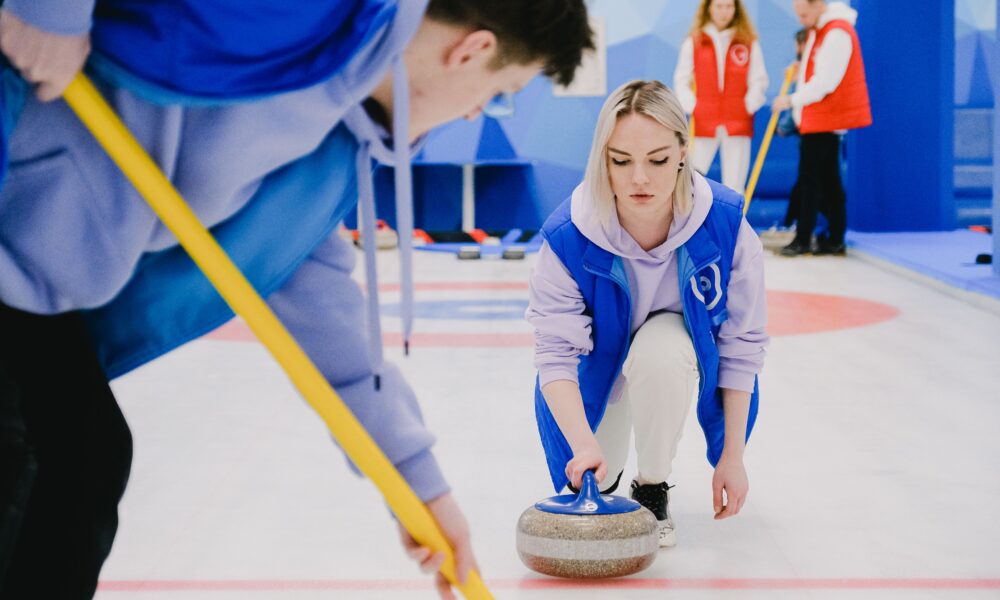
The article’s featured photo shows real players moving a curling stone down an indoor ice sheet. It is a sport photograph, not a photograph of an Olympic final. Watch the thrower’s release and teammates’ sweeping as separate parts of the same delivery.
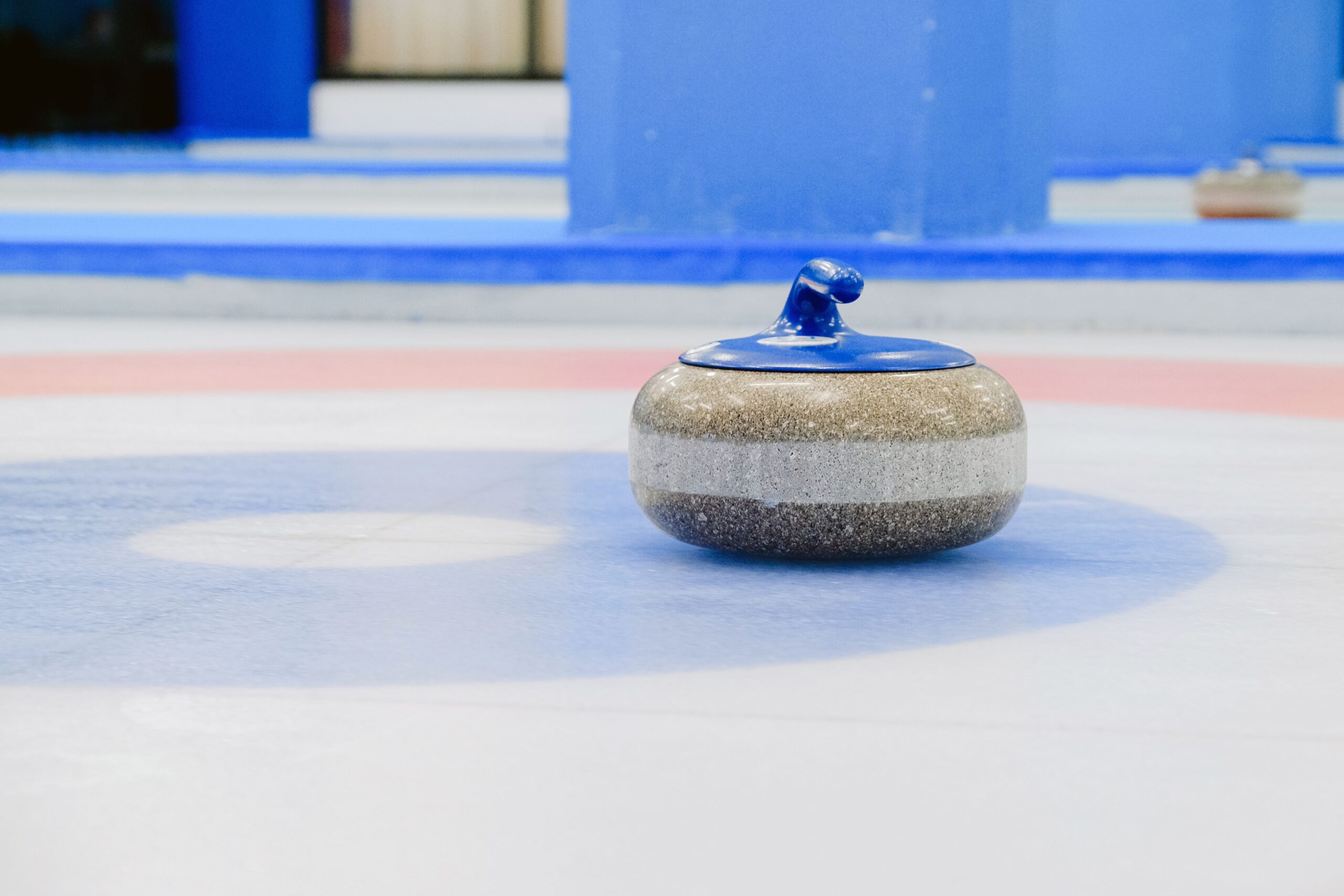
The second genuine photograph shows a stone on the scoring area. The circular rings guide play but do not have different point values, unlike a dartboard. The winning side’s number of counting stones, not their ring color, determines points.
What is the hammer in curling?
The hammer means the right to throw the final stone of an end. That is strategically valuable because the last delivery may remove an opponent’s shot, protect a lead or create a multi-point end.
Typically, the team that did not score in the preceding end has the hammer in the next one. A team that scores ordinarily gives up the hammer. On a blank end, the team that had the hammer keeps it, creating a strategic choice: a team may deliberately blank an end rather than take one point if it wants the last shot in the following end.
The hammer is an advantage, not a guaranteed point. Excellent placement, guards and takeout shots can allow the non-hammer team to score; this is called a steal.
Three common scoreboard situations
| What happened? | Score for that end | What happens to the hammer? |
|---|---|---|
| Red’s two stones are closer than Yellow’s closest | Red +2 | Yellow has the hammer in the next end |
| No stones finish in the house | 0–0 (blank) | Same team keeps the hammer |
| Yellow scores one while Red had the hammer | Yellow +1 (steal) | Red still has the hammer next end |
How an end works, from first stone to last
- Get set at the hack. The player begins the delivery from the foothold called a hack.
- Release before the near hog line. The stone must be released before the appropriate hog line; illegal releases can lead to removal under the rules.
- Deliver toward the house. The handle’s rotation imparts the curve that gives curling its name.
- Sweep when permitted. Teammates can brush the ice to influence how far the moving stone travels and its trajectory, within the sweeping restrictions.
- Alternate deliveries. In the four-person game, the teams alternate until each has thrown eight stones.
- Measure and score. The closest valid stones determine the end’s points, then the teams play in the opposite direction.
What are guards, draws and takeouts?
A draw is a precision shot intended to stop in or near the house. A guard comes to rest in front of the house, making it harder for an opponent to hit a protected stone behind it. A takeout hits another stone to remove it or change the position of stones in play. A freeze stops directly alongside another stone, often making it difficult to remove.
The free-guard zone rules in traditional curling limit early removal of certain guards, encouraging tactical play instead of easy takeouts from the first stone. The specific protected-stone procedure differs in mixed doubles. When interpreting a controversial Olympic shot, use the event’s applicable official rulebook rather than a generic recreational rule diagram.
How is Olympic mixed doubles curling different?
Mixed doubles uses one woman and one man per team. Each side delivers five stones per end, and one stone from each side is already positioned on the ice at the beginning of the end. One player delivers the first and fifth stones for the team; the teammate delivers the middle three. The sides are not required to keep the same delivery order from one end to the next.
With stones positioned before anyone throws, a mixed doubles end can produce a more open game with unusual scoring possibilities. It uses eight ends rather than the standard ten, and it has special restrictions on removing stones early in the end.
What is a power play?
In mixed doubles, a team can generally choose a power play once per game when it has the right to decide placement of the two initial stones. Instead of placing them on the sheet’s center line in the usual way, the two positioned stones move to one side, opening the central scoring lane. The tactic can create a chance for a big end but also exposes the team to risks. It is not available during an extra end.
Note the date of a rule explanation: World Curling updated some pre-positioned-stone geometry for the 2026-27 season. Guides describing the February 2026 Olympic tournament and guides explaining the later season can therefore give different measurement details without one necessarily being fraudulent.
Why do curlers sweep the ice?
The sheet has tiny frozen water droplets called pebble, which create the playing surface. Sweeping modifies the interaction of the sliding granite stone and that textured ice. Depending on the timing and technique, sweeping can help a stone travel farther and alter its line. Players communicate continuously to decide whether to sweep, slow down or adjust their plan.
It is misleading to describe every sweep as simply “melting a channel” in the ice. The physics depends on friction, temperature, pebble and the brush’s effect on the contact region. For a spectator, the key is that sweeping changes how the stone finishes, not the number of points assigned to a scoring ring.
How does curling compare with other Olympic ice sports?
Curling is a precision and positioning game. It shares the ice-sport setting with hockey but has neither a puck nor a goal scored during continuous skating play. To explore a separate Winter Games topic, read AVARIXO’s Olympic ice-hockey medal guide; the rules and scoring systems are entirely different.
Curling’s closest useful comparison is strategic turn-taking: one delivery influences the geometry the opponent must face, and the hammer can make a seemingly small early choice decisive. As another illustration of why technical sport scoring needs an exact rule set, AVARIXO’s high-jump attempt-and-tiebreak guide explains a different event’s measurement and tie procedures.
Frequently asked questions about curling
How many ends are in Olympic curling?
Ten in the standard men’s and women’s four-person events and eight in mixed doubles, with an extra end available to resolve a tie.
How many stones does each team throw?
Eight per end in four-person curling, divided into two deliveries per player. In mixed doubles each team delivers five stones and also begins with one positioned stone.
Can a team score more than one point?
Yes. A team gets one point for every counting stone closer to the button than its opponent’s best stone. That can produce multi-point ends.
What does a blank end mean?
No team scores. The team holding the hammer retains that last-stone advantage in the following end.
Does the bullseye count as extra points?
No. It is called the button. A stone closest to it helps determine who scores, but being in the center does not automatically grant two, three or more points.
Are the 2026 Olympics and 2026-27 curling rules identical?
Not in every detail. The February 2026 tournament used its competition-time rule set, and World Curling later published season updates, including changes to certain mixed doubles positioning details. Always check the applicable edition before using exact rule-number or placement specifications.
Editorial accuracy note: Competitive format, scoring, hammer and mixed doubles conventions were cross-checked against World Curling rule materials and Curling Canada’s official rules. The two locally hosted photos depict actual curling equipment and play, but are not presented as photos from a particular Olympic match.