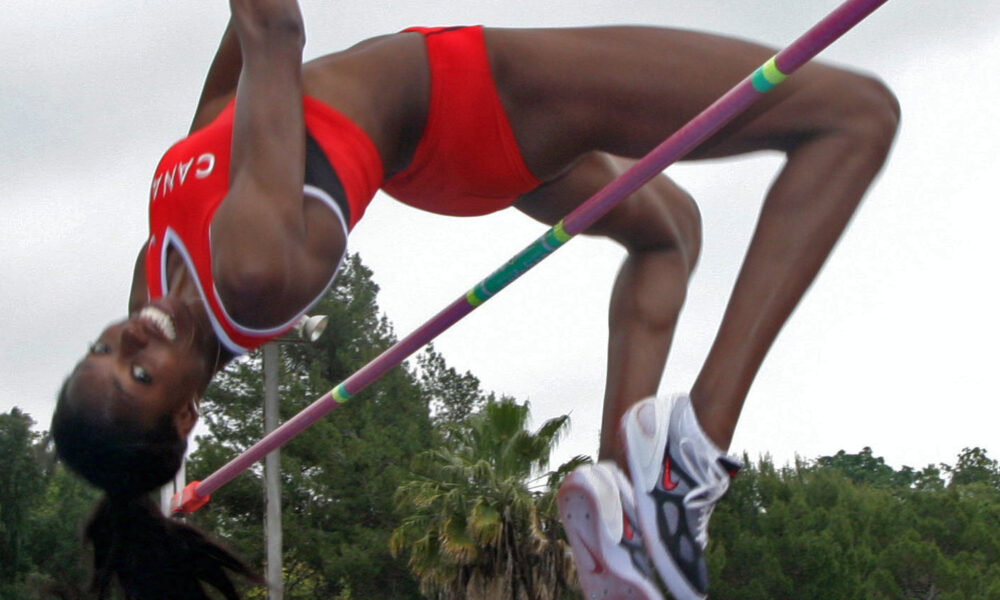

High jump is a track-and-field event in which athletes try to clear the highest possible horizontal bar using a one-foot takeoff, without equipment such as a pole. A successful jump clears the bar without knocking it off its supports. Contestants advance as the bar rises; three consecutive failures lead to elimination. This guide explains the scoring, the Fosbury Flop technique and what happens when two athletes tie.
The rules below are based on World Athletics’ high jump overview and the Olympics high jump rules explainer, checked October 11, 2026.
How does the high jump work?
- Set the opening bar height. The officials announce the competition’s available heights and progression.
- Choose when to enter. A jumper can attempt the current height or pass it to begin at a higher one.
- Approach and take off from one foot. The athlete uses a run-up and jumps unaided over the bar.
- Clear the bar. Brushing the crossbar is not automatically a foul; dislodging it is.
- Keep jumping higher. Competitors who remain in the contest can attempt the next height, with the bar raised gradually.
- Rank by the highest successful clearance. Equal best heights are settled by the countback procedure, with a special procedure for a first-place tie.
High jump rules: good jumps, failed jumps and passes
| Action | What it means |
|---|---|
| Clear bar without knocking it off | Valid clearance at that height |
| Touch bar but it stays on supports | Can still be a valid clearance |
| Bar falls because of the jumper | Failed attempt |
| Take off with both feet | Invalid high-jump attempt under the one-foot-takeoff rule |
| Pass a height or a remaining attempt | No clearance or failure added for the pass itself; previously accumulated consecutive failures still matter |
| Three consecutive failed attempts across one or more heights | Eliminated from further jumping in that competition |
A central trap for beginners is thinking every height starts a clean slate of three failures. It does not: consecutive misses carry from one height to the next. An athlete who misses twice, passes the rest of that height and moves up needs to clear the new height with the next attempt to stay alive.
How high does the bar go?
There is not one universal bar height for every participant. Competition officials set an opening height and a series of increments; different age groups and competitive levels use different progressions. Athletes may join at a height they choose from the announced sequence. A jumper’s result is their highest legally cleared height, typically recorded in meters and centimeters.
For example, someone who clears 1.75 meters, misses at 1.80 meters and then leaves the competition receives a best performance of 1.75 m. A miss alone does not erase an earlier clearance. In a meet, the marks in the results table also record successes, failures and passes so that the tie-break rules can be applied accurately.
What are the symbols on a high jump results sheet?
Event results are commonly displayed as a series of attempt marks alongside each bar height. Exact presentation may differ by meet, but the usual reading key is:
| Symbol | Meaning | Example |
|---|---|---|
| O | Successful clearance | O: cleared on the first attempt |
| X | Failed attempt | XO: missed once, then cleared |
| – or P | Passed the height or an attempt | Pass to a higher bar |
Results tables sometimes combine three attempt symbols at a single height. Read from left to right to see how many chances the athlete needed. Do not confuse the number of attempts at a particular height with the athlete’s final finishing position.
How are ties broken in high jump?
If two athletes clear the same maximum height, officials compare their attempts. The athlete with fewer misses at that last cleared height ranks ahead. If still tied, compare the total misses up to and including the last cleared height. For a first-place tie that remains unresolved, a jump-off may be held, subject to competition rules and the athletes’ choices.
The famous Tokyo 2020 men’s Olympic high jump illustrated the unusual outcome: Mutaz Essa Barshim and Gianmarco Tamberi agreed to share the gold medal rather than continue in a jump-off. Shared first place is therefore possible under the applicable procedure; it should not be assumed that every high-jump tie automatically leads to an extra jump.
Example: who places higher?
Jumper A and Jumper B both clear 1.90 m and fail at 1.95 m. If A needed only one attempt to clear 1.90 m but B needed two, A ranks ahead. If both cleared 1.90 m on the same attempt number, the officials look at their previous misses to see who has the better overall countback record.
What is the Fosbury Flop?
The Fosbury Flop is the back-first jumping style used widely in modern competition. The athlete approaches the bar along a curved path, takes off from one foot and rotates so their back passes over the crossbar before they land on the padded high-jump mat. The name comes from American athlete Dick Fosbury, whose use of the style helped transform the event at the 1968 Mexico City Olympics.
The distinctive curve is not decorative. It helps position the athlete’s body and generate the rotation needed to clear the bar efficiently. Merely running faster is not enough: approach rhythm, body posture and a well-timed final step are critical.
A beginner-friendly breakdown of high jump technique
1. Build a controlled approach
Beginners should learn a repeatable run-up before attempting demanding heights. Under coaching supervision, practice a smooth straight section flowing into a curved approach rather than sprinting full speed from the first step. The aim is to arrive at the takeoff point balanced and ready to push upward.
2. Plant and take off from one foot
The outside takeoff leg provides the legal one-foot push. Drive upward rather than diving horizontally at the bar. Swinging the free knee and keeping an upright, controlled torso through takeoff helps convert approach speed into vertical clearance.
3. Rotate over the bar
As the body passes the crossbar, the athlete arches through the back-first phase; the hips rise, then the legs are moved clear. Timing matters: dropping the legs too early can knock the crossbar off its supports even after the torso has cleared it.
4. Land safely
Practice only with a properly assembled high-jump landing mat and adequate free space, under suitable coaching or supervision. Never try the back-first technique onto grass, hard ground, a thin gym mat or an improvised landing area. Low-bar technique drills are more useful to a beginner than repeated high-risk maximum attempts.
High jump vs. pole vault vs. long jump
| Event | What is measured? | How does the athlete clear it? |
|---|---|---|
| High jump | Maximum vertical bar height | Unaided one-foot jump over a crossbar |
| Pole vault | Maximum vertical bar height | Uses a flexible pole for the vault |
| Long jump | Horizontal distance from the takeoff line | Jumps forward into a sandpit |
High jump and pole vault are both vertical jumps, but the use of a pole separates them. Long jump is measured by distance, and its attempts do not follow the same rising-bar progression.
Frequently asked high jump questions
Do high jumpers have three attempts at every height?
Three consecutive misses end the athlete’s participation; misses can carry over between heights if the athlete passes after failed attempts. A successful clearance breaks that string.
Can a high jumper touch the bar?
Yes. Touching the bar is not necessarily a failure if the bar stays correctly on its supports and no other rule is broken.
Why do high jumpers jump backward?
The Fosbury Flop uses a curved run-up and back-first clearance to create an efficient trajectory around the crossbar. Not every legal jump has to use that technique, but it is standard in elite competition.
What happens if two people jump the same height?
Officials apply countback for missed attempts, first at the last cleared height and then across earlier heights. If first place is still tied, an agreed shared placing may be allowed instead of a jump-off.
What should a first-time athlete practice first?
A repeatable approach, the single-leg takeoff and a safe landing, with a coach and appropriate landing equipment. Clearing a higher bar should follow good technique, not precede it.
Primary sources and photo credit
Rules, procedures and technique reviewed October 11, 2026 against World Athletics — High Jump and Olympics — High Jump Rules and Techniques. For event-specific regulations, always defer to the meet’s current technical rules.
Featured photo: Nicole Forrester, Wikimedia Commons, licensed CC BY-SA 3.0; image not altered by AVARIXO.

Other Articles