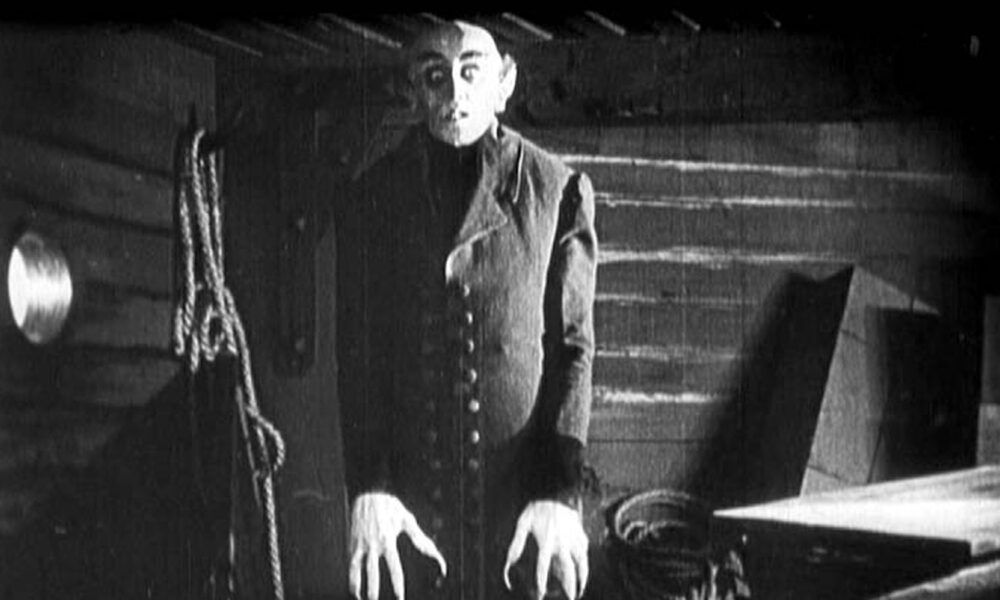

Quick answer: The original Nosferatu is a German silent horror film released in 1922, directed by F. W. Murnau and starring Max Schreck as Count Orlok. It is not the later 1979 adaptation or Robert Eggers’s 2024 film. In the original ending, Ellen deliberately draws Orlok to her while day breaks. The vampire remains with her too long, and sunlight destroys him; Ellen also dies. The film is an unauthorized adaptation of Bram Stoker’s Dracula and is now in the U.S. public domain in its original 1922 form, although new scores, restorations and packaging may have separate rights.
This guide covers what happens in the film, why its creature looks unlike a modern romantic vampire, what version names can mean and how to find a legitimate viewing copy without confusing the original with remakes. Ending spoilers follow.
Which Nosferatu is the original?
| Version | Release | How to identify it |
|---|---|---|
| Nosferatu: A Symphony of Horror | 1922 | Silent German film by F. W. Murnau; Max Schreck as Count Orlok |
| Nosferatu the Vampyre | 1979 | Werner Herzog’s separate adaptation; Klaus Kinski plays the vampire |
| Nosferatu | 2024 | Robert Eggers’s modern feature; Bill Skarsgård plays Orlok |
The complete German title is Nosferatu – Eine Symphonie des Grauens, often translated as Nosferatu: A Symphony of Horror. Listings may use Nosferatu the Vampire, A Symphony of Terror or a shortened title. To verify that a file is from 1922, look for Murnau, Schreck, Gustav von Wangenheim as Hutter and Greta Schröder as Ellen—not just the word ‘Nosferatu’ on the cover.
Nosferatu (1922) story explained
Act 1: A journey to Count Orlok’s castle
Thomas Hutter, a young estate agent, travels from the German town of Wisborg to a remote castle in the Carpathian region. His employer Knock has arranged a property transaction with the mysterious Count Orlok. Hutter initially treats the assignment as ordinary business. Gradually, the empty castle, sinister host and strange nighttime behavior reveal a threat that cannot be explained by a difficult client or an unfamiliar country.
Orlok is not the elegant socialite of later movie vampire traditions. His prominent ears, pallid skull, angular nose, long fingers and still movements make him seem like a predatory creature. Hutter’s encounter is a lesson in the film’s central visual idea: terror is more disturbing when the familiar domestic world is invaded by something physically out of place.
Act 2: The ship and plague reach Wisborg
Orlok makes his way to Wisborg by sea, bringing death and swarms of rats associated with disease. The ship sequence joins supernatural horror to public panic: there is no obvious way to contain a threat already inside the town. Residents see the crisis in terms of sickness and fatalities while the audience recognizes the vampire’s role. The monster’s influence moves from a haunted castle into streets and homes.
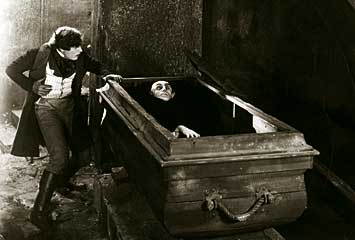
Murnau often used recognizable exterior locations, landscapes and harbors instead of confining every scene to deliberately distorted painted sets. That contrast makes Orlok’s unnatural presence unsettling. The British Film Institute’s study guide highlights plague imagery as one of the film’s most important changes from Stoker’s book.
Act 3: Ellen decides how to stop him
Ellen learns that the vampire can be kept from leaving a woman who freely offers herself until the morning light brings his destruction. She chooses to invite him in, knowing that she may die. Orlok drinks from her and loses track of the time. Dawn arrives, the monster perishes and Ellen does not survive the sacrifice. This ending is tragic, not a rescue in which Hutter defeats Orlok at the last second.
Why the original ending still matters
The film gives decisive agency to Ellen. Hutter has recognized the horror but cannot physically overpower it. Orlok’s weakness is not a magical weapon deployed by a heroic fighter; it is his inability to detach himself from the living person he consumes. The rising sun creates the deadline, while Ellen’s conscious choice makes the climax more than a simple accident.
It is reasonable to read the ending as personal sacrifice, as the destruction of a parasitic force, or as a story about a community unable to understand what is spreading through it. These are interpretations, not additional scenes documented in the film. The factual sequence remains that Ellen lures Orlok, daylight ends his attack, and she dies.
The 1922 cast and characters
| Performer | Original character | Role in the plot |
|---|---|---|
| Max Schreck | Count Orlok | Vampire seeking a new home near Ellen |
| Gustav von Wangenheim | Thomas Hutter | Estate agent sent to the castle |
| Greta Schröder | Ellen Hutter | Hutter’s wife, central to the ending |
| Alexander Granach | Knock | Real-estate intermediary linked to Orlok |
| John Gottowt | Professor Bulwer | Scholar associated with the story’s natural-science imagery |
Names may vary in translated or edited prints. Some later English-language versions changed the intertitles and substituted character names from Dracula. That can make the same 1922 footage appear to tell a slightly differently labeled story. A changed intertitle is not evidence of a wholly different original production.
Why Nosferatu used Count Orlok instead of Dracula
The production adapted Bram Stoker’s novel without the authorization of the author’s estate. Murnau’s film changed the names and locations, but the underlying story remained recognizable. Florence Stoker brought a successful copyright challenge, and an order called for the surviving prints to be destroyed. Some copies persisted, which is why the movie can still be watched and restored today. The BFI describes this extraordinary survival in its film record.
The dispute is historically significant because it shows that changing a character’s name is not a magic way to avoid copyright claims. It also explains some of the fragmented survival and varied title cards found in later editions.
What makes Murnau’s film visually distinctive?
Locations that feel tangible
Unlike an entirely stage-bound fantasy, the film uses external scenery—mountains, urban streets and a harbor—to make the supernatural visitor seem to threaten a real place. The familiar architecture and bodies make Orlok’s silhouette stranger. The movie has an expressionist imagination even where the sets are not uniformly expressionist.
Unnatural movement and shadows
Schreck performs with stiff, controlled motions rather than the fluid romance of many later vampire portrayals. His hands and outline become storytelling devices. The shadow can precede a character’s full appearance, turning a wall or doorway into an active part of the frightening scene.
The city as a victim
The rats, coffins and ship do not merely provide creepy decoration. They widen the stakes from Hutter’s private danger to the fate of Wisborg. The horror enters communal space, linking Gothic fantasy to fears about sickness and collective vulnerability.
For more on how silent actors communicate through movement and framing, see AVARIXO’s guide to silent film acting. To explore performers of the broader era, read our silent movie stars primer.
How long is the original Nosferatu?
There is not one universal runtime printed on every legitimate edition. The British Film Institute lists an 89-minute version in one film entry and an 85-minute version in its educational notes; historical footage survives through different prints, restorations, projection speeds and intertitle choices. A significantly shorter online upload may be a condensed or incomplete version rather than a faithful full presentation. For a comparison, check the edition’s stated restoration source, aspect ratio, intertitle language and score.
Is Nosferatu (1922) in the public domain?
The original 1922 film is in the public domain in the United States. That means the underlying historic moving images are not protected by an active U.S. film copyright. However, this statement does not automatically cover every modern restoration, newly composed soundtrack, translation, colorization, promotional poster or distribution package. A modern edition may contain separately protected work.
For a source with an explicit rights declaration and a labeled version, Wikimedia Commons hosts a 1922 Nosferatu video file, with the specific restoration noted on the file page. Confirm the edition and rights information before reusing any particular file, especially outside the United States. This is general context, not a substitute for legal advice.
Frequently asked questions
What year did the first Nosferatu come out?
1922. The film premiered in Germany and was directed by F. W. Murnau.
Who played the original Nosferatu?
Max Schreck played Count Orlok, the vampire depicted with long fingernails, a pale skull and protruding ears.
Is Nosferatu (1922) the same as Dracula?
No. It is an unauthorized adaptation of Bram Stoker’s Dracula, with changed names, setting and substantial plot elements including the plague motif.
Does Ellen survive in the original film?
No. Her choice prevents Orlok from escaping the dawn but costs her life.
Did the court really order the film destroyed?
Yes. A copyright lawsuit led to an order for the destruction of prints, but it was not fully carried out.
Can I stream or download the original without paying?
There are public-domain copies, including ones cataloged on Wikimedia Commons. Verify that a source really hosts 1922 footage and that any modern score or restoration has appropriate reuse terms.
Film history and edition details checked October 14, 2026. Where running times or intertitles differ, the distinction is identified rather than treating every copy as identical.

Other Articles