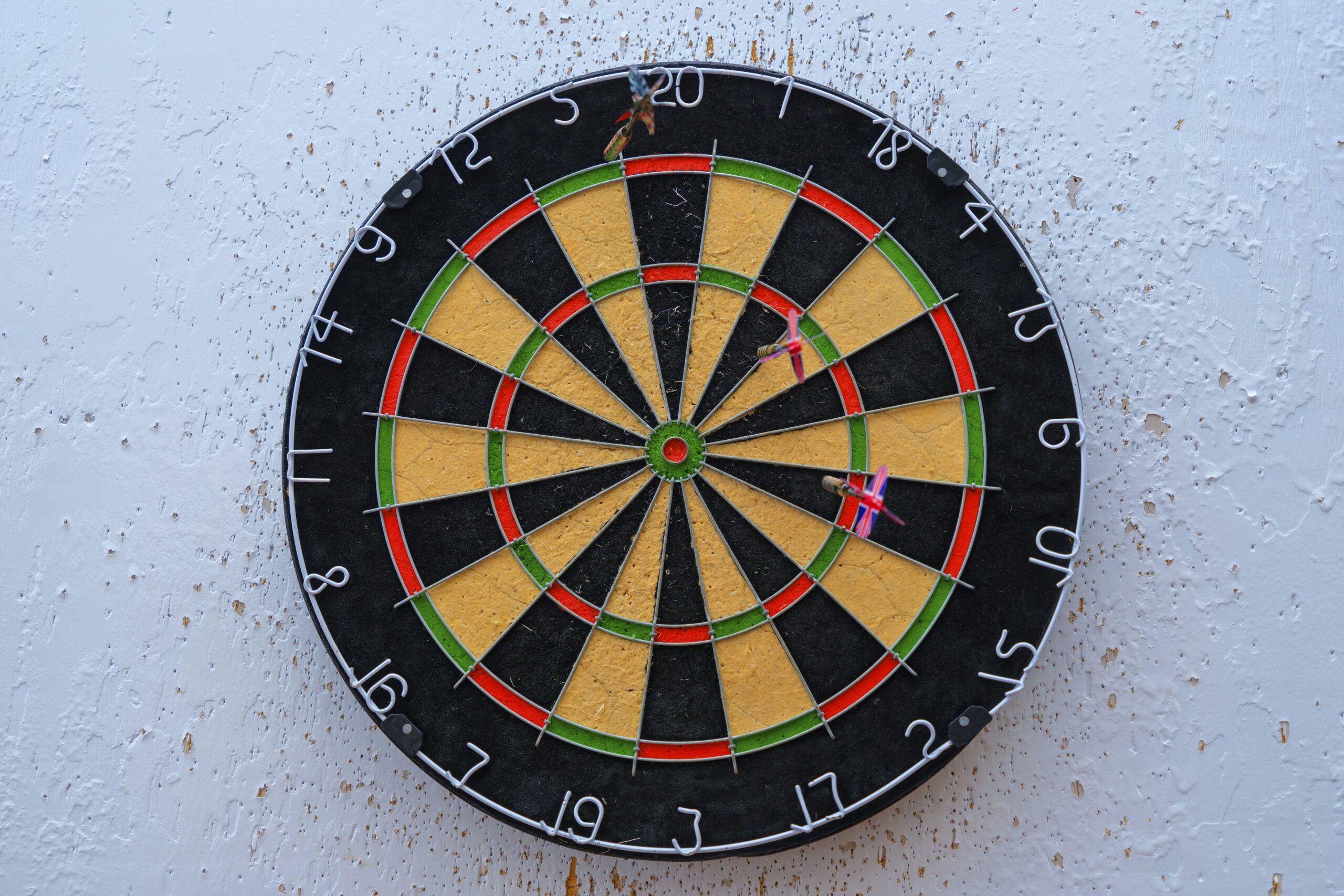

Cricket darts rules in one minute: Only the numbers 20, 19, 18, 17, 16, 15 and the bull matter. Take turns throwing up to three darts. Collect three marks on each target to close it; a single gives one mark, a double two and a treble three. After you close a number, extra hits on it score points until your opponent closes it too. The first player or team to close all seven targets and have at least as many points as the opponent wins. House and league variations exist, so confirm the format before playing.
Cricket darts rules at a glance
| Question | Standard answer |
|---|---|
| Players | Usually two players or two teams |
| Targets | 20, 19, 18, 17, 16, 15 and bull |
| Darts per turn | Three, unless the game ends earlier |
| Close a target | Record three marks on that target |
| Singles, doubles, triples | One, two or three marks respectively |
| Outer / inner bull | One / two marks, usually worth 25 / 50 points |
| How to win | Close every target and finish tied or ahead on points |
Step 1: Set up the board and score sheet
Use a standard dartboard. Write the seven cricket targets vertically on a score sheet, with one player’s marks and points on each side. A simple score sheet looks like this:
| Player A marks | Target | Player B marks |
|---|---|---|
| — | 20 | — |
| — | 19 | — |
| — | 18 | — |
| — | 17 | — |
| — | 16 | — |
| — | 15 | — |
| — | Bull | — |
| 0 points | Total | 0 points |
Choose who throws first by mutual agreement or the event’s start-of-match procedure. A normal turn consists of three darts, after which the other side throws. You can target the seven eligible sections in any order; there is no requirement to start at 20.
Step 2: Understand marks, doubles and triples
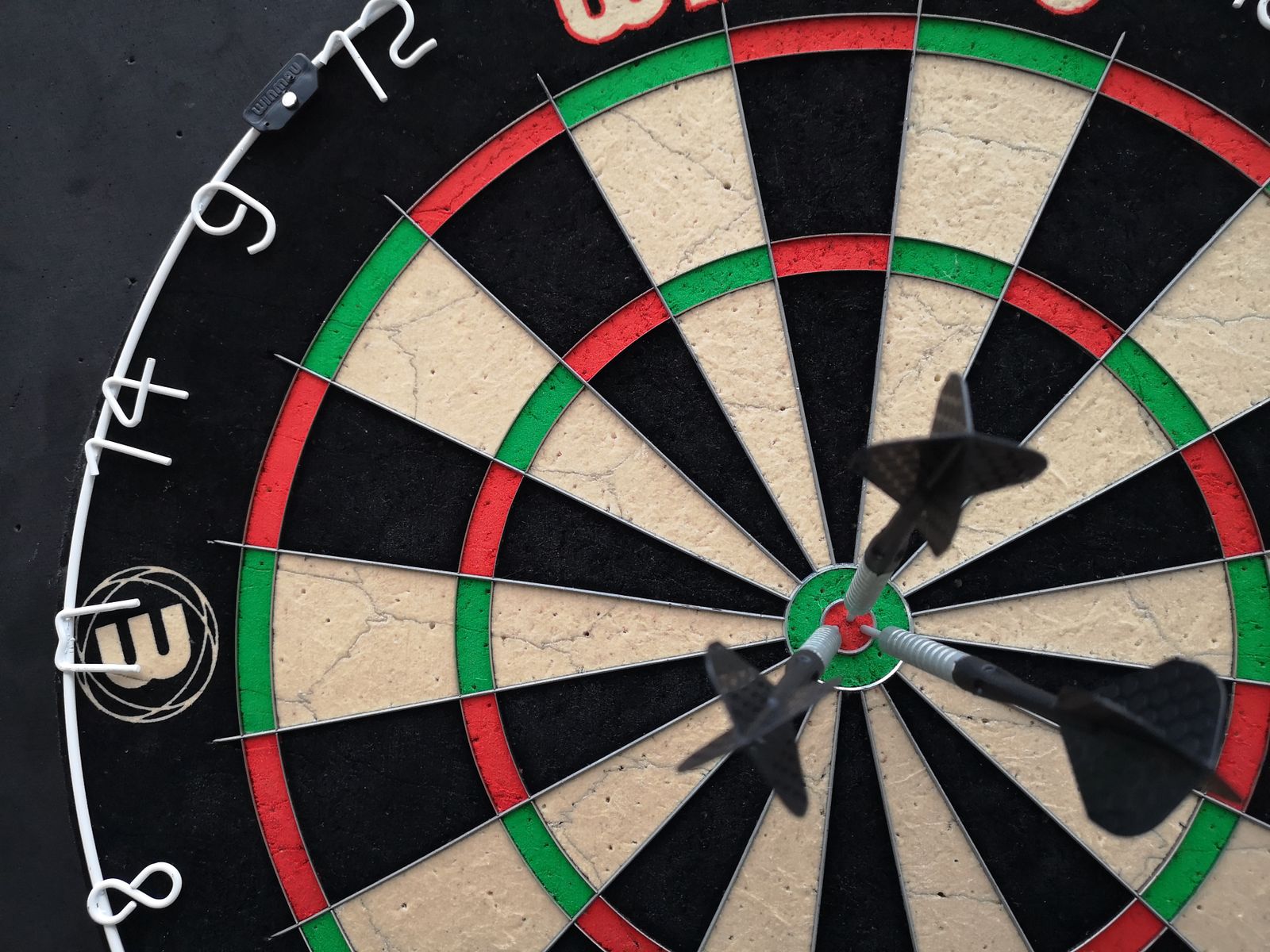
Every valid hit on a cricket number contributes marks. The narrow outer scoring ring is a double and the narrow inner ring is a treble (or triple). The broader single segment counts once.
| One dart lands in | Marks added | Example at 19 |
|---|---|---|
| Single 19 | 1 | One mark toward closing 19 |
| Double 19 | 2 | Two marks toward closing 19 |
| Triple 19 | 3 | Closes 19 immediately |
| Outer bull | 1 | One bull mark (25-point equivalent) |
| Inner bull | 2 | Two bull marks (50-point equivalent) |
| 14 or lower outside bull | 0 | Does not count in ordinary Cricket |
Scorekeepers commonly record one mark as a slash (/), two as an X and three as a circled X. These symbols are conventions rather than extra points. Once a player reaches three marks on a target, that number is closed for that player.
Step 3: Score only on targets your opponent has not closed
Closing a target gives you the right to score on it. If your opponent has not yet closed 20, a single 20 that lands after your third mark earns 20 points, a double 20 earns 40 and a triple 20 earns 60. The same idea applies to 19 through 15, and a bull mark is commonly worth 25 points. If both players close 20, it becomes dead: neither side can score any more points there.
Important: An overage on the exact dart that closes a target can score immediately. Suppose you already have one mark on 19. Your next dart lands in triple 19 (three more marks). Two of those three marks finish closing 19; the remaining mark scores 19 points, provided your opponent still has 19 open. A score sheet should show a closed 19 and 19 points, not four marks.
Worked example: Three darts, two targets and 20 points
Imagine Alex begins a turn with no marks. Bea also has no marks. Alex throws:
- Triple 20: three marks close the 20 for Alex; no points yet.
- Single 20: Alex scores 20 points because Bea has not closed her 20.
- Single 19: Alex records one mark on 19, but gets no points there yet.
After Alex’s turn, the score is Alex 20, Bea 0. If Bea now lands a triple 20, she closes 20 for herself. From then on, neither player can add points from 20. Alex still keeps the 20 points already earned.
What if a player closes everything but has fewer points?
That player has not won. Cricket is not simply a race to put three marks on every target. If you close the final bull while trailing 85–110, you must still overtake or tie your opponent on points. You can do that only on targets you have closed that your opponent has left open. If every target is closed by both sides and the scores remain different, the player who met the close-all condition while ahead wins; agree in advance on any special tie or unusual deadlocked-board rules used in your league.
Cricket darts vs. 501: Why the scoring feels different
| Feature | Cricket | 501 |
|---|---|---|
| Main goal | Close seven targets and be tied or ahead | Reduce your running score from 501 to exactly zero |
| Numbers that matter | 15–20 and bull | All scoring sectors |
| Score direction | Additional points added when a target is owned | Points subtracted from remaining total |
| Ending | Close all while not trailing | Usually finish on a double in standard 501 |
| Best beginner habit | Watch what your opponent has left open | Plan a checkout from your remaining score |
Cricket rewards both accuracy and tactics. A player who hits many high triples can still lose if the opponent controls the open numbers more effectively.
How to play Cut-Throat Cricket
Cut-Throat uses the same seven targets and the same mark system, but the point strategy is reversed. Once you own a target, extra hits on it add points to opponents who have not closed it, rather than adding points to your own score. In a typical Cut-Throat game, the side that closes every target with the lowest score wins. It is especially useful for three or more players, though local variations on who receives points exist. Clarify the scoring convention with your group before beginning.
Common cricket darts mistakes
- Counting every hit as one mark: doubles and triples count as two or three marks, so a single triple can close a number in one dart.
- Scoring too early: hits count as marks until the target closes; only surplus marks become points.
- Scoring on a dead number: once both sides have closed a target, it no longer generates points.
- Forgetting the bull: closing 15 through 20 is not enough; the bull also needs three marks.
- Assuming the person with the most points always wins: every target must also be closed.
- Confusing variants: Cut-Throat, no-points Cricket and league-specific formats can change the win condition.
Three practical tips to improve in Cricket
Close a high number before farming points
A triple 20 immediately gives you control of the most valuable number, but collecting points is not always better than closing a number your opponent is already exploiting. Choose your next dart by looking at both score columns.
Keep track of the bull throughout the game
The bull is often the last target left. You can avoid a difficult finish by collecting a mark or two when an easy opportunity appears earlier in the leg, rather than leaving all three marks until the end.
Use a repeatable warm-up
For five minutes, alternate three darts at 20 and three at 19, then finish with controlled attempts at the outer bull. Record whether you landed singles, doubles or triples; a genuine record of your grouping helps more than memorizing a supposed ‘perfect’ strategy.
Frequently asked questions
Can you score points in Cricket before closing a number?
No. You must accumulate three marks on that target first. Surplus marks on a dart that closes it can count as points if the opponent has the target open.
Does the bull count as 50 or 25 in Cricket?
Both zones count. The outer bull is one mark (25 points); the inner bull is two marks (50 points). You need three bull marks to close that target.
Is a triple worth three marks even if the player needs just one?
Yes. The first needed mark closes the target; the two surplus marks can score twice the target’s value if an opponent has not closed that number.
How many rounds do you play?
Standard Cricket does not need a fixed number of rounds: turns continue until someone meets the close-all and score condition. Some electronic or casual variants use round limits, so check the settings before starting.
What is the difference between Cricket and a conventional 301 or 501 game?
Cricket closes targets and scores against an opponent’s open sections; 301 and 501 count down to zero. The common starting and checkout conventions belong to different games.
For another beginner-friendly game whose point system rewards understanding the format before serving, see our pickleball serving, kitchen and scoring rules guide. Always follow your event’s house rules when they differ from the standard examples above.