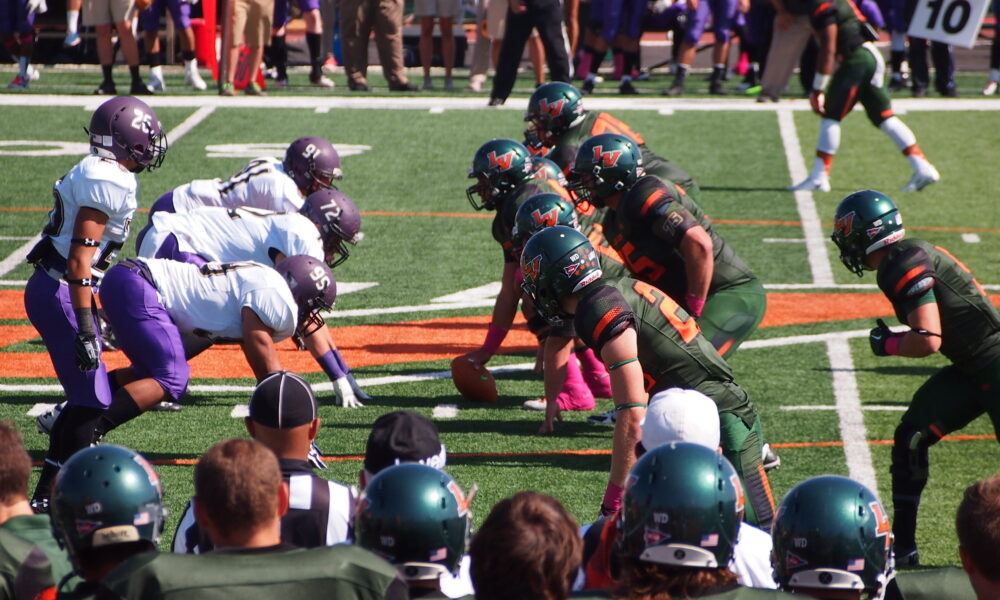

In the NFL, neutral zone infraction, offside and encroachment are different penalties that can all cost five yards. The key distinction is what the defender does and whether the officials stop the play before the snap. A neutral zone infraction typically stops play because a defender makes a threatening pre-snap move or triggers an immediate reaction from a nearby offensive player. Encroachment involves illegal contact before the snap. Defensive offside usually means a defender is in or beyond the neutral zone at the snap when a more specific dead-ball foul has not occurred.
This explainer uses the 2026 NFL Official Playing Rules, particularly Rule 3’s definitions and Rule 7, Section 4. Always distinguish professional NFL enforcement from college or high-school rules, which can be different.
First: what is the neutral zone in American football?
The neutral zone is the space between the planes passing through the front and back points of the football once it is ready for play. It extends sideways across the field. The offense and defense line up on opposite sides of this space. It is not a broad three-yard area or the entire distance between the offensive and defensive lines.
The ball itself establishes the neutral zone. A defender hovering near the line is not automatically penalized; the question is where that player’s body is relative to the zone and what happens before or at the snap.
Neutral zone infraction vs. offside vs. encroachment
| Penalty | Typical trigger | Play stopped? | Usual penalty |
|---|---|---|---|
| Neutral zone infraction | Defender threatens a clear path to the passer or kicker, or induces an immediate protective reaction from a nearby offensive player | Yes, before the snap | Five yards |
| Encroachment | Defender illegally contacts an offensive player or the ball before the snap | Yes, before the snap | Five yards |
| Defensive offside | Defender is in or beyond the neutral zone when the ball is snapped without an earlier dead-ball violation | Usually no: live-ball enforcement | Five yards |
These are simplified examples, not substitutes for the full rule text. The official classifications depend on exact positioning, timing and contact.
What counts as a neutral zone infraction?
Under NFL Rule 7-4-4, one familiar scenario occurs when a defender moves beyond the neutral zone before the snap and gets parallel to or beyond an offensive lineman with an unimpeded path toward the quarterback or kicker. Officials stop the action because the defender has created an immediate threat even if no contact occurs.
A second common scenario occurs when a defender enters the zone and causes a nearby offensive player to react immediately to protect themselves against impending contact. The familiar broadcast description is that the defensive movement draws an offensive lineman into moving. That is not an ordinary false start if it meets the rule’s reaction criteria.
Not every defensive twitch is a penalty. An apparent early jump that is corrected before the snap, without contact or a qualifying offensive reaction, may lead to no foul. The NFL Football Operations explanation describes the immediate-reaction and clear-path situations.
What is encroachment?
Encroachment is a pre-snap defensive foul involving contact. A defensive lineman enters the neutral zone and touches an offensive player, or touches the ball, before it is snapped. The official can kill the play rather than waiting for the offense to run a snap. It is not necessary for the defender to make a tackle or cause injury; the prohibited contact is enough.
Example: the defensive tackle lunges across the ball and bumps the guard before the center snaps it. That is different from a tackle who simply lines up with a hand marginally over the ball as it is snapped.
What is defensive offside?
Defensive offside is generally judged at the snap. A defender is in or beyond the neutral zone when the ball is put into play. Because the ball has been snapped, the action commonly continues with a flag rather than an immediate pre-snap whistle; the offense may finish the play and choose the advantageous result under normal enforcement rules.
Example: a defensive end anticipates the count, crosses the line too early, but does not contact an opponent and does not trigger a qualifying neutral-zone infraction. If the snap happens while that player is still illegally positioned, the officials can call offside.
Commentators often refer to the resulting snap as a “free play.” That does not guarantee the offense can do anything without consequence or that the play will always continue: other fouls, a dead-ball ruling or a turnover situation can complicate the result.
How all three penalties affect down and distance
Each typically carries a five-yard mark-off. For example, second-and-7 can become second-and-2 when a defensive five-yard penalty is accepted. A five-yard penalty does not itself create an automatic first down, but moving the ball far enough to reach the line to gain can result in one. Near a goal line, standard enforcement provisions may limit the distance to half the remaining yardage.
The main practical difference spectators notice is timing. Neutral zone infraction and encroachment usually bring a whistle before the snap. With simple defensive offside, the whistle may not come until the play has finished.
Four examples viewers can identify on replay
Example 1: defender crosses and bumps the center
The contact happens before the snap. The likely ruling is encroachment; the play is stopped and a five-yard penalty is announced.
Example 2: defender shoots through with a clear path to the quarterback
The defender is not touched by a blocker. If the movement meets the threatening-position condition, officials can call neutral zone infraction immediately.
Example 3: defender jumps into the zone, guard reacts defensively
If the guard is in close proximity and reacts immediately to protect against impending contact, officials may assess neutral zone infraction on the defense rather than false start on the offense.
Example 4: defender lines up just across the ball and stays there at the snap
Without a separate qualifying dead-ball act, this is a typical defensive offside situation. A flag may be thrown while the down continues.
Are these penalties the same as a false start?
No. A false start is an offensive pre-snap foul. An offensive player may make an illegal movement that simulates the beginning of the play. A defender’s qualifying penetration into the neutral zone can instead explain a nearby offensive player’s immediate reaction. Officials must decide which action caused the stoppage under the rule, not merely who moved first on television.
For more NFL rules context, read our guides to onside kicks in 2026 and regular-season versus playoff overtime. Those address distinct rules, not variations of offside.
Frequently asked questions
Is a neutral zone infraction an automatic first down?
No. It normally means a five-yard penalty. A first down can result when the accepted yardage reaches the line to gain.
Can a defender get back before the snap without a penalty?
Sometimes. A defender who returns to a legal position before the snap without prohibited contact or a qualifying immediate offensive reaction may avoid a foul.
Why does offside sometimes create a free play?
Defensive offside is commonly enforced after a live-ball snap. The offense may benefit from completing the play or accepting the penalty; dead-ball situations are different.
Are the NFL and NCAA rules identical?
No. This article addresses NFL rules for the 2026 season; use the relevant NCAA or high-school rulebook for those competitions.
Sources and photo credit
Rule sources: NFL Football Operations 2026 Rulebook and official 2026 NFL playing rules PDF. Verified October 11, 2026.
Featured photo of a pre-snap American football formation: Ian D. Keating / Wikimedia Commons, CC BY 2.0. Photo shows a college football formation to illustrate the neutral-zone concept; NFL-specific law is sourced separately.

Other Articles