

To craft a composter in Minecraft, put seven wooden slabs in a U shape on a 3×3 crafting table: place slabs in the left and right squares of the top two rows, and fill all three squares along the bottom. The resulting composter converts selected plants and food into bone meal, a useful fertilizer for growing crops, trees, and other plants. It also acts as a farmer villager’s job-site block. This guide explains the exact recipe, how the success percentages work, and how to connect a composter to hoppers for hands-off bone-meal collection.
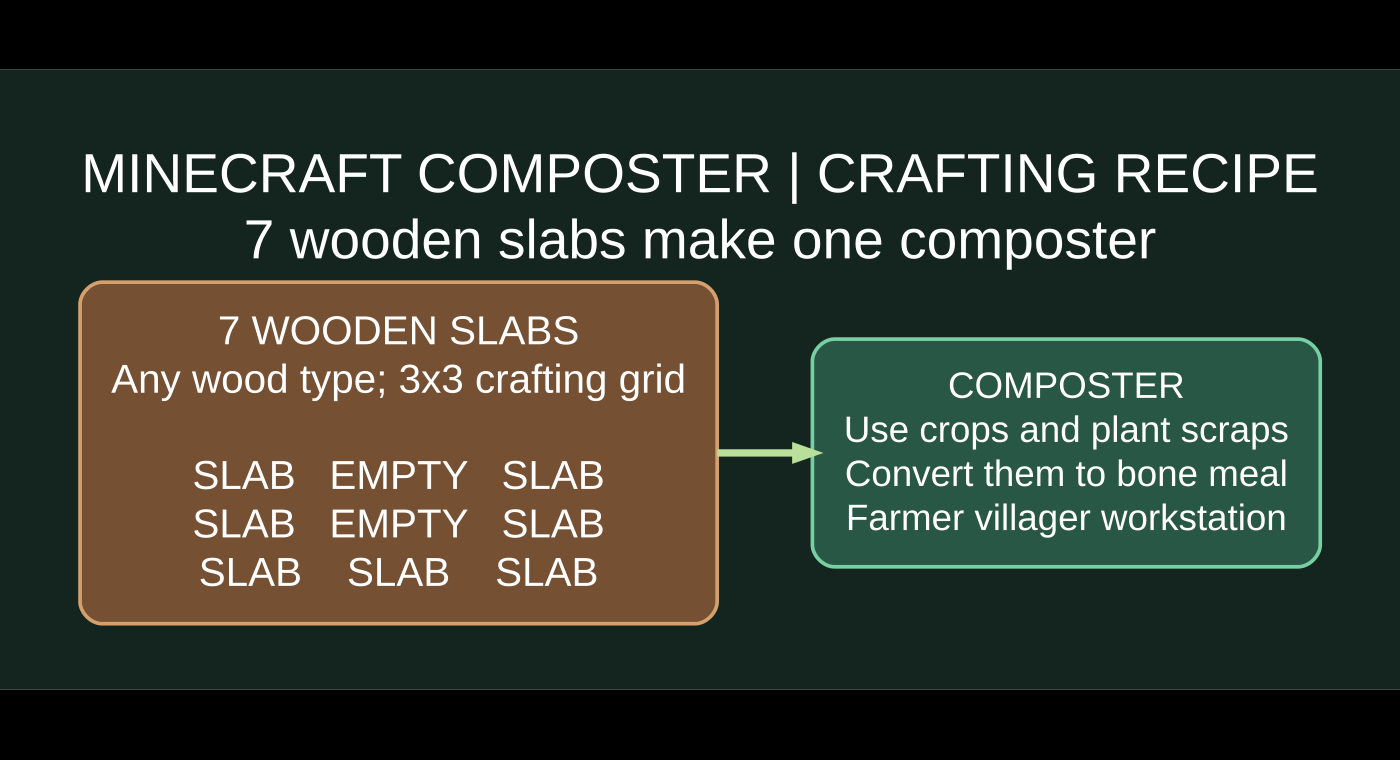
Minecraft composter recipe: the exact 3×3 pattern
Craft seven slabs from suitable wood. To make ordinary wooden slabs, place three matching planks in one row of a crafting table to create six slabs, then craft additional slabs as needed. You can use a supported wooden slab type for the composter recipe; stone slabs are not a substitute.
| Crafting grid row | Left | Middle | Right |
|---|---|---|---|
| Top | Wooden slab | Empty | Wooden slab |
| Middle | Wooden slab | Empty | Wooden slab |
| Bottom | Wooden slab | Wooden slab | Wooden slab |
Place the finished block near a field, greenhouse, or sorting room. You can also find composters generated at some village farms. A composter may be broken with different tools, but an axe works quickly. Breaking a partly filled composter does not preserve its unfinished compost, so collect any finished bone meal first.
How to use a composter and collect bone meal
- Place the composter where its top is accessible.
- Hold a compostable item, such as wheat seeds, kelp, carrots, bread, or leaves.
- Use the item on the composter. On desktop this is normally right-click; on mobile use the on-screen interaction. Successful composting adds a visible layer.
- Keep adding items until the composter reaches seven filled layers. An attempted addition can consume the item even when its chance roll fails.
- Let the compost finish briefly, then interact with the ready composter to collect one bone meal. The composter returns to empty, ready for another cycle.
The internal block state runs from level 0 (empty) to level 7 (seven successful additions), and then to the ready-to-collect level 8. Seven successful additions produce one bone meal, not necessarily seven items inserted. This distinction matters because low-chance items often fail to increase the fill level.
Which items are best for composting?
Different plant-based items have different chances of adding a layer. Minecraft’s official Block of the Month: Composter article confirms that wheat and beetroot seeds can be used and gives the important contrast between 30% seeds and 85% hay bales. Bedrock’s Minecraft creator documentation explains how each item’s composting chance is represented.

| Chance to add one layer | Example items | Practical use |
|---|---|---|
| 30% | Wheat seeds, beetroot seeds, saplings, many leaves | Best for large quantities of otherwise unused farm or tree byproducts. |
| 50% | Cactus, melon slices, sugar cane, dried kelp block | Useful renewable materials from simple farms. |
| 65% | Carrots, potatoes, apples, pumpkins | Good when you have excess harvests. |
| 85% | Bread, baked potatoes, cookies, hay bales | High probability, but consider their crafting or food value. |
| 100% | Cake, pumpkin pie | Always increases a layer but often too expensive to waste on compost. |
The most efficient choice depends on abundance, not just percentage. A field producing stacks of seeds can supply more bone meal over time than manually crafting cakes. Avoid spending rare or useful food unless you have a dedicated surplus. As a simple estimate under normal probability behavior, seven guaranteed successful additions need seven 100% items, while 30%-chance items take more attempts on average. Individual results vary.
What cannot go in a Minecraft composter?
Not everything organic-looking is accepted. Minecraft excludes meat and fish, poisonous potatoes, dead bushes, and bamboo from ordinary composting, among other exceptions. A composter is not a universal trash can, and a modpack or add-on may alter accepted items. If your item is rejected, first verify that it is compostable in your edition and current game version.
Make a simple automatic composter with hoppers
You can automate ingredient loading and bone-meal pickup using two hoppers and at least one collection chest. A hopper feeding into the top inserts compostable material; a hopper beneath the composter extracts finished bone meal. This is convenient with a crop or kelp farm that produces more material than you can use.
- Place a collection chest at ground level or in a collection area.
- Install a hopper so its output points into that chest.
- Place the composter directly on top of the extracting hopper.
- Place a second hopper above the composter. Check that it points into the composter rather than sideways into another container.
- Place an input chest above the upper hopper and fill it with compostable items.
- Wait for the input hopper to feed the composter and the bottom hopper to collect finished bone meal.
This is a bone-meal conversion system, not a machine that grows crops on its own. A truly continuous farm also needs a renewable item supply and correct harvesting/collection mechanics. Avoid connecting the output hopper backward: hoppers only transfer in the direction of their output nozzle. Our Minecraft hopper guide explains facing, chests, and common redstone problems.
Why won’t my composter work?
| Problem | Likely explanation | What to try |
|---|---|---|
| Items disappear, but the bar does not rise | The probability roll failed. | Keep using spare items or use a higher-chance material. |
| I filled it but got no bone meal | Level 7 is not yet ready for collection. | Allow the brief finishing delay, then interact with an empty hand. |
| A hopper won’t insert items | Incorrect hopper direction or unsupported material. | Put a hopper above and ensure it can insert downward into the composter. |
| Bone meal does not arrive in my chest | The extracting hopper is absent or facing the wrong way. | Place it underneath and point it into the collection chest. |
| A villager ignores the composter | Its profession may be locked or the worksite may be inaccessible. | Check working access and whether you traded with that villager before assigning a new job. |
Composter vs. furnace and smoker: which one should you use?
A composter does not cook food or smelt ore. It converts some plant and food materials into bone meal, with no fuel slot. A furnace cooks and smelts many materials using fuel, while a smoker is specialized for faster food cooking. Use a composter when your primary goal is fertilizing crops or recycling renewable harvests.
Why do farmer villagers use a composter?
The composter is the farmer villager job-site block. An eligible, unemployed villager who can claim the workstation may adopt the farmer profession. This lets you set up a village trading area without confusing composting with actual crop harvesting. Existing villagers whose trades are locked do not simply change jobs when you move a composter. For the differences among all profession blocks, see our Minecraft villager jobs and workstations guide.
Frequently asked questions
How many wooden slabs make a composter?
Seven wooden slabs arranged in a U shape on a 3×3 crafting table make one composter. Stone slabs and regular full plank blocks do not satisfy this recipe.
How much bone meal does a full composter give?
Each full cycle produces one bone meal. Seven successful compost layers are required before it becomes ready for collection.
Is wheat a good composter item?
It is compostable, but there can be more efficient ways to use a wheat farm’s byproducts. Extra seeds are a convenient low-probability input and crafted bread is a high-probability input. Choose according to your available resources.
Can composters automatically produce bone meal?
Yes, when connected to an input hopper and an extracting hopper. The hoppers can move compostable items into the composter and retrieve the bone meal when it is ready.
Can you compost bamboo or rotten flesh?
Under standard vanilla mechanics, bamboo and meat-type materials such as rotten flesh are not ordinary composter inputs. Use supported plants or food instead.
Does the composter work in Java and Bedrock?
Yes. The seven-slab recipe, bone-meal output, and farmer workstation role exist in both editions, although some detailed item behavior and add-on mechanics can vary by edition or update.
Bottom line
For most survival bases, the best composter strategy is simple: craft the block with seven wooden slabs, keep it next to a farm, feed it plentiful crop scraps, and collect bone meal when the level is complete. If harvests are piling up, add hoppers for automatic feeding and collection. This gives your plant surplus a useful purpose without requiring rare materials or specialized machinery.

Other Articles
How to Set Up Voicemail on iPhone: Greeting, Password and Fixes
