
Quick answer: The Mercury capsule was NASA’s first human-spaceflight vehicle, a one-person spacecraft built to launch an astronaut, operate briefly in space, survive reentry, and return by parachute to an ocean splashdown. Six Americans flew in Mercury capsules between May 1961 and May 1963. The program proved that people could work in space and return safely, but Mercury was not designed to land on the Moon or dock with another spacecraft.
Mercury capsule: key facts at a glance
| Question | Answer |
|---|---|
| Space agency | NASA, Project Mercury |
| Program years | 1958 to 1963 |
| Seats | One astronaut |
| Human flights | Six, from Freedom 7 to Faith 7 |
| Launchers | Redstone for suborbital astronaut flights; Atlas for orbital astronaut flights |
| First US human in space | Alan Shepard, Freedom 7, May 5, 1961 |
| First American to orbit Earth | John Glenn, Friendship 7, February 20, 1962 |
| Final mission | Gordon Cooper, Faith 7, May 15–16, 1963 |
| Recovery | Parachute-assisted ocean splashdown followed by retrieval |
NASA distinguishes the Mercury Seven—the original seven astronauts selected in 1959—from the six crewed Mercury missions. Donald “Deke” Slayton was one of the seven but did not fly in Mercury, so the two counts should not be confused.
What did the Mercury spacecraft actually look like?
A Mercury capsule had a blunt, conical crew compartment, a broad heat shield on the lower end and a narrow end topped by a tower carrying an escape rocket. The hardware was deliberately compact: one astronaut sat inside a small pressurized cabin with controls and instruments surrounding the couch. Astronauts wore pressure suits during the flights.
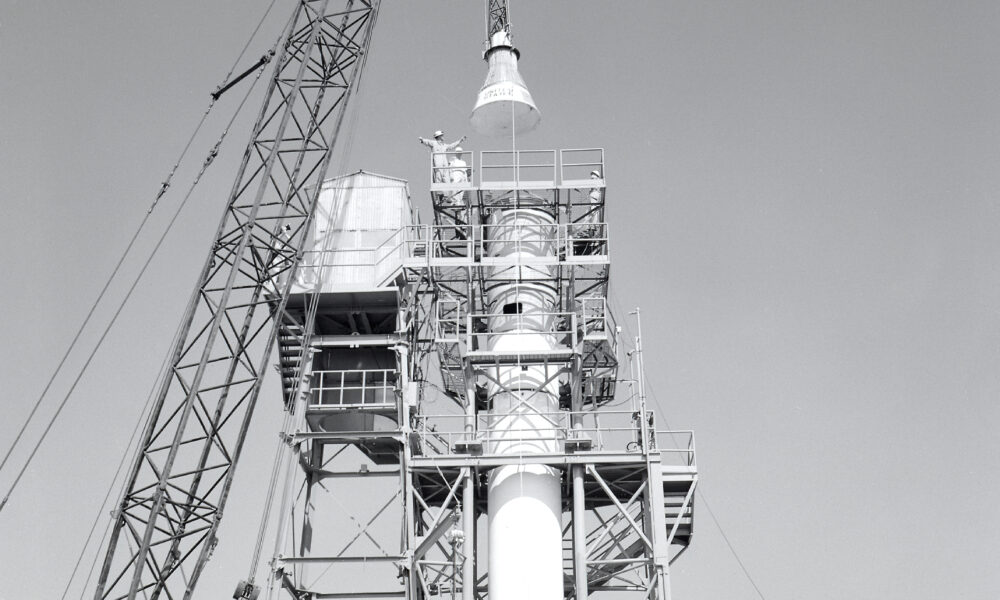
The featured photograph shows an actual NASA Mercury capsule on the Redstone test stand in 1960. It is a real hardware photograph from the preflight test program, not a computer illustration or a modern mockup. Test photos matter because they show the capsule and launch vehicle in the configuration engineers actually worked on.
The heat shield
During reentry, the spacecraft encountered extreme aerodynamic heating as it rapidly slowed in the atmosphere. Mercury used a protective heat-shield system at its blunt end to manage that heat, rather than trying to preserve an exposed metal shell. Later NASA crew vehicles used related blunt-body principles, although their detailed shapes and materials changed.
The launch escape tower
The tower above the capsule carried a rocket system intended to pull the crew compartment away from a malfunctioning booster early in flight. Its purpose was launch-phase safety; the tower was not intended to stay with the returning capsule throughout the mission. The 1960s system should not be confused with a modern emergency system or assumed to cover every imaginable scenario.
Parachutes and splashdown
After coming back into Earth’s atmosphere, Mercury reduced descent speed with parachutes and splashed down into the ocean, where recovery crews retrieved the astronaut and capsule. This was a fundamental design difference from a runway-landing spacecraft. The capsule did not have landing legs or a rocket system for a controlled touchdown on the Moon.
How did a Mercury capsule launch and return?
- Countdown and launch: The capsule sat on a launch vehicle, with the astronaut strapped in and a ground team monitoring systems. Redstone carried the two crewed suborbital flights; Atlas carried the four crewed orbital flights.
- Ascent: The booster provided the speed and altitude required for the mission. A suborbital flight briefly reached space but did not complete an orbit; an orbital flight had enough horizontal speed to circle Earth.
- Spaceflight: The astronaut monitored cabin and vehicle systems, communicated with ground controllers, and conducted planned checks or observations. The Mercury capsule did not perform the sophisticated rendezvous maneuvers later practiced by Gemini.
- Reentry: The capsule was oriented for a heat-shield-first return through the atmosphere. In an emergency, the astronaut and controllers could have to rely on backup systems.
- Descent and recovery: The landing parachutes slowed the spacecraft for an ocean splashdown, followed by retrieval by ships or aircraft-supported recovery teams.
The six Mercury astronaut flights
| Capsule | Astronaut | Date | Main significance |
|---|---|---|---|
| Freedom 7 | Alan Shepard | May 5, 1961 | First American in space, suborbital |
| Liberty Bell 7 | Virgil “Gus” Grissom | July 21, 1961 | Second American spaceflight, suborbital |
| Friendship 7 | John Glenn | February 20, 1962 | First American to orbit Earth, three orbits |
| Aurora 7 | M. Scott Carpenter | May 24, 1962 | Three-orbit mission with observations and experiments |
| Sigma 7 | Walter Schirra | October 3, 1962 | Six-orbit mission |
| Faith 7 | L. Gordon Cooper | May 15–16, 1963 | Longest Mercury flight, 22 orbits |
The named capsules were individual spacecraft rather than six nicknames for one reusable vehicle. They are historically associated with the astronauts who flew them, while engineering changes and mission duration varied across the program.
What is the actual Mercury capsule photo in this article?
The first image is NASA’s 1960 photograph of a Mercury capsule at the Redstone test stand. The second image is a different genuine NASA photograph showing John Glenn entering the Friendship 7 Mercury capsule before launch on February 20, 1962. It depicts a real astronaut and actual spacecraft, not an artist’s impression.
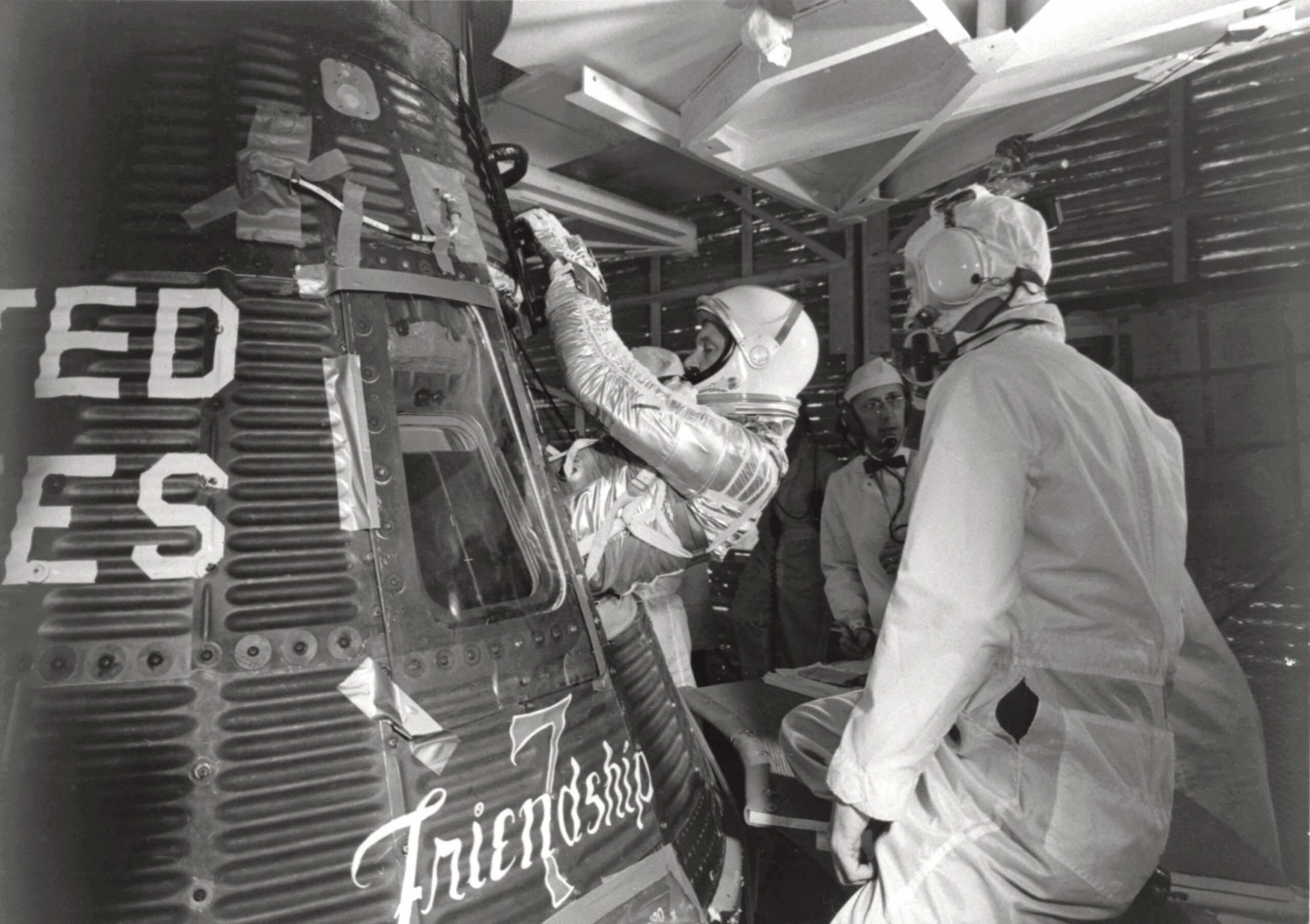
Photographs of Mercury on display at museums can also show actual surviving vehicles, but visitors should read the accompanying exhibit identification carefully: capsules from uncrewed tests and capsule replicas have different histories from the six crewed missions. If a photograph is simply labeled “Mercury” with no mission, date or identification, do not assume it depicts Friendship 7 specifically.
Mercury capsule versus Gemini spacecraft versus Apollo
| Characteristic | Mercury | Gemini | Apollo |
|---|---|---|---|
| Typical crew | One | Two | Three in command module |
| Key goal | First US human spaceflight and orbital return | Longer flights, rendezvous, docking and spacewalks | Lunar travel, landing missions and return |
| Lunar landing vehicle? | No | No | Separate lunar module on landing missions |
| Core challenge | Demonstrate human spaceflight and safe recovery | Prove techniques for complex missions | Put systems and crew together for lunar exploration |
Mercury pioneered US crewed operations but had little room for advanced tasks. Gemini’s second seat and orbital maneuvering capability allowed crews to practice rendezvous, docking and spacewalking. Apollo required those lessons but used a substantially different architecture. A useful modern contrast is the X-37B guide, which discusses a robotic spaceplane that can land on a runway, unlike a parachute-recovered Mercury capsule.
Which Mercury capsule should I look up first?
For the first US astronaut in space, start with Freedom 7 and the May 1961 suborbital mission. For the first American orbit and the spacecraft in our second photograph, start with Friendship 7. For endurance and the end of the program, review Faith 7. NASA’s mission-specific galleries and historical spacecraft catalog numbers provide stronger proof of photo identity than an unlabeled image search result.
For a later milestone in American human spaceflight, see our Artemis II science-data explainer. It concerns a very different era, mission duration and data environment rather than a direct comparison of onboard equipment.
Frequently asked questions
How many people could fit in a Mercury capsule?
One astronaut. Gemini was NASA’s follow-up two-person spacecraft program.
Was Mercury the first US spacecraft in orbit?
Mercury was the first US program to put an American astronaut into orbit, with John Glenn aboard Friendship 7 on February 20, 1962. Earlier US uncrewed satellites and test missions had already orbited Earth.
Did Mercury capsules land on the Moon?
No. They operated around Earth or on suborbital trajectories and returned to the ocean. Apollo later carried astronauts to the Moon.
Were all seven Mercury astronauts launched in Mercury spacecraft?
No. NASA selected seven astronauts, but six flew Mercury’s six crewed missions. Deke Slayton was in the original class but did not fly aboard Mercury.
What happened to John Glenn’s Mercury capsule?
Friendship 7 was recovered after Glenn’s flight and became a preserved historic spacecraft. Its real photographs, museum records and NASA’s mission archive can help identify it.
Are the photographs in this guide genuine?
Yes. Both are separate, historical NASA photographs of physical Mercury flight hardware and operations; neither is a generated render. Their source and original mission identification are recorded internally with the site’s media items.
Official references: NASA Project Mercury archive and NASA Friendship 7 image archive. Last reviewed: October 15, 2026.