
Quick answer (October 8, 2026): Margaret Hamilton, the software engineer who led the MIT team that developed Apollo’s onboard flight software, died on September 30, 2026, at age 90, according to an MIT announcement published October 7. Her legacy is not just the famous 1969 photo beside stacks of printed code: her team’s priority-based scheduling, fault recovery and testing helped the Apollo 11 lunar module continue its descent when the onboard computer displayed 1201 and 1202 program alarms. Those alarms were real; the crucial difference was that the software could preserve essential landing work while handling an overload.
Margaret Hamilton: The confirmed facts
| Question | Confirmed answer |
|---|---|
| When did she die? | September 30, 2026; MIT announced her death October 7. |
| How old was she? | 90 (born in 1936). |
| What was her Apollo role? | Led the Software Engineering Division at MIT’s Instrumentation Laboratory, which developed Apollo flight software. |
| What made the software notable? | Priority-driven execution, recovery from overloads and engineering practices for mission-critical systems. |
| Which alarms became famous? | 1202 and 1201 during Apollo 11’s final descent on July 20, 1969. |
| Was an official cause of death released? | The MIT obituary used for this report does not specify a cause. Claims about one should not be treated as verified. |
MIT describes Hamilton as a computing pioneer who authored more than 130 publications and later founded technology businesses. The institute’s obituary should take priority over unsourced social posts or obituaries that supply personal details without attribution.
What were Apollo 11’s 1202 and 1201 computer alarms?
The Apollo Guidance Computer was operating under an unusually demanding workload as Neil Armstrong and Buzz Aldrin descended toward the lunar surface in the Eagle lunar module. The computer displayed 1202 and later 1201 program alarms. They signaled that it was running short of resources needed to process some scheduled operations. The exact alarm codes reflected particular internal resource shortages, not a message saying the entire spacecraft had stopped functioning.
NASA’s Apollo 11 anniversary history records that mission control evaluated the alarm and gave the crew permission to continue. The separate Apollo 11 Lunar Surface Journal’s technical analysis explains the overloaded task queues and how the flight software recovered.
What triggered the overload?
The computer was handling requests tied to radar data and guidance work. The rendezvous-radar configuration was contributing tasks that competed with landing priorities. NASA’s retrospective material describes a misconfiguration related to radar switches and operating procedures. That is more specific than the popular shorthand that the computer simply “crashed.” It did not lose every ability needed to land.
How did the software respond?
The software was designed so that essential, time-critical work received priority. Under resource pressure, the executive could recover and resume selected high-priority processes rather than allowing less important tasks to prevent landing calculations from running. According to NASA’s retrospective, this design was intentional, tested and crucial to maintaining control.
This was a team achievement. Hamilton led the group and shaped its approach, while many programmers, systems engineers, controllers and astronauts were responsible for bringing Apollo 11 down safely. It would be misleading to claim that she personally typed every instruction in the spacecraft’s code or that a single line of her software independently landed the lunar module.
What actually happened in the final minutes before landing?
NASA’s Apollo 11 Lunar Surface Journal preserves the crew communications and discussions about the alarms. The landing continued after the flight controllers assessed the problem; Armstrong also made critical piloting decisions to avoid an unsuitable landing area.
| Stage | Why it mattered |
|---|---|
| Eagle descends toward the Moon | The guidance computer must calculate critical navigation and control tasks while other subsystems supply inputs. |
| 1202 alarm appears | Onboard software detects an overload condition instead of silently failing. |
| Houston evaluates the alarm | Flight controllers determine that the landing can proceed under the observed conditions. |
| Additional 1202 and 1201 alarms follow | Priority-based recovery helps preserve essential operations while resource demands continue. |
| Armstrong maneuvers to a safer site | The landing succeeds through a combination of robust software, flight controllers’ judgment and astronaut piloting. |
The distinction matters: the computer’s alarm was a warning about a resource problem; it was not evidence that Hamilton’s code had failed. Its ability to handle that abnormal condition was among the reasons the crew could continue.
Why Hamilton’s work mattered beyond Apollo 11
Fault tolerance became a core engineering goal
Instead of assuming that all components, people and procedures would behave perfectly, Hamilton’s group built software intended to cope with mistakes, changing priorities and unforeseen workloads. Modern spacecraft, aircraft and other high-reliability systems still face that kind of design problem. The specific hardware is radically different, but the engineering questions—what must keep running, how should failures be detected, and what should be recovered first—remain familiar.
Software engineering became an identifiable discipline
Hamilton strongly advocated treating software with the rigor and professional standing accorded to hardware engineering. She is widely associated with popularizing the expression software engineering, although the history of any technical term rarely belongs to one person alone. NASA’s profile of Hamilton and the Apollo code photo emphasizes the teamwork, the flight-software challenge and her influence on the discipline.
NASA later formally recognized her contribution
NASA honored Hamilton with an Exceptional Space Act Award in 2003 for her scientific and technical contributions. The agency’s award release cites asynchronous software, priority scheduling, end-to-end testing and systems that kept humans in the decision loop. She later received the Presidential Medal of Freedom in 2016, a recognition discussed in MIT’s October 7 obituary.
What is the story behind the famous code-stack photograph?
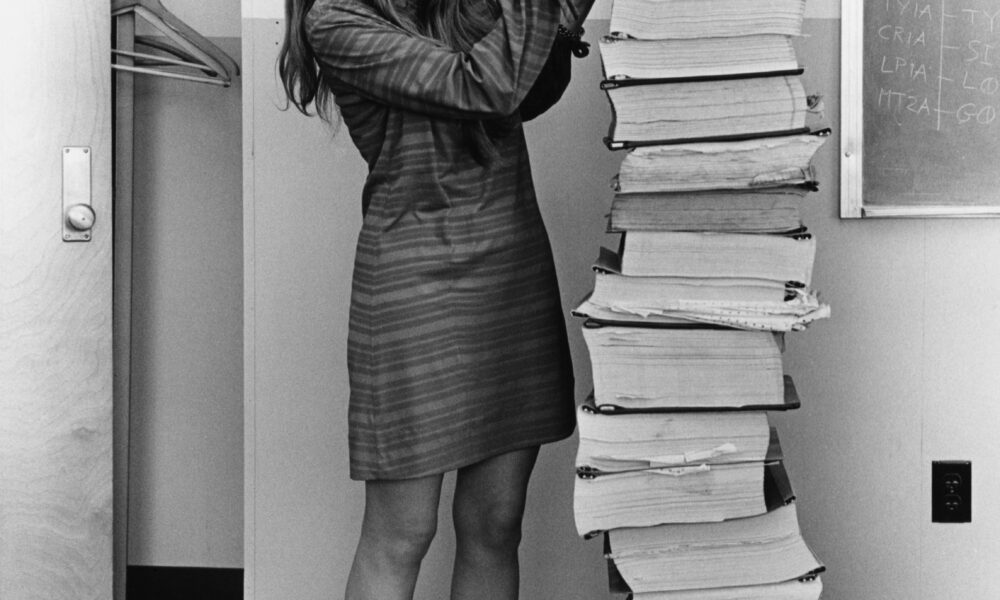
The widely shared black-and-white photo shows Hamilton in 1969 standing next to printed listings of the Apollo programs produced by her entire MIT team. It is an authentic photograph, not a recent AI-generated reconstruction, and the printed stack is not solely her handwritten code. The image used with this AVARIXO article is the restored historic photo credited to Draper Laboratory, available via Wikimedia Commons. Commons lists it as public domain in the United States; the photographer’s institutional credit and restoration history are given on that source page.
NASA’s accompanying historical explanation quotes Hamilton about the picture and makes clear that it represents the work of both lunar-module and command-module software teams. The size of the printout is a striking illustration of the project’s complexity, but it should not be mistaken for a complete measure of the software’s quality.
How is Hamilton’s legacy connected to later Moon missions?
Software reliability became even more important as spacecraft adopted larger, more complex computers and automation. Apollo’s experience showed that an engineering team must design for unexpected inputs and operating states, not just the intended flight plan. The lessons apply to contemporary Moon exploration even when modern systems use different codebases and hardware.
For a current example of how lunar missions continue producing technical evidence, see AVARIXO’s Artemis II science-data release guide. It covers a different mission and should not be confused with Apollo-era flight-software archives.
Frequently asked questions
Is it confirmed that Margaret Hamilton died?
Yes. MIT published its obituary on October 7, 2026, confirming she died September 30 at age 90.
What was Margaret Hamilton’s cause of death?
The MIT notice referenced here does not give a cause. Do not rely on unsourced cause-of-death claims.
Did Margaret Hamilton personally write all Apollo 11 software?
No. She led a substantial MIT software engineering team. The program was a collaborative engineering effort developed and tested by many people.
What did the Apollo 11 1202 alarm mean?
It signaled a computer executive-resource overload. The software was designed to preserve higher-priority work and recover while mission controllers evaluated whether descent could continue.
Did the 1201 and 1202 errors almost cancel the Moon landing?
The alarms created real uncertainty and required an explicit judgment from mission control. They did not automatically require an abort, and the flight-software design allowed critical guidance work to continue.
Was the photograph with giant stacks of code real?
Yes. NASA and Wikimedia Commons document the 1969 photograph. It shows Hamilton beside software listings produced by her team; it is not a photo of one person writing every page by hand.
Primary sources and editorial note
Publication-date check: October 8, 2026. This article draws primarily on MIT’s October 7 obituary, NASA’s Apollo program-alarm technical history, the Apollo 11 Lunar Surface Journal, and NASA’s archive about the photograph and her role. Claims about the alarms are distinguished from the separate news of Hamilton’s death. The historical photo is locally hosted in the AVARIXO Media Library with appropriate attribution in this article.