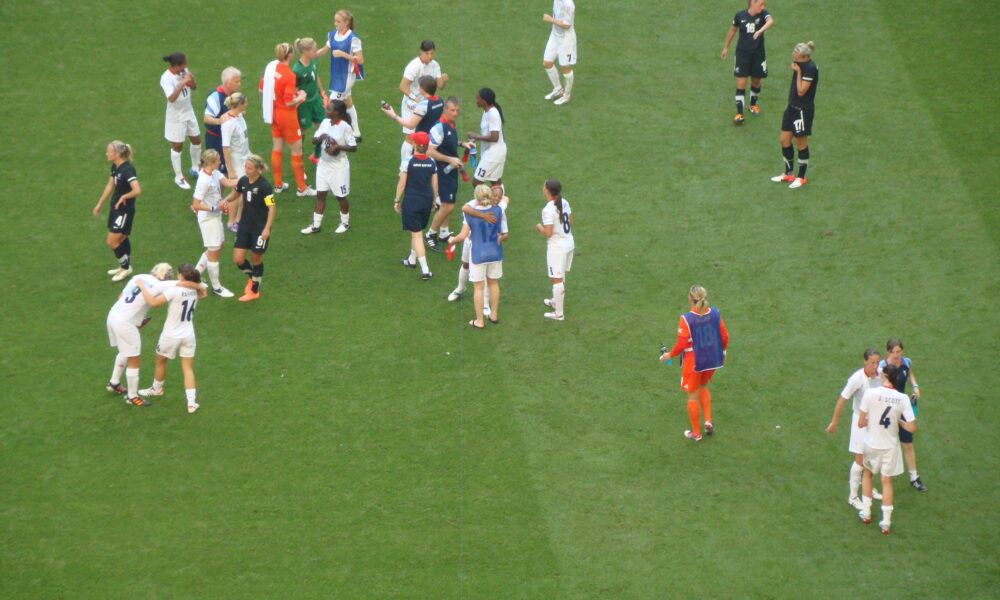

A standard 11-a-side soccer team has 11 players on the field: 10 outfield players and one goalkeeper. Two full teams make 22 players on the pitch at kick-off. The exact number of substitutes a club may name or use depends on the competition, and a team can finish with fewer than 11 because of red cards or other circumstances.
Soccer players: quick numbers
| Question | Answer |
|---|---|
| Players per team on the field | 11 maximum |
| Goalkeepers included in 11 | 1 |
| Outfield players on a full team | 10 |
| Players across both teams at kickoff | 22 when both teams are full |
| Minimum number to start/continue under Law 3 | Normally 7, with narrow temporary exceptions in the 2026–27 laws |
| Bench players | Additional substitutes, number depends on competition rules |
The governing rule is Law 3: The Players in the IFAB Laws of the Game. That source sets the maximum at 11, including the goalkeeper. Always check competition rules when you need a precise matchday squad or substitution allowance.
Which positions make up the starting 11?
The 11 players do not have to follow a single tactical formation. Coaches can arrange their 10 outfield players differently while keeping the goalkeeper. One common 4-3-3 lineup is:
| Group | Players | Typical job |
|---|---|---|
| Goalkeeper | 1 | Protect the goal; special use of hands within the penalty area under the laws |
| Defenders | 4 | Stop attacks and help the team build possession |
| Midfielders | 3 | Connect defense to attack and manage central space |
| Forwards | 3 | Move into attacking positions and create scoring chances |
| Total | 11 | One full team |
Some teams play 4-4-2, 3-5-2 or a system with wing-backs instead; those still use one goalkeeper plus 10 outfielders. Our soccer formation comparison explains the tactical differences, while the positions guide covers individual roles.
Are substitutes counted in the 11?
No. A substitute on the bench is part of the named match squad, but not one of the 11 currently playing. When a substitution is permitted, the player leaving comes off and the substitute enters. At no point should an ordinary, properly administered substitution mean 12 players from one team are actively on the field.
Do not confuse the number of substitutes named with the number of substitutions allowed. Different competitions can have different lists, substitution opportunities, concussion protocols and special allowances. For example, allowing five substitutions does not mean the starting team has 16 players on the pitch.
What if someone gets a red card?
A player sent off during the match cannot simply be replaced with a substitute to restore 11 on the field. The team generally continues one player short, such as 10 versus 11 after one red card. A second dismissal can reduce it further.
Under IFAB Law 3, a match normally cannot start or continue with fewer than seven players on a team. The 2026–27 law changes identify limited temporary exceptions, including defined protocols for temporary dismissals or off-field treatment/assessment, so the blanket “always seven in every instant” claim misses that nuance.
What if a team starts with fewer than 11?
An adult 11-a-side game may begin with fewer than 11, provided the competition rules and the minimum player requirement are satisfied. Seven is the ordinary Law 3 floor. A team with eight or nine players may therefore legally play while at a numerical disadvantage, depending on league rules and circumstances.
If players arrive late, organizers also apply their rules governing named starters and substitutes. Teams cannot simply add any unregistered spectator after the match begins.
How many players are in other forms of soccer?
| Format | Common on-field team size | Important note |
|---|---|---|
| Adult association football | 11 | Includes goalkeeper |
| Futsal | 5 | Different laws and smaller court |
| Beach soccer | 5 | Different rules and playing surface |
| Youth 7v7 | 7 | Common youth format; local rules apply |
| Youth 9v9 | 9 | Common developmental format; local rules apply |
The everyday question “how many soccer players?” usually means 11-a-side, but youth and small-sided formats should not be treated as exceptions to the adult rule; they are separate match formats with their own regulations.
Frequently asked questions
Does the goalkeeper count among the 11?
Yes. Each full soccer team has one goalkeeper and 10 outfield players at a time.
Are there 11 or 12 players on a team?
There are 11 on the field under ordinary association-football rules. You may hear “12th player” as a fan metaphor, not an additional legal player.
Are there 22 players on a soccer field?
At full strength, 22 players participate across both teams combined, excluding referees and staff. Red cards and other circumstances can reduce the total.
Can a team play with 10 players?
Yes, such as after a red card. The ordinary minimum to start or continue is seven, subject to the current law’s limited temporary exceptions.
Is the bench part of the team?
Yes, reserves are part of the wider matchday squad, but only those on the field count toward the permitted 11.
Bottom line: think 11 per side, 22 combined for standard soccer. Bench sizes, minimum-player exceptions and substitutions depend on the applicable laws and competition rules.
Photo credit: Jon Candy, Wikimedia Commons, CC BY-SA 2.0.

Other Articles

Minecraft Weather Command: Clear, Rain, Thunder and Snow Explained
How Long Is Halftime in Soccer? FIFA Rules and Match Timing
