
Offside in soccer happens when an attacking player is in an offside position at the moment a teammate plays or touches the ball and then becomes involved in active play. Merely standing beyond the defensive line is not automatically a foul. Under IFAB Law 11, the referee awards the defending team an indirect free kick if an offside offence occurs.
Here is the simplest way to understand the rule, followed by practical examples and exceptions that explain why apparently identical situations can receive different decisions.
The offside rule in one sentence
An attacker can be in an offside position when a teammate plays the ball if the attacker is in the opponents’ half and any relevant part of their body is closer to the goal line than both the ball and the second-last opponent. They are penalized only if they then affect play in a way covered by Law 11.
How to tell whether a player is offside
- Freeze the action when the teammate plays the ball. The relevant snapshot is not when the attacker receives it. IFAB specifies the first point of contact when a teammate plays or touches the ball, with a special last-contact rule for a goalkeeper’s throw.
- Check the halfway line. An attacker cannot be in an offside position while in their own half or on the halfway line.
- Find the second-last opponent. This is often the deepest outfield defender, but the goalkeeper is not always one of the two players closest to the goal line.
- Compare the attacker with the ball. The attacker must be nearer to the goal line than both the ball and the second-last opponent. Being level with the second-last opponent means onside.
- Check involvement. A player in an offside position is only penalized if they play the ball, interfere with an opponent or gain an advantage as defined in the law.
Offside position vs. offside offence: the key difference
A winger standing behind the second-last defender when a teammate passes elsewhere may be in an offside position but commit no offence. If the winger never touches the pass and does not block a defender or goalkeeper, play can continue. If a second teammate receives the ball and then makes a new pass when the winger has moved back onside, the winger’s position is assessed again at that new touch.
An attacker can also interfere without touching the ball: challenging a defender, blocking a goalkeeper’s clear line of vision or making an obvious action that affects an opponent’s ability to play a nearby ball can all lead to an offside offence. The official’s decision depends on the effect on play, not simply where someone was standing.
Five easy examples of the offside rule
| Situation | Decision | Reason |
|---|---|---|
| A striker is beyond the second-last defender when a teammate passes forward, then collects the pass. | Offside | The striker was in an offside position at the teammate’s touch and interfered with play. |
| A striker is level with the second-last defender when the pass is made. | Onside | Being level is permitted. |
| An attacker runs behind the defense after the teammate has released the ball from an onside position. | Onside | Position is judged at the teammate’s touch, not when the pass arrives. |
| An attacker receives a pass while still in their own half at the teammate’s touch. | Onside | A player in their own half cannot be in an offside position. |
| An offside-position attacker stands still while a different, onside teammate collects the pass and the first attacker affects no opponent. | No offside offence | Position alone is not an offence. |
What body parts count for offside?
The head, torso and feet can count. Hands and arms do not count for any player, including goalkeepers. The upper boundary of the arm is at the bottom of the armpit. This matters for tight video reviews: a foot or shoulder can be ahead of the second-last opponent while an outstretched hand cannot put a player offside.
When is there no offside?
Law 11 expressly says a player cannot commit an offside offence when receiving the ball directly from a goal kick, throw-in or corner kick. However, a subsequent pass by a teammate creates a new offside check. For example, a corner is taken short, and the receiver passes back to the original kicker: the kicker can be offside at the moment of that return pass.
Other situations that do not automatically produce an offence include a player being level with the second-last opponent, being in their own half, or being ahead of the defense but behind the ball when it is played.
Does touching the ball off a defender cancel offside?
Not always. An accidental deflection or a save does not automatically reset an attacker’s offside status. By contrast, an opponent’s genuinely deliberate play of the ball can change the decision, except for a deliberate save. IFAB asks officials to consider control, reaction time, distance, ball speed and whether the defender had a realistic opportunity to pass, possess or clear it. A desperate stretch that barely deflects a fast pass is not the same as a defender deliberately controlling and playing the ball.
That is why two rebounds that look similar on television may be judged differently. The precise movement and whether the defender controlled the play matter more than the fact that the ball touched a defender.
What happens after an offside call?
The defending team receives an indirect free kick at the place where the offside offence occurred. That can even be in the attacker’s own half if the player moves back from an offside position before interfering with play. Offside itself is not a yellow-card offence; separate misconduct may still be sanctioned.
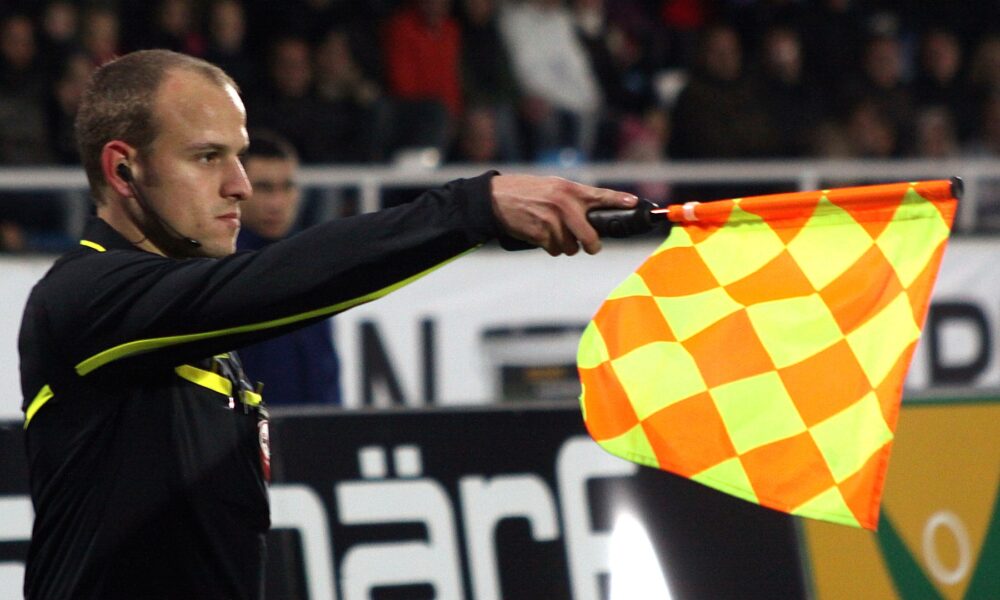
The assistant referee may signal with a raised flag, but the referee makes the final decision. VAR can assist with certain reviewable incidents, such as an offside offence in the attacking phase of a goal. For how reviews work, see our guide to VAR decisions in soccer.
Offside rule vs. the offside trap
The rule applies to all teams. The offside trap is a defensive tactic: defenders step forward together just before a pass to leave a runner beyond the second-last opponent at the relevant moment. The tactic fails if a defender keeps the runner onside or the pass is timed after the runner has returned to a legal position.
Frequently asked questions
Can you be offside from a throw-in?
No, not when you receive the ball directly from the throw-in. You can be offside on a teammate’s subsequent pass.
Can you be offside from a corner?
Not directly from the corner kick. A second touch or return pass can create an offside situation.
Can you be offside if you are behind the ball?
No. A player must be nearer to the opponents’ goal line than the ball as well as the second-last opponent to be in an offside position.
Is the goalkeeper always the last defender for offside?
No. Law 11 counts opponents, not a designated goalkeeper. Any two opponents may be the two closest to their own goal line.
Can you be offside without touching the ball?
Yes, if you interfere with an opponent as defined by Law 11. But merely standing in an offside position is not an offence.
When does the referee judge the offside line?
At the moment the attacking teammate plays or touches the ball, subject to the specific contact-point rule in Law 11. The position when the pass arrives is not the deciding snapshot.
Official rule and related reading
The primary authority is IFAB Law 11 — Offside. If you are learning soccer terminology from the beginning, our soccer positions and numbers guide explains where the different players usually operate.
Featured photo: Steindy, “Clemens Schüttengruber, Fußballschiedsrichter (02),” Wikimedia Commons, CC BY-SA 3.0. Original photo, not modified. Source and attribution.

Other Articles

High Jump Rules Explained: Technique, Scoring, Attempts and Ties
